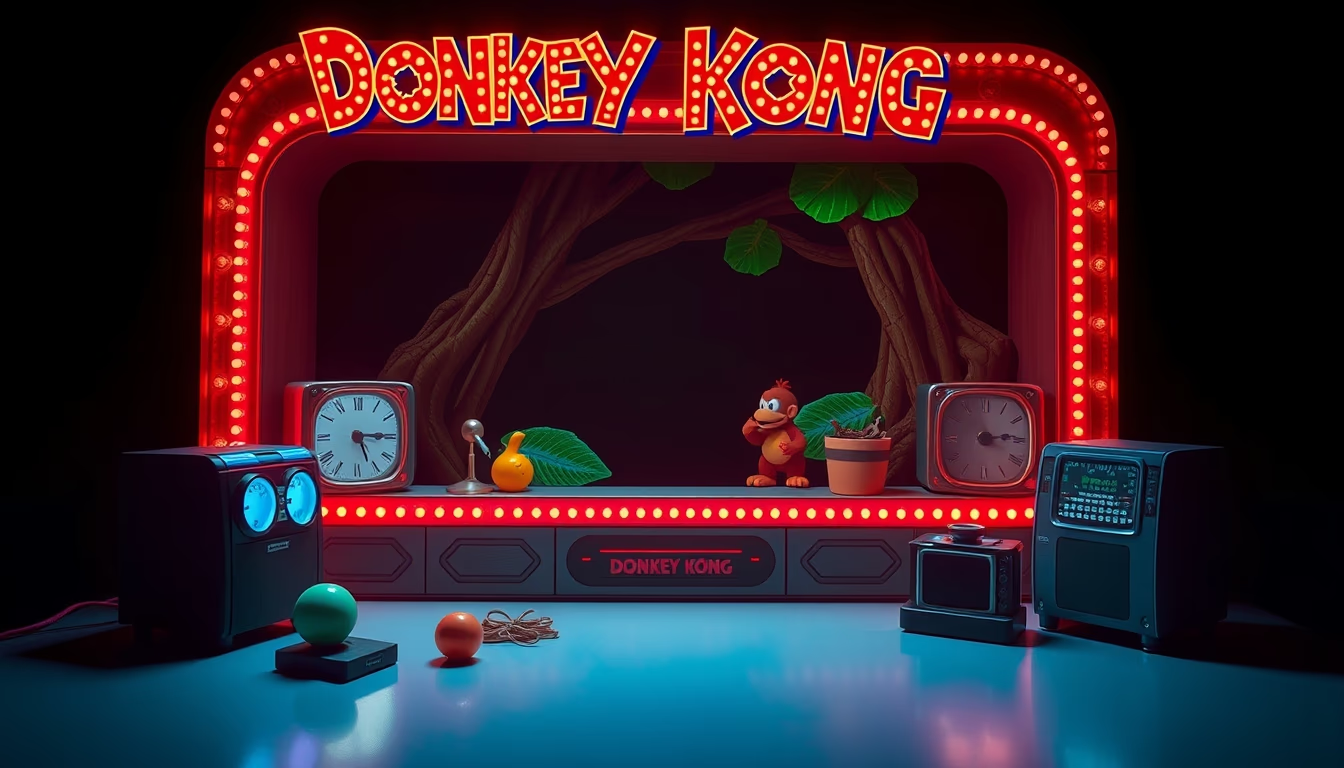
Donkey kong screen retro
1344×768 · AVIF · CC BY 4.0

Donkey Kong, the classic 1981 Nintendo arcade game, introduced the carpenter Jumpman, later Mario, in a rescue narrative that defined the platform genre.
About this subject
Released in 1981 by Nintendo, Donkey Kong is a landmark in video game history. The player controls Jumpman, a carpenter who must rescue his girlfriend Pauline from a giant gorilla, Donkey Kong. The game was designed by Shigeru Miyamoto, who would later create franchises such as Super Mario and The Legend of Zelda. Originally, Nintendo planned a game based on Popeye, but after failing to secure the license, Miyamoto developed original characters: the hero, the damsel, and the villain. Donkey Kong was a commercial and critical success, establishing Nintendo in the North American arcade market. Its innovations include the first narrative with cutscenes and the jumping mechanic, which became a standard in platform games.
The game screen features four distinct stages: a girder structure, a construction site with elevators, a conveyor belt, and a screw room. Each stage requires the player to dodge barrels thrown by Donkey Kong, as well as enemies like fireballs. The increasing difficulty and scoring based on time and collected items (such as a hat and umbrella) encouraged replayability. The game was also one of the first to use 16-bit graphics in arcade hardware, with detailed sprites and a black background that contrasted with the vibrant character colors.
Donkey Kong's cultural significance extends beyond the game. It spawned a franchise including sequels, an animated series, and the famous documentary The King of Kong (2007), which chronicles the competition for high scores. The character Donkey Kong became a pop culture icon, appearing in fighting, racing, and platform games. The theme music, composed by Hiroshi Kawaguchi, is one of the most recognized in video games. To this day, world records are competed for in the original game, with advanced techniques involving the kill screen, a bug that prevents progression after level 22.
In terms of nostalgia and collecting, original Donkey Kong arcade cabinets are highly sought after. Nintendo has re-released the game on various platforms, including NES, Game Boy Advance, and Nintendo Switch. The retro aesthetic, with pixel art and chip sounds, continues to influence independent developers. The long-exposure image captures the essence of this classic, highlighting the glow of the CRT monitor and the feeling of being in an '80s arcade room.
Frequently Asked Questions
What was the most important innovation of Donkey Kong?
Donkey Kong introduced the first narrative with cutscenes in video games and the jumping mechanic, which became the foundation for the platform genre.
Why did the character Jumpman become Mario?
Jumpman was renamed Mario in later games, in honor of Mario Segale, the owner of the warehouse where Nintendo of America stored its arcades. The name stuck and the character evolved into the famous plumber.
What is the kill screen in Donkey Kong?
The kill screen is a bug that occurs at level 22, where the programming cannot generate more obstacles, making the game impossible to continue. This establishes a theoretical limit for the maximum score.
Direct URL
https://pub-c7d6a6ea828543ac903a74a341ccb2e1.r2.dev/imagens/donkey-kong-screen-retro-long-exposure-fresh18.avifHow to credit
Include a visible link back to UtilizAí. Copy one of the snippets below:
<a href="https://xn--utiliza-eza.com/en/midia/imagens/donkey-kong-screen-retro-long-exposure-fresh18">Donkey kong screen retro</a> by <a href="https://xn--utiliza-eza.com">UtilizAí</a>, licensed under <a href="https://creativecommons.org/licenses/by/4.0/">CC BY 4.0</a>.
[Donkey kong screen retro](https://xn--utiliza-eza.com/en/midia/imagens/donkey-kong-screen-retro-long-exposure-fresh18) by [UtilizAí](https://xn--utiliza-eza.com), CC BY 4.0
License: CC-BY-4.0