Distributed ledger multiple servers in data center
1344×768 · AVIF · CC BY 4.0

Distributed ledgers maintain synchronized records across servers in data centers, ensuring transparency and security without a central authority.
About this subject
A distributed ledger is a decentralized database that replicates and synchronizes records across multiple servers, typically located in data centers worldwide. Unlike a centralized database, where a single entity controls the data, a distributed ledger operates on a peer-to-peer network, where each node (server) maintains an identical copy of the ledger. This eliminates the need for intermediaries, such as banks or governments, and reduces risks of fraud or manipulation, as any change requires consensus from the majority of nodes.
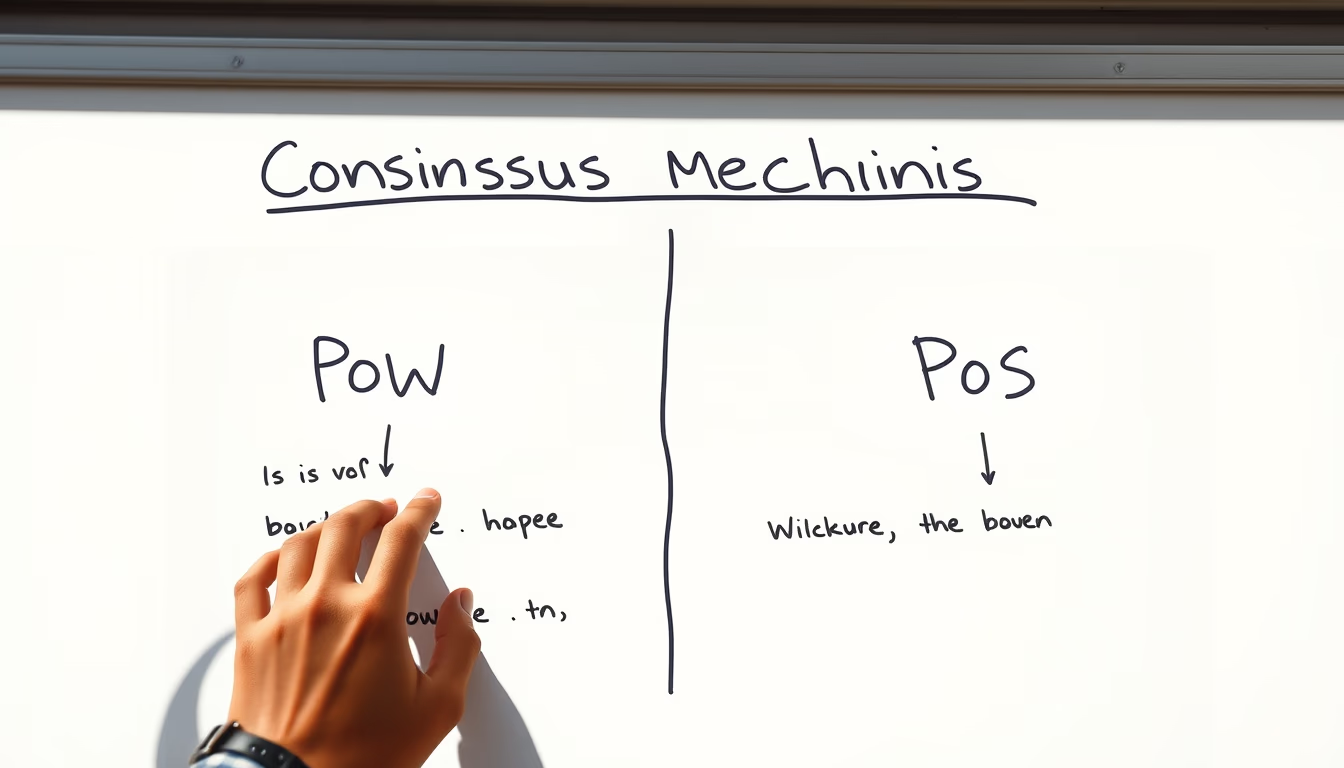
The most well-known type of distributed ledger is blockchain, which organizes data into cryptographically chained blocks. However, other variants exist, such as Directed Acyclic Graphs (DAGs) used in cryptocurrencies like IOTA. In data centers, servers run consensus algorithms like Proof of Work (PoW) or Proof of Stake (PoS) to validate transactions. PoW, used by Bitcoin, consumes significant energy, while PoS is more efficient. Modern blockchain data centers often employ liquid cooling and renewable energy sources to mitigate environmental impact.
Applications of distributed ledgers extend beyond cryptocurrencies. They are used in supply chains to track products, in electronic voting systems to ensure integrity, and in intellectual property registries. In Brazil, startup OriginalMy uses blockchain to authenticate documents, and the BNDES platform tokenizes financial assets. Scalability remains a challenge: networks like Ethereum process about 15 transactions per second, while centralized systems like Visa handle thousands. Solutions like sharding and sidechains aim to address this.
The security of a distributed ledger relies on redundancy and immutability. If one server fails, others continue operating. However, 51% attacks (where a group controls most of the computational power) can compromise the network. Data centers implement firewalls, encryption, and continuous monitoring to protect nodes. The twilight blue hour in the photograph symbolizes the transition and constant innovation in this field.
Frequently Asked Questions
What is a distributed ledger?
It is a decentralized database where records are replicated and synchronized across multiple servers, without a central authority. Each node in the network has an identical copy of the data.
What is the difference between a distributed ledger and blockchain?
Blockchain is a specific type of distributed ledger that organizes data into chained blocks. Other types exist, such as DAGs, which do not use blocks.
How do data centers ensure the security of a distributed ledger?
They use redundancy, encryption, firewalls, and consensus algorithms. 51% attacks are mitigated by distributing computational power among many nodes.
Direct URL
https://pub-c7d6a6ea828543ac903a74a341ccb2e1.r2.dev/imagens/distributed-ledger-multiple-servers-in-data-center-documentary-photography-twilight-blue-hour.avifHow to credit
Include a visible link back to UtilizAí. Copy one of the snippets below:
<a href="https://xn--utiliza-eza.com/en/midia/imagens/distributed-ledger-multiple-servers-in-data-center-documentary-photography-twilight-blue-hour">Distributed ledger multiple servers in data center</a> by <a href="https://xn--utiliza-eza.com">UtilizAí</a>, licensed under <a href="https://creativecommons.org/licenses/by/4.0/">CC BY 4.0</a>.
[Distributed ledger multiple servers in data center](https://xn--utiliza-eza.com/en/midia/imagens/distributed-ledger-multiple-servers-in-data-center-documentary-photography-twilight-blue-hour) by [UtilizAí](https://xn--utiliza-eza.com), CC BY 4.0
License: CC-BY-4.0
Tags
Related images
 Smart contract code on monitor with solidity syntax highlighted
 Consensus mechanism diagram on whiteboard showing PoW vs PoS
 Distributed ledger multiple servers in data center
 Hash function visualization cryptographic equations on glass screen
 Hash function visualization cryptographic equations on glass screen
 Hash function visualization cryptographic equations on glass screen