Distributed ledger multiple servers in data center
1344×768 · AVIF · CC BY 4.0

Distributed ledgers are digital records replicated across multiple servers in data centers, ensuring transparency and security without a central authority.
About this subject
A distributed ledger is a consensus-based shared database synchronized across multiple nodes in a network, each holding an identical copy of the record. Unlike traditional centralized databases, no single entity controls the data. This technology underpins blockchain but also includes other architectures like DAG (Directed Acyclic Graph). Replication across geographically dispersed data center servers increases resilience against failures and cyberattacks.
The first practical implementation of a distributed ledger was Bitcoin, launched in 2009 by Satoshi Nakamoto. Since then, the technology has evolved into enterprise applications such as Hyperledger Fabric and R3 Corda, used in finance, supply chains, and digital identity. Modern data centers host these nodes, leveraging power and connectivity redundancy to ensure 24/7 availability.
A curious fact: the term "distributed ledger" was popularized by the Bank of England in 2015 while studying digital currencies. Unlike public blockchains, private distributed ledgers can have access permissions, controlling who validates transactions. This makes them attractive for business consortia seeking efficiency without exposing sensitive data to the public.
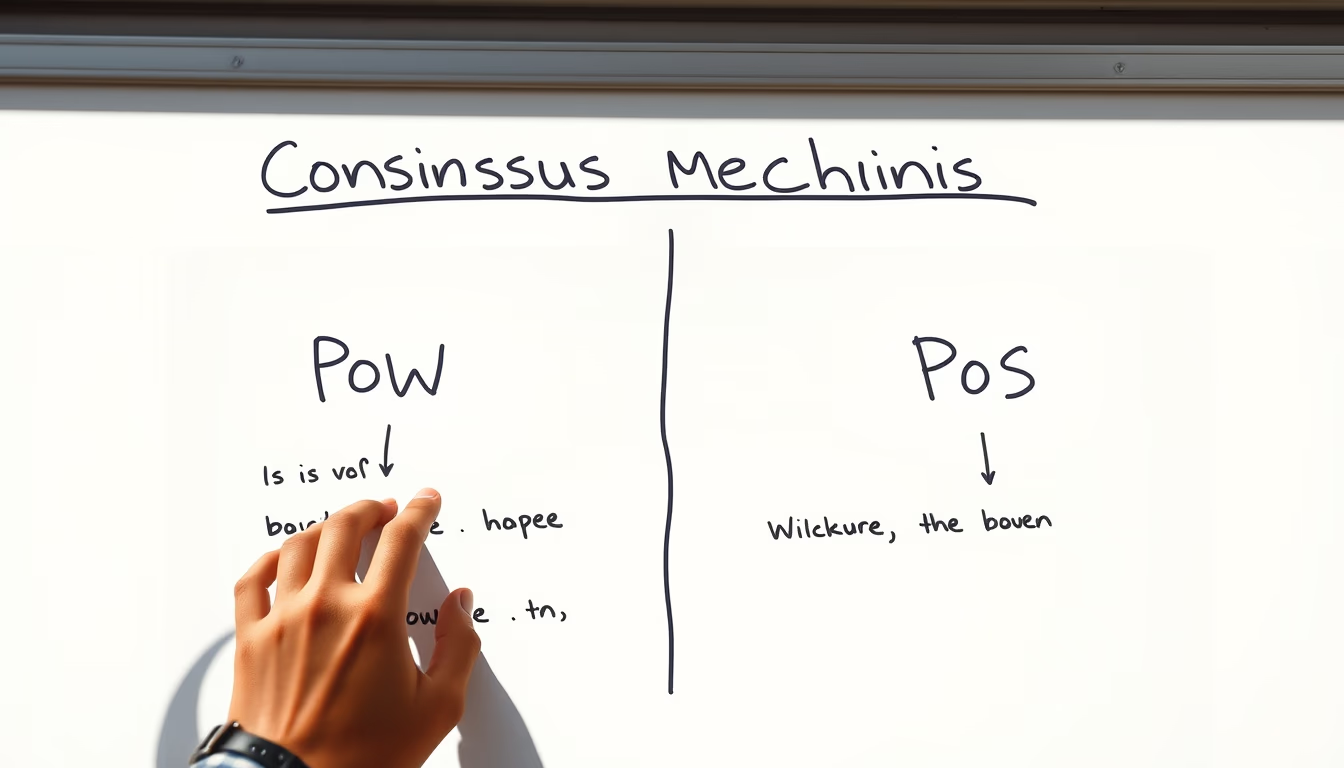
Security is maintained by consensus mechanisms like Proof of Work, Proof of Stake, or Byzantine Fault Tolerance. Each transaction is verified by multiple servers before being added to the ledger, making tampering practically impossible without controlling most nodes. This feature is crucial for sectors like healthcare and government, where data integrity is paramount.
Frequently Asked Questions
What is the difference between a distributed ledger and blockchain?
Blockchain is a specific type of distributed ledger that organizes data into chained blocks. Other types, like DAG, do not use blocks. Every blockchain is a distributed ledger, but not every distributed ledger is a blockchain.
How many servers are needed for a distributed ledger to work?
There is no minimum number, but networks with at least three nodes are common for fault tolerance. Public networks like Bitcoin have thousands of nodes; enterprise consortia may operate with dozens.
Are distributed ledgers immutable?
Practically, yes. Altering a record would require modifying most copies simultaneously, which is unfeasible in large networks. However, in permissioned ledgers, governance rules may allow corrections.
Direct URL
https://pub-c7d6a6ea828543ac903a74a341ccb2e1.r2.dev/imagens/distributed-ledger-multiple-servers-in-data-center-documentary-photography-bright-midday-sun.avifHow to credit
Include a visible link back to UtilizAí. Copy one of the snippets below:
<a href="https://xn--utiliza-eza.com/en/midia/imagens/distributed-ledger-multiple-servers-in-data-center-documentary-photography-bright-midday-sun">Distributed ledger multiple servers in data center</a> by <a href="https://xn--utiliza-eza.com">UtilizAí</a>, licensed under <a href="https://creativecommons.org/licenses/by/4.0/">CC BY 4.0</a>.
[Distributed ledger multiple servers in data center](https://xn--utiliza-eza.com/en/midia/imagens/distributed-ledger-multiple-servers-in-data-center-documentary-photography-bright-midday-sun) by [UtilizAí](https://xn--utiliza-eza.com), CC BY 4.0
License: CC-BY-4.0
Tags
Related images
 Smart contract code on monitor with solidity syntax highlighted
 Consensus mechanism diagram on whiteboard showing PoW vs PoS
 Distributed ledger multiple servers in data center
 Hash function visualization cryptographic equations on glass screen
 Hash function visualization cryptographic equations on glass screen
 Hash function visualization cryptographic equations on glass screen