Distributed ledger multiple servers in data center
1344×768 · AVIF · CC BY 4.0

Understand how a distributed ledger operates across multiple servers inside a data center, ensuring security and transparency in digital transactions.
About this subject
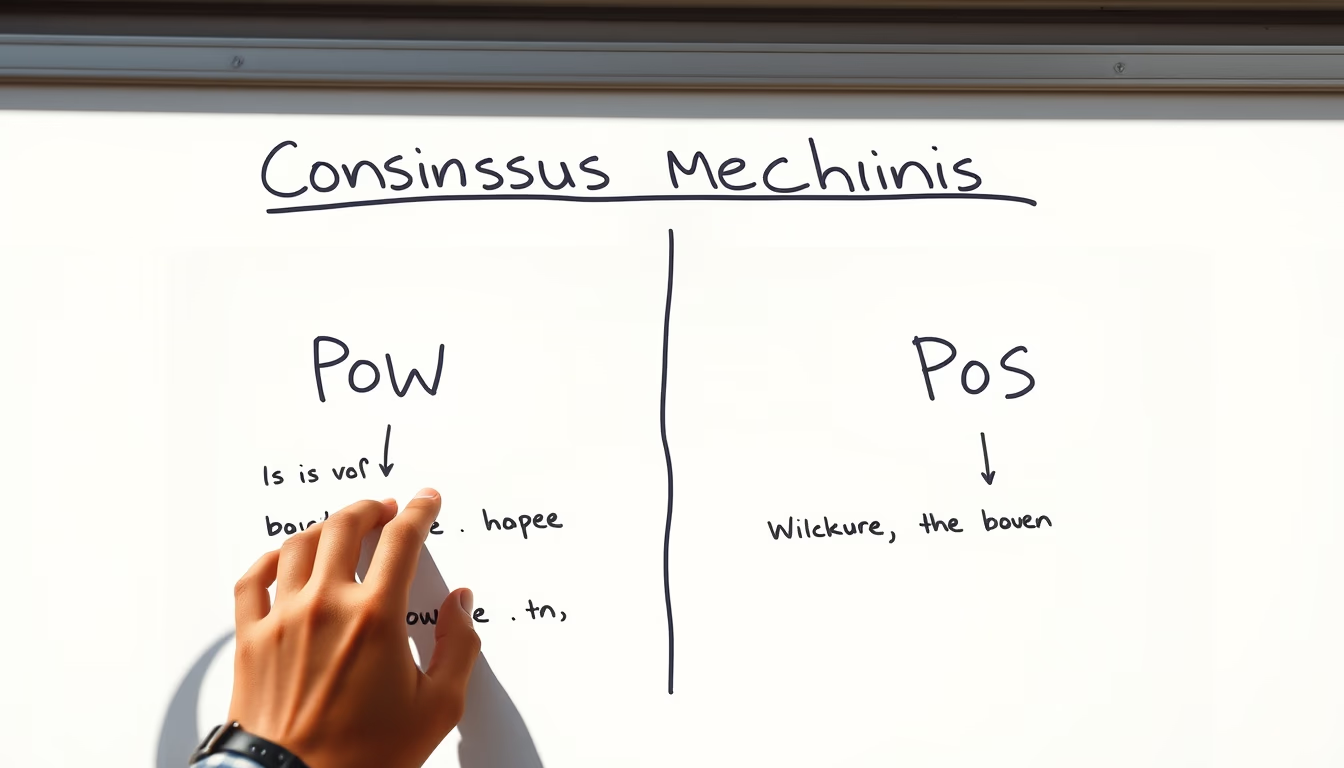
A distributed ledger is a decentralized database that records transactions immutably and transparently, without the need for a central authority. In a data center, multiple servers host identical copies of this ledger, constantly synchronizing through consensus mechanisms such as Proof of Work or Proof of Stake. This architecture ensures that no single point of failure compromises data integrity, as each server validates and stores the complete transaction history.
Modern data centers provide robust infrastructure to support distributed ledgers, with cooling systems, redundant power sources, and high-speed connectivity. Companies like IBM and Amazon Web Services offer blockchain solutions that run on their clouds, allowing organizations to implement ledgers without investing in their own hardware. Scalability is a challenge, as increasing transactions demand more computational power and bandwidth, but advances in sharding and more efficient consensus protocols are mitigating these limitations.
A practical example is Hyperledger Fabric, a permissioned framework that runs on enterprise servers and is used by consortia like IBM's Food Trust to track food supply chains. Another case is Corda, focused on financial transactions, which operates in data centers of banks and insurers. Security is reinforced by asymmetric cryptography and hashing, making it virtually impossible to alter recorded data. However, latency between geographically distributed servers remains an obstacle for real-time applications like instant payments.
Interestingly, the energy consumed by data centers maintaining public ledgers like Bitcoin is comparable to the consumption of entire countries, sparking debates about sustainability. Solutions like Proof of Stake drastically reduce this expenditure, adopted by blockchains such as Ethereum after 'The Merge' upgrade. In Brazil, data centers from Equinix and Ascenty host nodes for blockchains like Bitcoin and Ethereum, contributing to the global network's decentralization.
Frequently Asked Questions
What is a distributed ledger?
It is a decentralized database that records transactions immutably and transparently, without a central authority. Each network participant holds an identical copy of the ledger, and updates are validated by consensus.
How does a data center support a distributed ledger?
The data center provides physical infrastructure for servers hosting ledger copies, with power redundancy, cooling, and high-speed connectivity. Servers communicate via consensus protocols to maintain synchronization.
What are the scalability challenges of distributed ledgers?
Increasing transactions demand more computational power and bandwidth. Solutions like sharding and more efficient consensus protocols (e.g., Proof of Stake) help improve scalability.
Direct URL
https://pub-c7d6a6ea828543ac903a74a341ccb2e1.r2.dev/imagens/distributed-ledger-multiple-servers-in-data-center-closeup-macro-shot-overcast-soft-daylight.avifHow to credit
Include a visible link back to UtilizAí. Copy one of the snippets below:
<a href="https://xn--utiliza-eza.com/en/midia/imagens/distributed-ledger-multiple-servers-in-data-center-closeup-macro-shot-overcast-soft-daylight">Distributed ledger multiple servers in data center</a> by <a href="https://xn--utiliza-eza.com">UtilizAí</a>, licensed under <a href="https://creativecommons.org/licenses/by/4.0/">CC BY 4.0</a>.
[Distributed ledger multiple servers in data center](https://xn--utiliza-eza.com/en/midia/imagens/distributed-ledger-multiple-servers-in-data-center-closeup-macro-shot-overcast-soft-daylight) by [UtilizAí](https://xn--utiliza-eza.com), CC BY 4.0
License: CC-BY-4.0
Tags
Related images
 Smart contract code on monitor with solidity syntax highlighted
 Consensus mechanism diagram on whiteboard showing PoW vs PoS
 Distributed ledger multiple servers in data center
 Hash function visualization cryptographic equations on glass screen
 Hash function visualization cryptographic equations on glass screen
 Hash function visualization cryptographic equations on glass screen