Distributed ledger multiple servers in data center
1344×768 · AVIF · CC BY 4.0

Distributed ledgers are decentralized databases that record transactions across multiple servers simultaneously, ensuring security and transparency.
About this subject
A distributed ledger is a type of database that is consensually shared and synchronized among multiple participants across different locations. Unlike a traditional centralized database where a single entity controls the record, a distributed ledger operates on a network of servers, each maintaining an identical copy of the record. This eliminates the need for a central authority and reduces the risk of a single point of failure or data manipulation.
The technology emerged as the foundation for cryptocurrencies like Bitcoin, but today it is applied in sectors such as finance, supply chain, healthcare, and governance. In Brazil, the Central Bank has been studying the use of distributed ledgers for the development of the Real Digital, the Brazilian digital currency. Additionally, companies like IBM and Microsoft offer platforms such as Hyperledger Fabric and Azure Blockchain for implementing enterprise solutions.
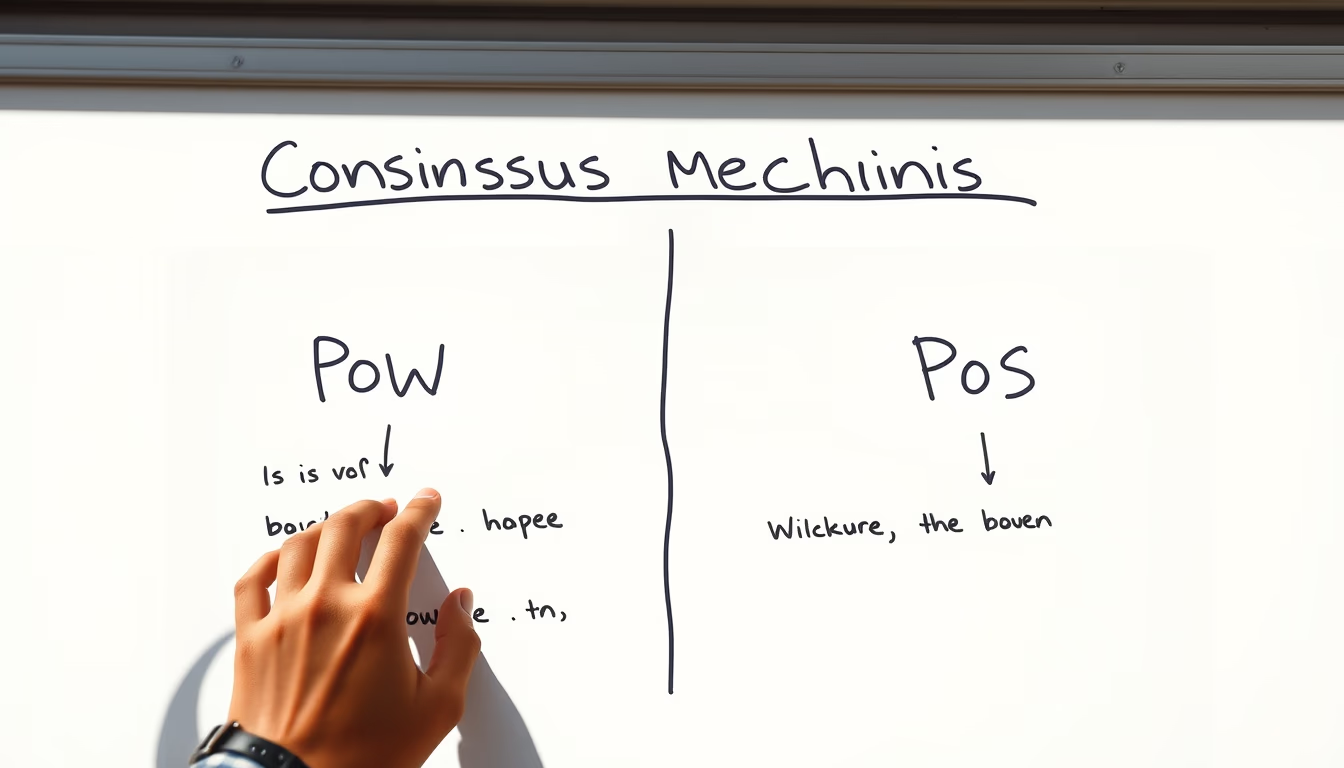
An important curiosity is that not every distributed ledger is a blockchain. While blockchain organizes data into chained blocks, other models like DAG (Directed Acyclic Graph) are also used. The security of the system depends on consensus algorithms such as Proof of Work or Proof of Stake, which ensure that all copies of the ledger remain consistent even in the presence of failures or attacks.
In the context of data centers, implementing distributed ledgers requires high network availability and storage, as each node must process and store all transactions. This raises challenges of scalability and energy efficiency, but also offers resilience and immutability of data, characteristics valued in critical applications.
Frequently Asked Questions
What is the difference between a distributed ledger and a blockchain?
Every blockchain is a distributed ledger, but not every distributed ledger is a blockchain. While blockchain organizes data into chained blocks, other models like DAG or Hashgraph are also used.
How does a distributed ledger ensure security?
Through consensus algorithms like Proof of Work or Proof of Stake, which require a majority of nodes to validate transactions before they are recorded, preventing unilateral alterations.
What are the challenges of implementing distributed ledgers in data centers?
Key challenges include scalability to handle high transaction volumes, energy efficiency due to intensive processing, and the need for high network availability.
Direct URL
https://pub-c7d6a6ea828543ac903a74a341ccb2e1.r2.dev/imagens/distributed-ledger-multiple-servers-in-data-center-cinematic-wide-shot-golden-hour-late-afternoon.avifHow to credit
Include a visible link back to UtilizAí. Copy one of the snippets below:
<a href="https://xn--utiliza-eza.com/en/midia/imagens/distributed-ledger-multiple-servers-in-data-center-cinematic-wide-shot-golden-hour-late-afternoon">Distributed ledger multiple servers in data center</a> by <a href="https://xn--utiliza-eza.com">UtilizAí</a>, licensed under <a href="https://creativecommons.org/licenses/by/4.0/">CC BY 4.0</a>.
[Distributed ledger multiple servers in data center](https://xn--utiliza-eza.com/en/midia/imagens/distributed-ledger-multiple-servers-in-data-center-cinematic-wide-shot-golden-hour-late-afternoon) by [UtilizAí](https://xn--utiliza-eza.com), CC BY 4.0
License: CC-BY-4.0
Tags
Related images
 Smart contract code on monitor with solidity syntax highlighted
 Consensus mechanism diagram on whiteboard showing PoW vs PoS
 Distributed ledger multiple servers in data center
 Hash function visualization cryptographic equations on glass screen
 Hash function visualization cryptographic equations on glass screen
 Hash function visualization cryptographic equations on glass screen