Container ship cargo ocean
1344×768 · AVIF · CC BY 4.0
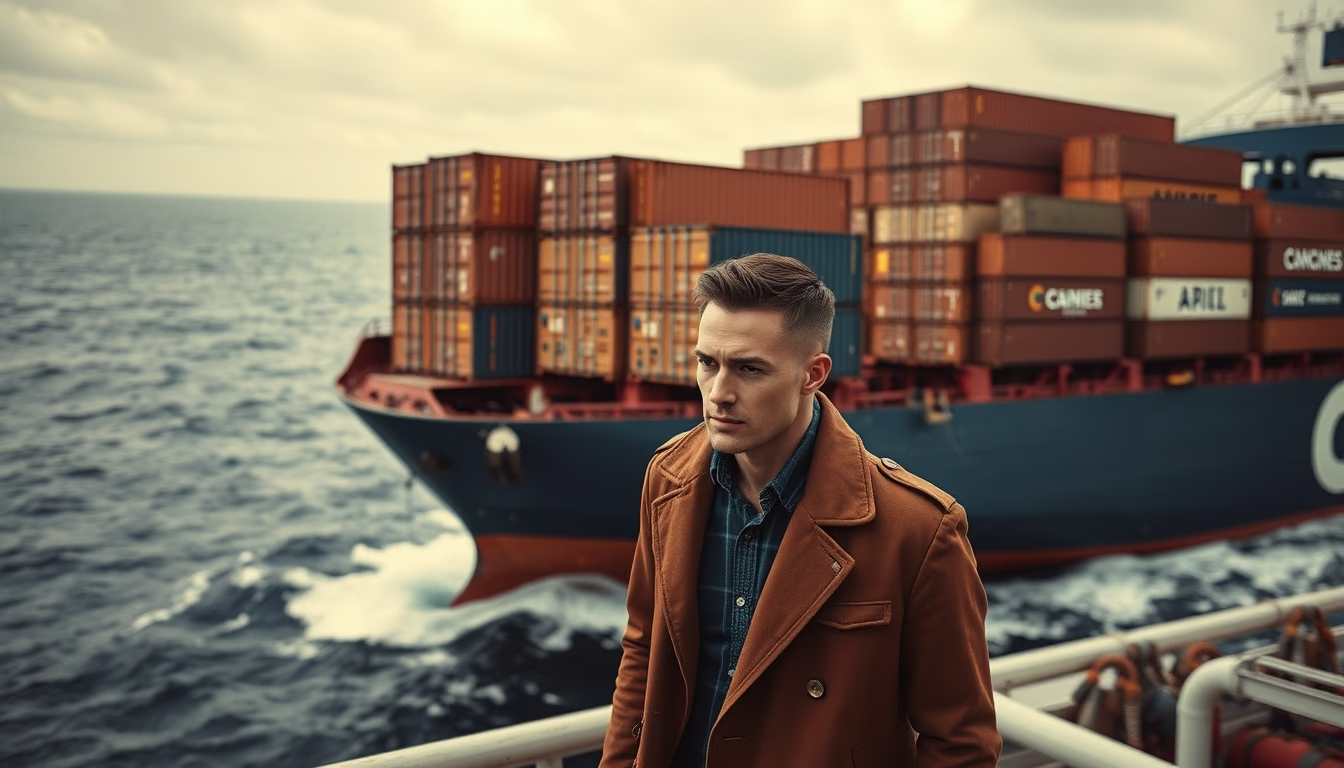
Cargo ships carry 90% of global trade, connecting continents and moving billions of tons of containers annually.
About this subject
Cargo ships, especially container ships, are the backbone of international trade. Responsible for transporting about 90% of the world's goods, these giant vessels can carry over 20,000 twenty-foot equivalent units (TEU) on a single voyage. The world's largest container ship, MSC Irina, has a capacity of 24,346 TEU, measuring 399 meters in length and 61 meters in width. These ships operate on fixed routes, connecting major ports such as Shanghai, Rotterdam, and Santos, and sail across oceans including the Atlantic, Pacific, and Indian.
The evolution of cargo ships followed the growth of globalization. Before container standardization in the 1950s, loading was manual and time-consuming. The invention of the container by Malcom McLean revolutionized the industry, reducing costs and loading times. Today, ships are built with low-speed engines burning heavy fuel oil, but environmental pressure is driving the industry to seek alternatives like LNG, methanol, and even rotor sails. A large ship's CO2 emissions can equal those of thousands of cars, but per ton transported, maritime freight is the most efficient mode.
Besides container ships, other types of cargo vessels exist: bulk carriers (soybeans, ore), tankers, and general cargo ships. Each serves specific market needs. The port of Santos in Brazil is the largest in Latin America, moving over 100 million tons annually, much of it in containers. Operations involve cranes, trucks, and a complex logistics system that relies on ships arriving and departing within tight time windows.
Curiously, the term 'cargo' comes from Spanish 'cargar,' meaning to load. Many cargo ships fly flags of convenience, registered in countries like Panama and Liberia to reduce tax and labor costs. The crew, typically 20 to 30 people, lives onboard for months, facing rough seas and long distances. Maritime safety is governed by SOLAS (International Convention for the Safety of Life at Sea), which sets standards for construction and equipment.
Frequently Asked Questions
How many containers can a cargo ship carry?
The largest container ships can carry over 24,000 TEU (20-foot containers). The latest model, MSC Irina, has a capacity of 24,346 TEU.
How are containers secured on the ship to prevent accidents?
Containers are secured using twist-lock connectors and steel lashings. The system distributes weight to withstand waves and strong winds.
What fuel do cargo ships use and how does it affect the environment?
Most use heavy fuel oil (HFO), which emits sulfur and CO2. Recent regulations (IMO 2020) require low-sulfur fuel or exhaust gas cleaning systems.
Direct URL
https://pub-c7d6a6ea828543ac903a74a341ccb2e1.r2.dev/imagens/container-ship-cargo-ocean-high-fashion-editorial-p12.avifHow to credit
Include a visible link back to UtilizAí. Copy one of the snippets below:
<a href="https://xn--utiliza-eza.com/en/midia/imagens/container-ship-cargo-ocean-high-fashion-editorial-p12">Container ship cargo ocean</a> by <a href="https://xn--utiliza-eza.com">UtilizAí</a>, licensed under <a href="https://creativecommons.org/licenses/by/4.0/">CC BY 4.0</a>.
[Container ship cargo ocean](https://xn--utiliza-eza.com/en/midia/imagens/container-ship-cargo-ocean-high-fashion-editorial-p12) by [UtilizAí](https://xn--utiliza-eza.com), CC BY 4.0
License: CC-BY-4.0