Blockchain network visualization glowing nodes connected by lines on dark background
1344×768 · AVIF · CC BY 4.0

Blockchain network visualization with glowing nodes and linear connections on a dark background, representing decentralized infrastructure.
About this subject
Blockchain technology is a distributed ledger that records transactions securely, transparently, and immutably. Each block contains a set of transactions and a cryptographic hash of the previous block, forming a chain. Decentralization is key: there is no central authority, and data is validated by consensus among network nodes. This makes blockchain resistant to fraud and censorship. The concept was introduced in 2008 by a person or group under the pseudonym Satoshi Nakamoto, as the foundation for Bitcoin, the first cryptocurrency. Since then, blockchain has evolved beyond cryptocurrencies, being used in smart contracts, supply chains, digital identity, and electronic voting. Networks like Ethereum, Hyperledger, and Solana offer different consensus and scalability approaches. The visualization of glowing nodes and linear connections is common in blockchain graphics, symbolizing network interconnectivity and activity. Each node can represent a participating computer, and lines indicate transactions or information propagation. The dark background contrasts with luminous elements, highlighting the digital and technological nature of the system. Brazil has seen growing blockchain adoption, with initiatives such as using the technology in judicial processes and the instant payment system Pix, although Pix is not blockchain-based. The National Electric Energy Agency (ANEEL) is also studying blockchain to track renewable energy certificates.
Frequently Asked Questions
What is a node in a blockchain network?
A node is any computer that maintains a copy of the blockchain ledger and participates in validating and propagating transactions. Nodes can be full (store the entire history) or light (only block headers).
How does the visualization of nodes and lines help understand blockchain?
It graphically represents the decentralized network topology, showing how nodes interconnect and exchange information. Lines symbolize transactions or communication, making the distributed structure easier to grasp.
What is the difference between public and private blockchain?
Public blockchain (e.g., Bitcoin, Ethereum) is open for anyone to participate as a node or miner. Private blockchain (e.g., Hyperledger) has restricted access to authorized participants, offering more control and privacy.
Direct URL
https://pub-c7d6a6ea828543ac903a74a341ccb2e1.r2.dev/imagens/blockchain-network-visualization-glowing-nodes-connected-by-lines-on-dark-backgr-closeup-macro-shot-studio-professional-lighting.avifHow to credit
Include a visible link back to UtilizAí. Copy one of the snippets below:
<a href="https://xn--utiliza-eza.com/en/midia/imagens/blockchain-network-visualization-glowing-nodes-connected-by-lines-on-dark-backgr-closeup-macro-shot-studio-professional-lighting">Blockchain network visualization glowing nodes connected by lines on dark background</a> by <a href="https://xn--utiliza-eza.com">UtilizAí</a>, licensed under <a href="https://creativecommons.org/licenses/by/4.0/">CC BY 4.0</a>.
[Blockchain network visualization glowing nodes connected by lines on dark background](https://xn--utiliza-eza.com/en/midia/imagens/blockchain-network-visualization-glowing-nodes-connected-by-lines-on-dark-backgr-closeup-macro-shot-studio-professional-lighting) by [UtilizAí](https://xn--utiliza-eza.com), CC BY 4.0
License: CC-BY-4.0
Tags
Related images
 Smart contract code on monitor with solidity syntax highlighted
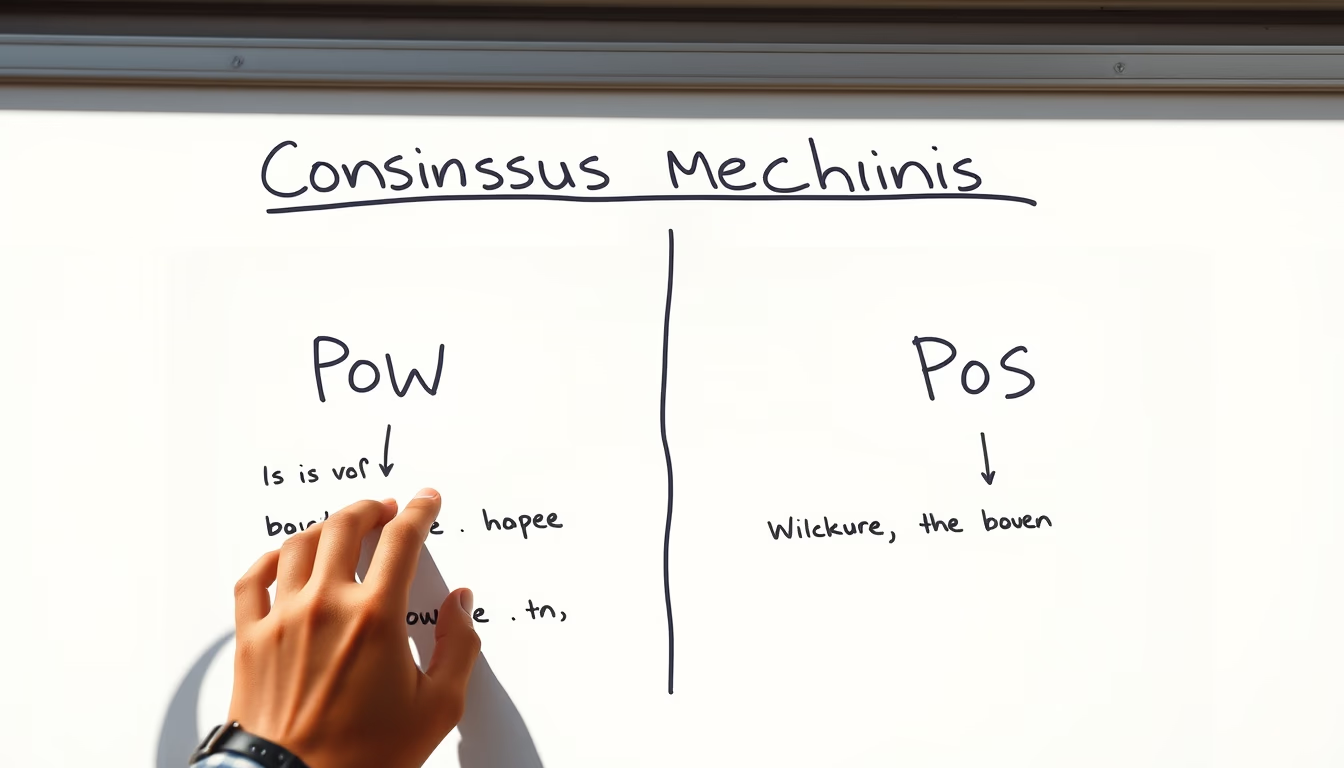 Consensus mechanism diagram on whiteboard showing PoW vs PoS
 Distributed ledger multiple servers in data center
 Hash function visualization cryptographic equations on glass screen
 Hash function visualization cryptographic equations on glass screen
 Hash function visualization cryptographic equations on glass screen