Blockchain network visualization glowing nodes connected by lines on dark background
1344×768 · AVIF · CC BY 4.0

Abstract visualization of a blockchain network with glowing nodes connected on a dark background, representing decentralized infrastructure.
About this subject
Blockchain is a distributed ledger technology that revolutionized how data and transactions are stored and verified. Each node in the network represents a computer or server that maintains a full copy of the ledger, ensuring transparency and security without a central authority. The lines connecting nodes symbolize cryptographic communications and consensus mechanisms, such as proof-of-work or proof-of-stake, that validate new blocks.
This visualization is common in graphical representations of public blockchains like Bitcoin and Ethereum, where thousands of nodes spread globally form a resilient mesh. The dark background with glowing nodes evokes an active digital ecosystem, where each point of light is a participant validating transactions. In practice, the actual topology of a blockchain is not a uniform network but a dynamic peer-to-peer structure.
Blockchain technology has applications beyond cryptocurrencies, including smart contracts, supply chains, digital identity, and electronic voting. Decentralization offers resistance to censorship and fraud, but also imposes scalability and energy consumption challenges. Networks like Ethereum are migrating to proof-of-stake to reduce environmental impact.
Trivia: The first blockchain was conceived in 2008 by Satoshi Nakamoto, implemented in 2009 as the core of Bitcoin. Since then, the number of active nodes has grown exponentially, with millions of participants worldwide.
Frequently Asked Questions
What does each node represent in a blockchain network?
Each node is a computer or server that maintains a full or partial copy of the distributed ledger. Nodes validate transactions, propagate data, and participate in consensus, ensuring network integrity.
What are the main public blockchains?
Bitcoin and Ethereum are the most well-known. Bitcoin focuses on decentralized financial transactions, while Ethereum supports smart contracts and decentralized applications (dApps). Others include Solana, Cardano, and Polkadot.
Is the glowing nodes visualization accurate?
It is a simplified artistic representation. In reality, the network topology is more complex and dynamic, with nodes connecting randomly. The image conveys the idea of decentralization and interconnection, but does not reflect the exact structure.
Direct URL
https://pub-c7d6a6ea828543ac903a74a341ccb2e1.r2.dev/imagens/blockchain-network-visualization-glowing-nodes-connected-by-lines-on-dark-backgr-aerial-drone-shot-bright-midday-sun.avifHow to credit
Include a visible link back to UtilizAí. Copy one of the snippets below:
<a href="https://xn--utiliza-eza.com/en/midia/imagens/blockchain-network-visualization-glowing-nodes-connected-by-lines-on-dark-backgr-aerial-drone-shot-bright-midday-sun">Blockchain network visualization glowing nodes connected by lines on dark background</a> by <a href="https://xn--utiliza-eza.com">UtilizAí</a>, licensed under <a href="https://creativecommons.org/licenses/by/4.0/">CC BY 4.0</a>.
[Blockchain network visualization glowing nodes connected by lines on dark background](https://xn--utiliza-eza.com/en/midia/imagens/blockchain-network-visualization-glowing-nodes-connected-by-lines-on-dark-backgr-aerial-drone-shot-bright-midday-sun) by [UtilizAí](https://xn--utiliza-eza.com), CC BY 4.0
License: CC-BY-4.0
Tags
Related images
 Smart contract code on monitor with solidity syntax highlighted
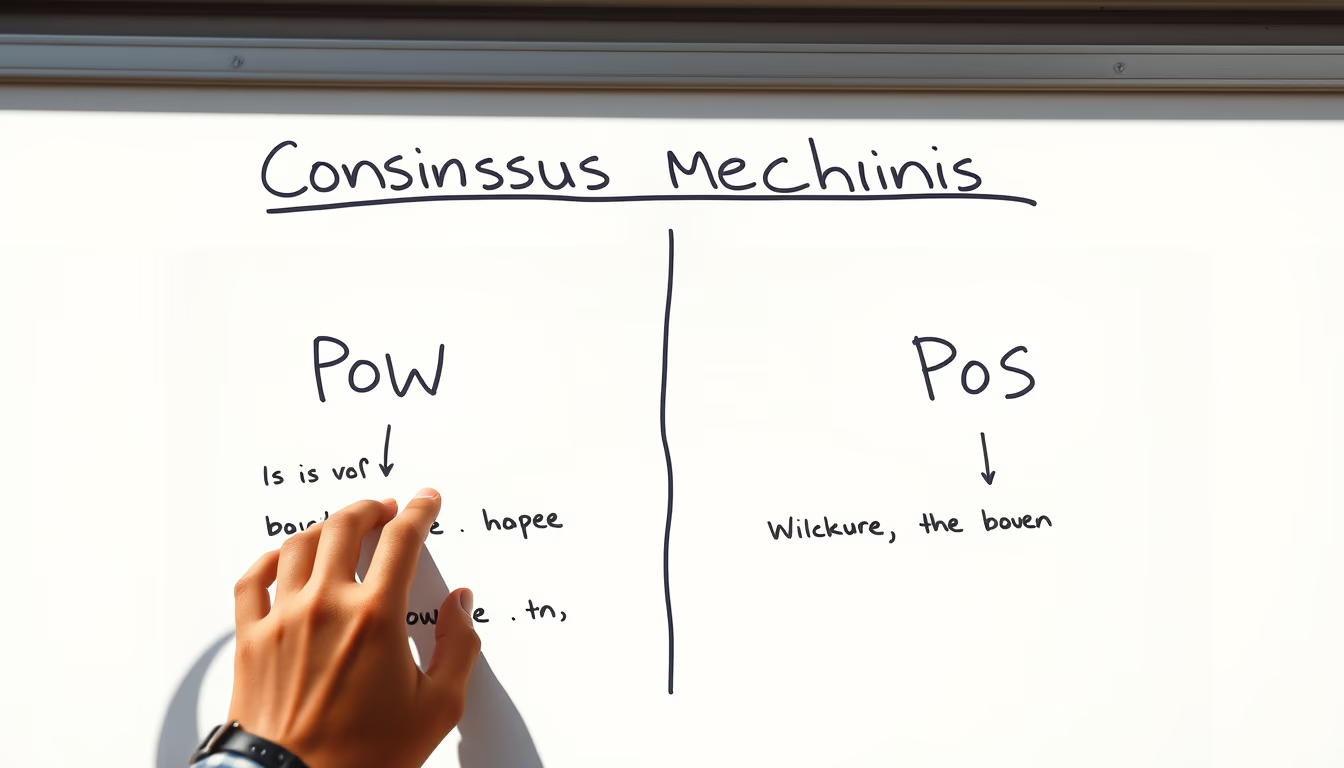 Consensus mechanism diagram on whiteboard showing PoW vs PoS
 Distributed ledger multiple servers in data center
 Hash function visualization cryptographic equations on glass screen
 Hash function visualization cryptographic equations on glass screen
 Hash function visualization cryptographic equations on glass screen