Vinyl record on turntable closeup
1344×768 · AVIF · CC BY 4.0
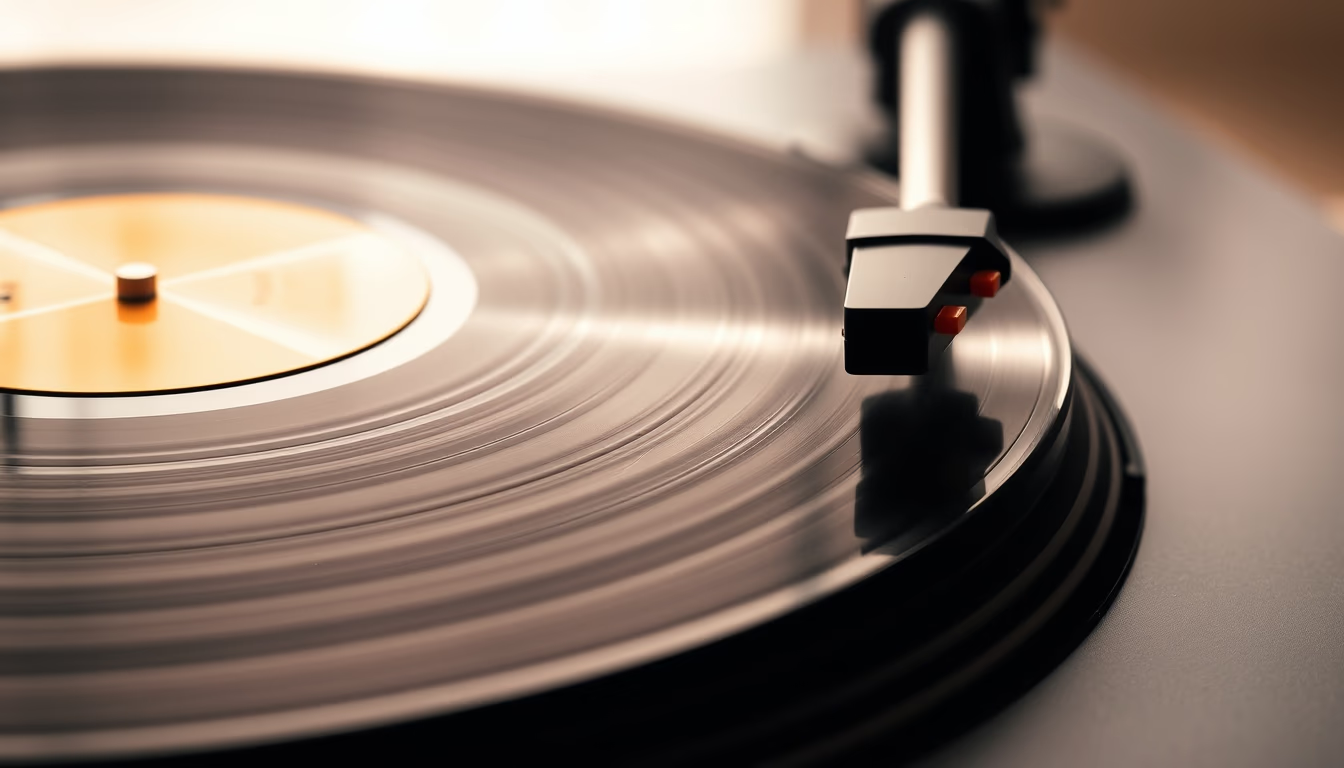
Closeup of a vinyl record on a turntable: grooves, stylus, and the minimalist aesthetic defining the analog revival.
About this subject
The vinyl record, a sound storage medium that dominated the music market between the 1950s and 1980s, has experienced a notable revival since the 2000s. In 2023, vinyl sales surpassed CD sales for the first time since 1987, according to the Recording Industry Association of America (RIAA). The format stores sound in spiral modulated grooves and requires a turntable equipped with a sapphire or diamond stylus to read the physical variations and convert them into an electrical signal. The most common speed is 33⅓ RPM for LPs, while singles typically run at 45 RPM. Minimalist aesthetics, often associated with album covers and the presentation of the turntable itself, reflect a search for simplicity and focus on musical content, contrasting with digital abundance. The vinyl manufacturing process involves pressing a PVC compound between metal matrices, creating grooves that correspond to the sound wave's shape. Analog audio quality, with its continuous response and natural harmonic distortion, is often praised by audiophiles for providing a warmer, more immersive experience. Beyond music, vinyl has become a collector's item and decorative piece, with album covers displayed as art. The 'minimalist composition' trend in image curation highlights the purity of design and equipment functionality, emphasizing each component, such as the tonearm and platter, in its simplest essence.
Frequently Asked Questions
Why did vinyl records become popular again?
The vinyl revival is driven by a desire for a tactile, physical music experience, warmer analog sound quality appreciated by audiophiles, and the aesthetic appeal of album art. Vinyl also functions as a collector's item and a symbol of authenticity in a digital age.
How does a turntable read the grooves?
The turntable's stylus travels along the spiral grooves, which have lateral or vertical variations. These variations cause the stylus to vibrate. The vibrations are converted into electrical signals by the cartridge's piezoelectric or magnetic element, then amplified and sent to speakers.
What is the difference between 33 RPM and 45 RPM vinyl?
33 ⅓ RPM records are typically 12-inch LPs containing a full album. 45 RPM records are usually 7-inch singles, offering higher audio quality per minute but shorter playback time.
Direct URL
https://pub-c7d6a6ea828543ac903a74a341ccb2e1.r2.dev/imagens/vinyl-record-on-turntable-closeup-minimalist-composition-p5.avifHow to credit
Include a visible link back to UtilizAí. Copy one of the snippets below:
<a href="https://xn--utiliza-eza.com/en/midia/imagens/vinyl-record-on-turntable-closeup-minimalist-composition-p5">Vinyl record on turntable closeup</a> by <a href="https://xn--utiliza-eza.com">UtilizAí</a>, licensed under <a href="https://creativecommons.org/licenses/by/4.0/">CC BY 4.0</a>.
[Vinyl record on turntable closeup](https://xn--utiliza-eza.com/en/midia/imagens/vinyl-record-on-turntable-closeup-minimalist-composition-p5) by [UtilizAí](https://xn--utiliza-eza.com), CC BY 4.0
License: CC-BY-4.0