St basil cathedral
1344×768 · AVIF · CC BY 4.0
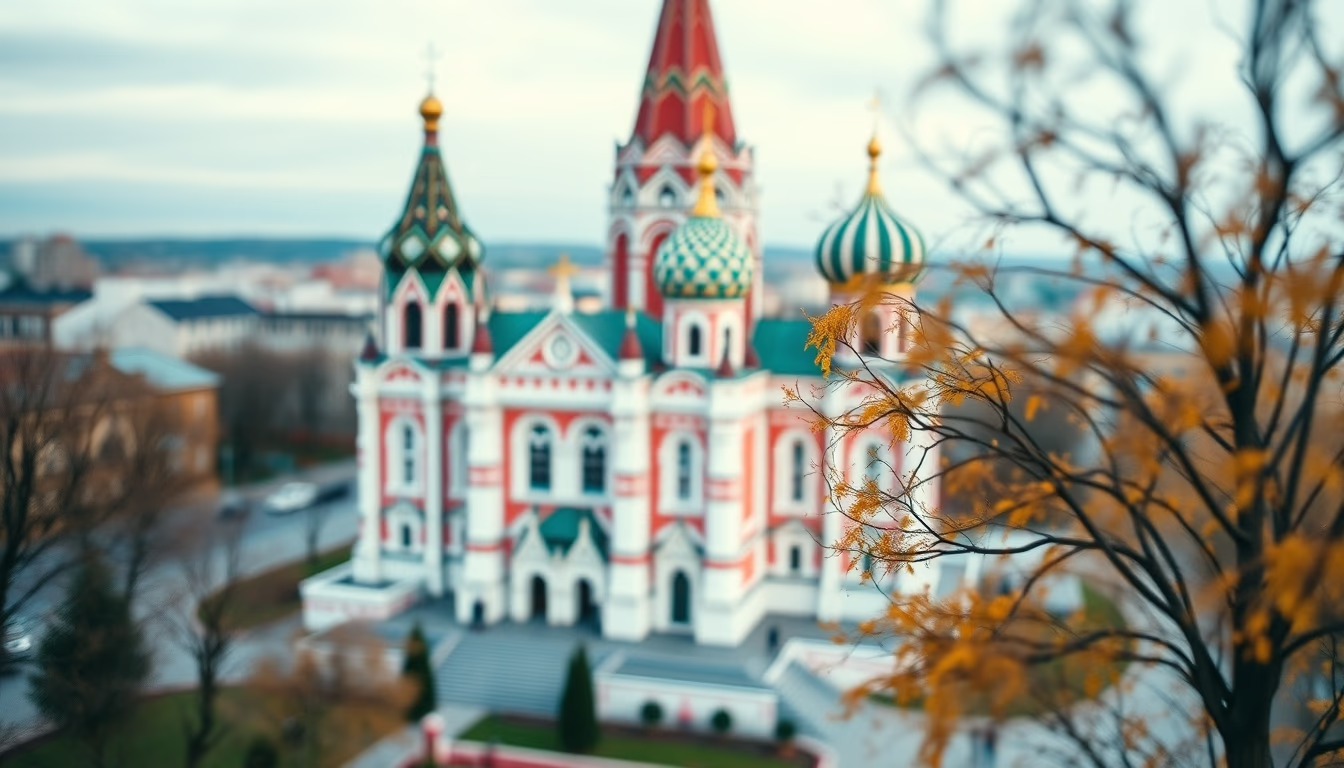
St. Basil's Cathedral, on Moscow's Red Square, is a global icon of Russian architecture with its colorful onion-shaped domes.
About this subject
St. Basil's Cathedral, officially the Cathedral of the Intercession of the Most Holy Theotokos on the Moat, was built between 1555 and 1561 by order of Tsar Ivan IV (Ivan the Terrible) to commemorate the conquest of the Khanate of Kazan. Located on Moscow's Red Square, it is one of Russia's most recognizable symbols. Its unique structure consists of nine interconnected chapels, each topped with a distinct onion dome. The central dome is gold, surrounded by eight colorful domes in vibrant shades of green, blue, yellow, and red, with geometric patterns and spirals. The design was likely influenced by the Church of the Ascension in Kolomenskoye, also from the 16th century. Originally, the domes were gold or red; the current colors were added in the 17th and 18th centuries, possibly reflecting Eastern and Byzantine influences. The cathedral was designated a UNESCO World Heritage Site in 1990, together with the Kremlin and Red Square.
The cathedral's architecture broke from earlier Russian Orthodox tradition, which favored centralized churches with single domes. Instead, St. Basil's features an asymmetric and complex composition, with each independent chapel dedicated to a different saint, all connected by galleries and passages. The popular name "St. Basil's" comes from Basil the Blessed, a holy fool for Christ who was buried on the site. During the Soviet period, the cathedral was secularized and turned into a museum, surviving Stalin's planned demolition. Today it operates as part of the State Historical Museum, receiving thousands of visitors annually.
A persistent legend claims that Ivan the Terrible blinded the architects Postnik and Barma so they could never replicate such a masterpiece. However, no historical evidence supports this story, and the exact authorship remains debated among scholars. The cathedral stands approximately 47.5 meters tall, and its silhouette has become a ubiquitous motif on Russian postcards and souvenirs, synonymous with the country's culture and history.
Viewed from different angles, the cathedral appears almost like a cluster of independent churches, but it is a unified structure. Its location at the southern end of Red Square, near the Kremlin's Savior Gate, makes it an unmistakable focal point. The tilt-shift effect often applied to photographs of the cathedral enhances the miniature model appearance, highlighting the intricate geometry and vivid colors, but the true grandeur of the building can only be appreciated in person.
Frequently Asked Questions
Why are the domes of St. Basil's Cathedral colorful?
The current colors were added in the 17th and 18th centuries. The vibrant hues are thought to have been influenced by Eastern and Byzantine styles, and also to symbolize the Heavenly Jerusalem described in the Bible, with its precious stones.
How many domes does St. Basil's Cathedral have?
The cathedral has nine main onion domes: one central and eight surrounding it, each atop an independent chapel. Some counts include a small dome over the bell tower, making ten, but the classic number is nine.
Was St. Basil's Cathedral built to celebrate the conquest of Kazan?
Yes, it was commissioned by Ivan the Terrible to commemorate the victory over the Khanate of Kazan in 1552. Construction began in 1555 and ended in 1561, though exact dates are debated.
Direct URL
https://pub-c7d6a6ea828543ac903a74a341ccb2e1.r2.dev/imagens/st-basil-cathedral-tilt-shift-miniature-p8.avifHow to credit
Include a visible link back to UtilizAí. Copy one of the snippets below:
<a href="https://xn--utiliza-eza.com/en/midia/imagens/st-basil-cathedral-tilt-shift-miniature-p8">St basil cathedral</a> by <a href="https://xn--utiliza-eza.com">UtilizAí</a>, licensed under <a href="https://creativecommons.org/licenses/by/4.0/">CC BY 4.0</a>.
[St basil cathedral](https://xn--utiliza-eza.com/en/midia/imagens/st-basil-cathedral-tilt-shift-miniature-p8) by [UtilizAí](https://xn--utiliza-eza.com), CC BY 4.0
License: CC-BY-4.0