Salt crystal macro
1344×768 · AVIF · CC BY 4.0
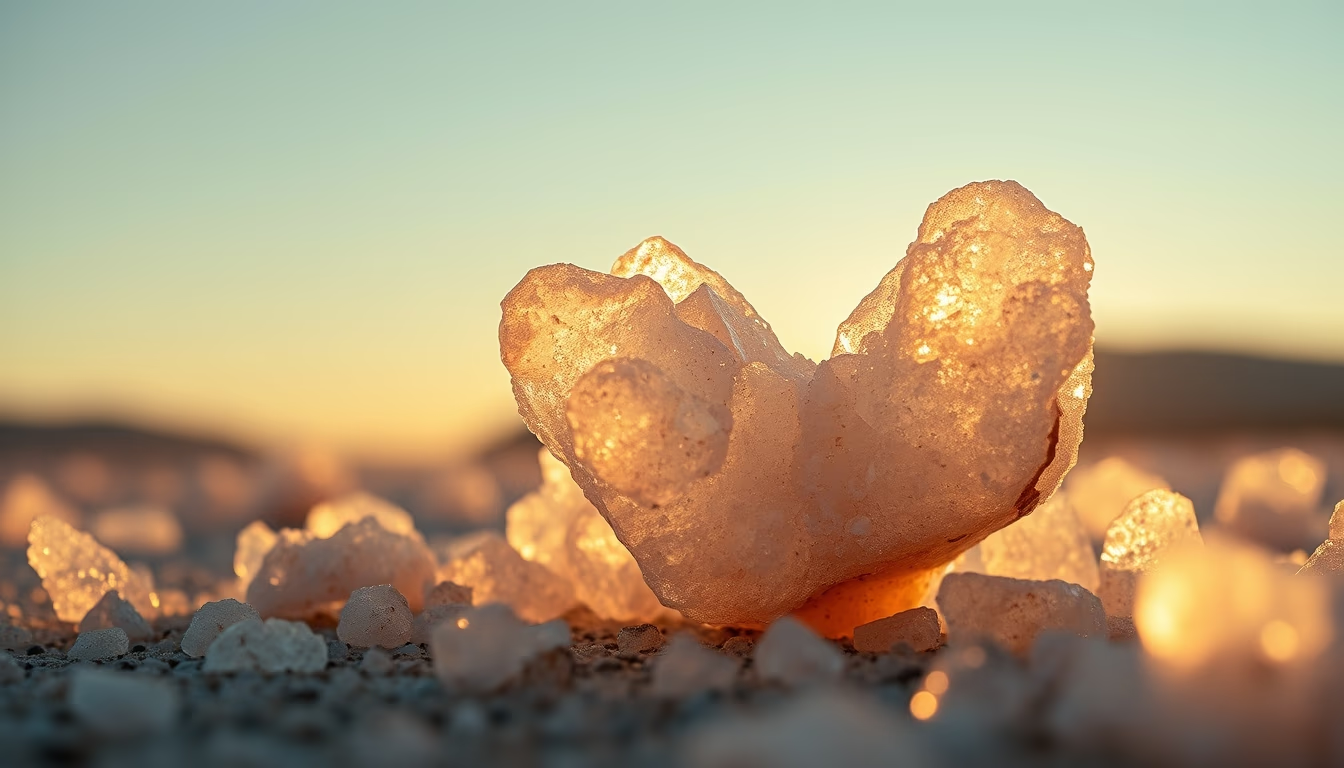
Magnified salt crystals reveal perfect cubic structures formed by controlled evaporation of saltwater.
About this subject
Table salt, or sodium chloride (NaCl), crystallizes in the cubic system, forming cubes with well-defined edges. When viewed in macro, each crystal displays flat faces and characteristic right angles. This geometric structure results from the ionic bonding between sodium and chlorine ions, which arrange themselves in a repeating three-dimensional lattice.
Salt crystal formation occurs naturally in salt pans, where seawater is evaporated in shallow ponds. The evaporation rate, temperature, and water purity influence crystal size and perfection. Larger, more regular crystals are obtained through slow, controlled evaporation, as in traditional salt pans in regions such as Rio Grande do Norte, Brazil's largest marine salt producer.
Beyond culinary use, salt has industrial applications, such as in the production of chlorine and caustic soda. Halite, the mineral name for NaCl, is also found in underground deposits formed by the evaporation of ancient seas millions of years ago. These deposits can be hundreds of meters thick and are mined in salt mines.
Interestingly, salt is essential for human life, but excessive consumption is linked to health issues like hypertension. The World Health Organization recommends less than 5 grams per day. In macro photography, salt crystals are a popular subject due to their symmetry and abstract beauty.
Frequently Asked Questions
Why do salt crystals have a cubic shape?
Salt crystals (NaCl) have a cubic shape due to the cubic crystal system, where sodium and chlorine ions alternate in a three-dimensional lattice, forming right angles between faces.
How are salt crystals naturally formed?
They form by evaporation of saltwater in salt pans or natural depressions. Slow evaporation allows ions to organize into larger, more regular crystals.
Do sea salt and table salt have the same crystal structure?
Yes, both are primarily NaCl and crystallize in the cubic system. Differences in crystal size and impurities may slightly alter appearance.
Direct URL
https://pub-c7d6a6ea828543ac903a74a341ccb2e1.r2.dev/imagens/salt-crystal-macro-cinematic-wide-shot-v2.avifHow to credit
Include a visible link back to UtilizAí. Copy one of the snippets below:
<a href="https://xn--utiliza-eza.com/en/midia/imagens/salt-crystal-macro-cinematic-wide-shot-v2">Salt crystal macro</a> by <a href="https://xn--utiliza-eza.com">UtilizAí</a>, licensed under <a href="https://creativecommons.org/licenses/by/4.0/">CC BY 4.0</a>.
[Salt crystal macro](https://xn--utiliza-eza.com/en/midia/imagens/salt-crystal-macro-cinematic-wide-shot-v2) by [UtilizAí](https://xn--utiliza-eza.com), CC BY 4.0
License: CC-BY-4.0