Romanesque cathedral arches
1344×768 · JPG · CC BY 4.0
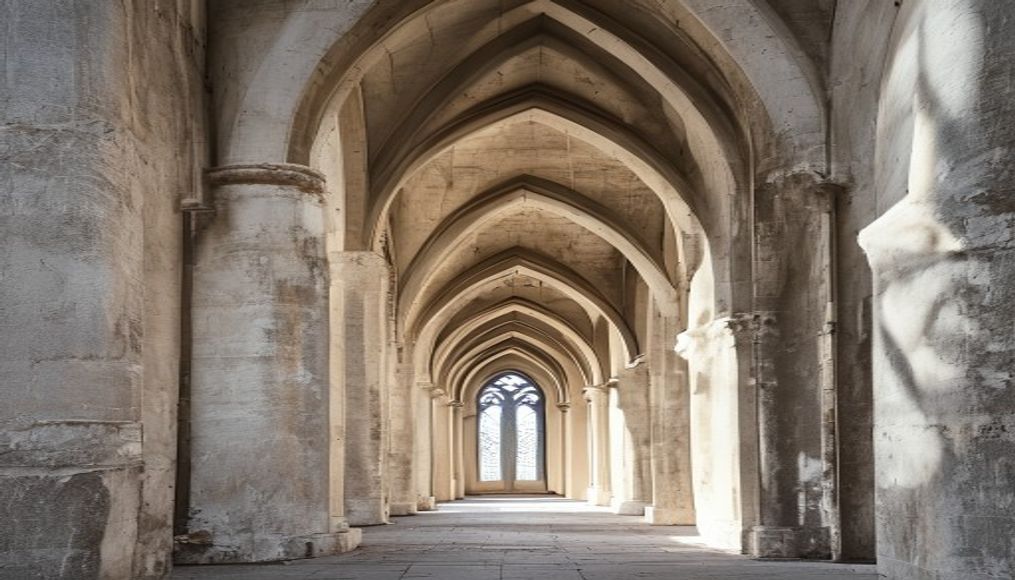
Romanesque cathedral arches, characterized by semicircular forms and solidity, define medieval European architecture between the 11th and 13th centuries.
About this subject
Romanesque arches are a central feature of the architectural style that flourished in Europe from roughly 1000 to 1200 AD. Derived from Roman arches, they are semicircular and built with wedge-shaped stones, forming a structure that efficiently distributes weight. This technique enabled the construction of wide naves and barrel vaults, characteristic of Romanesque cathedrals and monasteries.
The Romanesque style emerged as a response to the need for larger, more durable churches after the year 1000, when Europe experienced a period of relative stability and population growth. Romanesque cathedrals such as Santiago de Compostela in Spain and Speyer Cathedral in Germany display semicircular arches not only in doors and windows but also in blind arcades and galleries. These arches, often combined with thick walls and small openings, convey a sense of solidity and protection.
Culturally, Romanesque arches symbolized the authority of the Church and continuity with the Roman Empire. They also influenced later Gothic architecture, which replaced the semicircular arch with the pointed arch to allow greater height and light. Today, many Romanesque cathedrals are UNESCO World Heritage sites, preserving these arches as testaments to medieval engineering.
Frequently Asked Questions
What characterizes a Romanesque arch?
A Romanesque arch is semicircular, built with wedge-shaped stones (voussoirs) that support each other. It distributes weight evenly to the sides, allowing for solid and durable structures.
What is the difference between a Romanesque arch and a Gothic arch?
The Romanesque arch is semicircular, while the Gothic arch is pointed. The pointed arch allows for greater height and larger openings for stained glass, resulting in lighter and brighter interiors.
Where can I see famous examples of Romanesque arches?
Notable examples include Speyer Cathedral (Germany), Cluny Abbey (France), Santiago de Compostela Cathedral (Spain), and the Basilica of Saint-Sernin in Toulouse (France).
Direct URL
https://pub-c7d6a6ea828543ac903a74a341ccb2e1.r2.dev/imagens/romanesque-cathedral-arches-minimalist-composition-p4.jpgHow to credit
Include a visible link back to UtilizAí. Copy one of the snippets below:
<a href="https://xn--utiliza-eza.com/en/midia/imagens/romanesque-cathedral-arches-minimalist-composition-p4">Romanesque cathedral arches</a> by <a href="https://xn--utiliza-eza.com">UtilizAí</a>, licensed under <a href="https://creativecommons.org/licenses/by/4.0/">CC BY 4.0</a>.
[Romanesque cathedral arches](https://xn--utiliza-eza.com/en/midia/imagens/romanesque-cathedral-arches-minimalist-composition-p4) by [UtilizAí](https://xn--utiliza-eza.com), CC BY 4.0
License: CC-BY-4.0