Romanesque cathedral arches
1344×768 · AVIF · CC BY 4.0
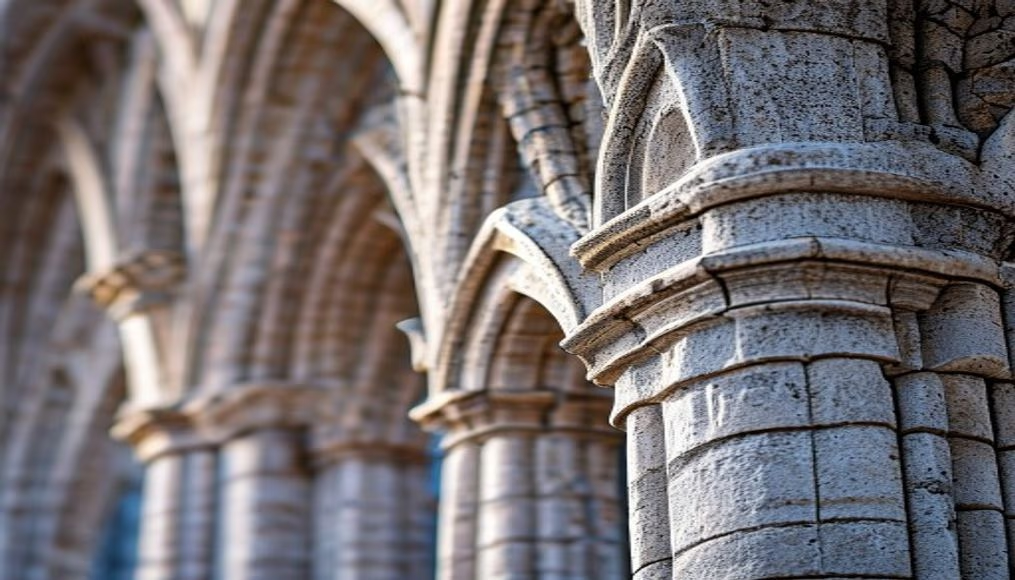
Romanesque cathedral arches, with their semicircular shape and sturdy construction, mark a key transition from ancient to Gothic architecture.
About this subject
Romanesque arches, typical of cathedrals built between the 10th and 12th centuries, are defined by their semicircular shape, inherited from ancient Roman architecture. They are characterized by structural solidity, with massive pillars, thick walls, and few openings, creating a dark and imposing interior. Notable examples include the Cathedral of Santiago de Compostela in Spain, Cluny Abbey in France, and Speyer Cathedral in Germany, known for its vast vaulted nave.
The construction technique of Romanesque arches required precise fitting of wedge-shaped stones arranged over a wooden formwork until completion. This approach ensured the durability of many structures that survive today. Interestingly, the Romanesque arch was gradually replaced by the pointed Gothic arch, which allowed for greater height and light, but the Romanesque legacy remains in the foundations of many later cathedrals.
Beyond architecture, the Romanesque style also influenced sculpture and mural painting, featuring religious themes and stylized figures. The robustness of the arches not only supported the weight of the vaults but also symbolized the strength of medieval Christian faith. Today, these arches are studied as testaments to the engineering and art of a transformative cultural era in Europe.
Frequently Asked Questions
What characterizes a Romanesque arch?
It is a semicircular arch built with wedge-shaped stones (voussoirs) supported by sturdy pillars, typical of architecture from the 10th to 12th centuries.
Which cathedrals have famous Romanesque arches?
Notable examples include the Cathedral of Santiago de Compostela (Spain), Speyer Cathedral (Germany), and Durham Cathedral (England).
How did the Romanesque arch influence later architecture?
It laid the foundation for the pointed Gothic arch, which enabled taller, lighter structures, whereas Romanesque prioritized solidity and dim interiors.
Direct URL
https://pub-c7d6a6ea828543ac903a74a341ccb2e1.r2.dev/imagens/romanesque-cathedral-arches-macro-closeup-p3.avifHow to credit
Include a visible link back to UtilizAí. Copy one of the snippets below:
<a href="https://xn--utiliza-eza.com/en/midia/imagens/romanesque-cathedral-arches-macro-closeup-p3">Romanesque cathedral arches</a> by <a href="https://xn--utiliza-eza.com">UtilizAí</a>, licensed under <a href="https://creativecommons.org/licenses/by/4.0/">CC BY 4.0</a>.
[Romanesque cathedral arches](https://xn--utiliza-eza.com/en/midia/imagens/romanesque-cathedral-arches-macro-closeup-p3) by [UtilizAí](https://xn--utiliza-eza.com), CC BY 4.0
License: CC-BY-4.0