Ribosome detail render
1344×768 · AVIF · CC BY 4.0
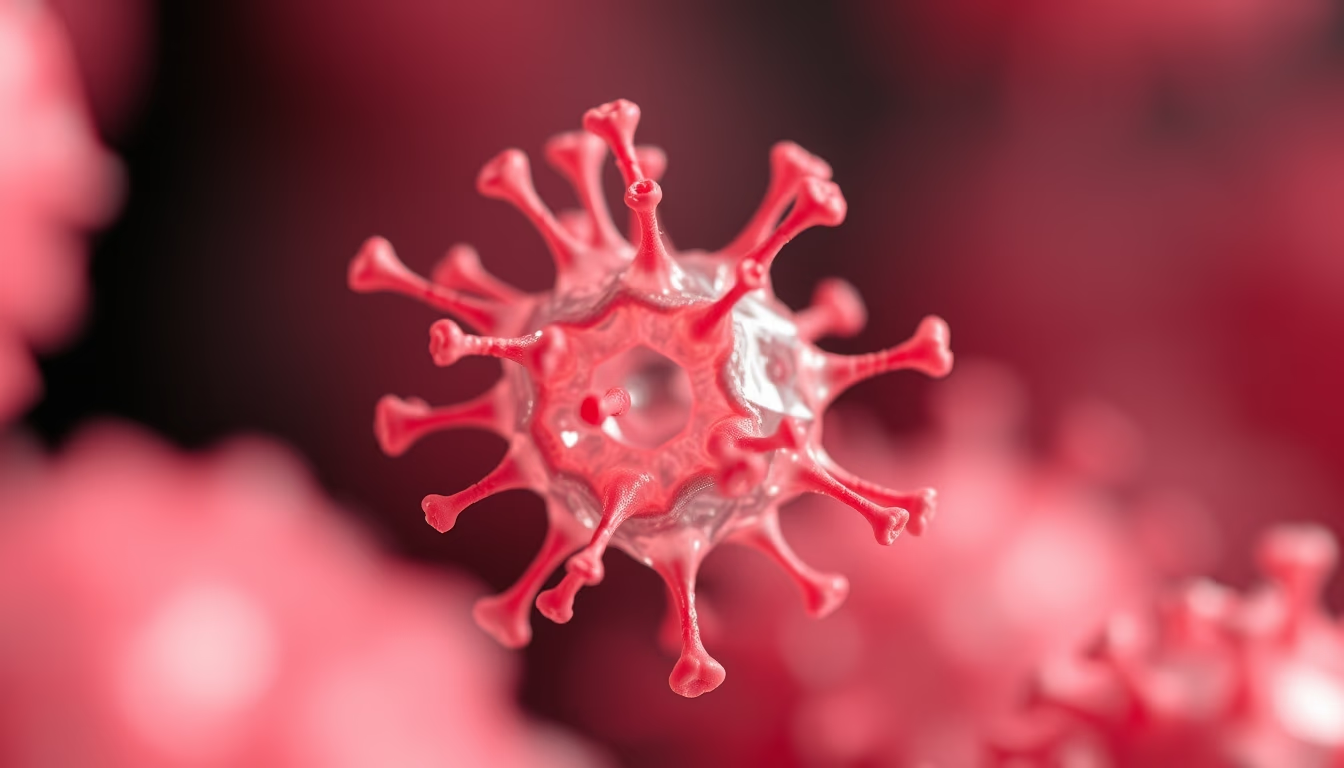
Os ribossomos são complexos moleculares responsáveis pela síntese de proteínas, presentes em todas as células vivas, com estruturas distintas em procariotos e eucariotos.
Sobre o tema
Os ribossomos são máquinas celulares fundamentais que realizam a tradução do RNA mensageiro em cadeias polipeptídicas, processo essencial para a vida. Cada ribossomo é composto por duas subunidades, uma maior e uma menor, que se associam durante a síntese proteica. Em procariotos, como bactérias, o ribossomo tem coeficiente de sedimentação 70S, com subunidades 50S e 30S. Já em eucariotos, incluindo humanos, o ribossomo é maior, 80S, com subunidades 60S e 40S. Essa diferença é alvo de muitos antibióticos, como a tetraciclina, que se liga à subunidade 30S bacteriana sem afetar os ribossomos eucarióticos.
A estrutura tridimensional do ribossomo foi elucidada em detalhes atômicos graças à criomicroscopia eletrônica e à cristalografia de raios X, trabalhos que renderam o Prêmio Nobel de Química em 2009 a Venkatraman Ramakrishnan, Thomas Steitz e Ada Yonath. O ribossomo contém RNA ribossômico (rRNA) e proteínas. O rRNA atua como catalisador da formação da ligação peptídica, caracterizando-o como uma ribozima. Essa descoberta revolucionou a compreensão da origem da vida, sugerindo que o RNA pode ter sido a primeira molécula autorreplicante.
Curiosamente, os ribossomos não são organelas envoltas por membrana, mas sim complexos ribonucleoproteicos. Eles podem estar livres no citoplasma ou associados ao retículo endoplasmático rugoso, onde sintetizam proteínas destinadas à secreção ou à membrana. A taxa de síntese proteica é impressionante: uma única célula de mamífero contém milhões de ribossomos, capazes de adicionar até 20 aminoácidos por segundo a uma cadeia nascente. Mutações em componentes ribossômicos estão ligadas a doenças humanas, como a anemia de Diamond-Blackfan e a síndrome 5q-, evidenciando sua importância clínica.
Perguntas frequentes
Qual a diferença entre ribossomos 70S e 80S?
Ribossomos 70S são encontrados em procariotos (bactérias) e em organelas como mitocôndrias e cloroplastos. Ribossomos 80S são típicos de eucariotos. A diferença no coeficiente de sedimentação refere-se ao tamanho e composição molecular: 70S tem subunidades 50S e 30S, enquanto 80S tem subunidades 60S e 40S.
Por que antibióticos como a tetraciclina não afetam ribossomos humanos?
Antibióticos como tetraciclina e eritromicina têm como alvo específico a subunidade menor (30S) ou maior (50S) dos ribossomos bacterianos, que são estruturalmente diferentes dos ribossomos eucarióticos. Isso permite inibir seletivamente a síntese proteica bacteriana sem prejudicar as células humanas.
O que significa dizer que o ribossomo é uma ribozima?
Ribozima é uma molécula de RNA com atividade catalítica. No ribossomo, o rRNA da subunidade maior catalisa a formação da ligação peptídica entre aminoácidos, o que antes se pensava ser função exclusiva de proteínas. Essa descoberta mostrou que o RNA pode atuar como enzima, apoiando a hipótese do 'mundo de RNA' na origem da vida.
URL direta
https://pub-c7d6a6ea828543ac903a74a341ccb2e1.r2.dev/imagens/ribosome-detail-render-macro-closeup-p2.avifComo creditar
Inclua um link visível de volta pro UtilizAí. Copie um dos snippets abaixo:
<a href="https://xn--utiliza-eza.com/midia/imagens/ribosome-detail-render-macro-closeup-p2">Ribosome detail render</a> by <a href="https://xn--utiliza-eza.com">UtilizAí</a>, licensed under <a href="https://creativecommons.org/licenses/by/4.0/">CC BY 4.0</a>.
[Ribosome detail render](https://xn--utiliza-eza.com/midia/imagens/ribosome-detail-render-macro-closeup-p2) by [UtilizAí](https://xn--utiliza-eza.com), CC BY 4.0
Licença: CC-BY-4.0