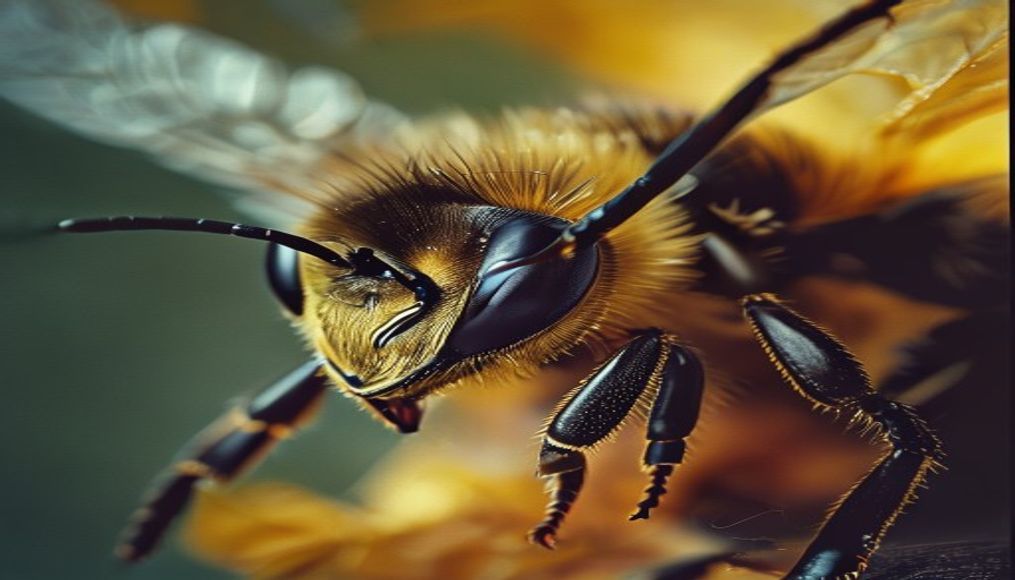
Queen bee macro
1344×768 · AVIF · CC BY 4.0
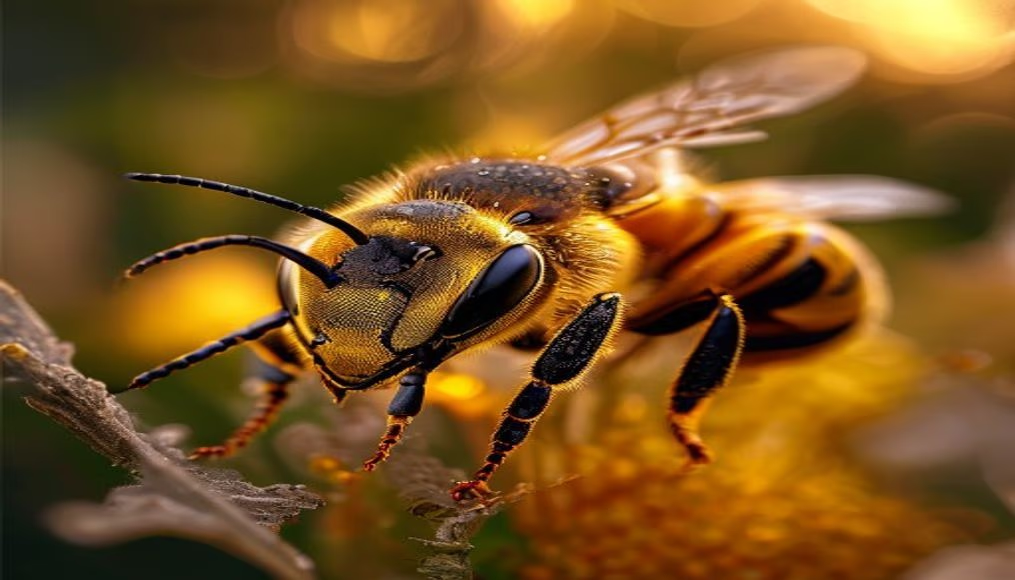
The queen bee is the only fertile female in the hive, responsible for egg laying and maintaining social order.
About this subject
The queen bee is the central figure in any honey bee colony (Apis mellifera). Unlike workers, she has fully developed reproductive organs and can live 2 to 5 years, while workers live only a few weeks. During peak season, a healthy queen lays between 1,500 and 2,000 eggs per day, reaching up to 3,000 in selected breeds. This high output is sustained by constant feeding of royal jelly, secreted by the glands of young worker bees.
Physically, the queen is distinguished by her longer abdomen and lack of pollen baskets (corbiculae). Her stinger is smooth and curved, allowing her to sting multiple times without dying, but she only uses it to eliminate rivals during swarming or supersedure. Chemical communication is vital: the queen's mandibular pheromones inhibit the development of workers' ovaries and maintain hive cohesion. If the queen ages or dies, workers create special queen cells to rear a new one.
In modern beekeeping, marking the queen is common practice. Beekeepers attach a colored tag to her thorax according to the year (white, yellow, red, green, blue), following an international code. This allows monitoring of her age, performance, and timely replacement. Queen rearing techniques are essential for genetic improvement, disease control (e.g., Varroa mites), and increasing honey productivity.
Globally, honey bee subspecies vary in queen behavior. The Italian queen (Apis mellifera ligustica) is known for high egg-laying and gentleness; the African queen (Apis mellifera scutellata) is more aggressive and swarms frequently. Macro photography of queens, using specialized lenses, reveals stunning details such as compound eyes, iridescent wings, and abdominal structure. This subject is prized by travel photojournalists documenting beekeeping practices worldwide.
Frequently Asked Questions
How many eggs does a queen bee lay per day?
On average, 1,500 to 2,000 eggs per day during the season, up to 3,000 in prolific breeds like the Italian bee.
What is the difference between a queen bee and worker bees?
The queen is larger, has a longer abdomen, and is the only fertile female. Workers are sterile and perform tasks such as nectar collection, brood care, and hive defense.
How do beekeepers identify the queen bee in the hive?
They use colored tags on the thorax following a yearly color code (white, yellow, red, green, blue). This makes it easy to locate and monitor the queen's age and performance.
Direct URL
https://pub-c7d6a6ea828543ac903a74a341ccb2e1.r2.dev/imagens/queen-bee-macro-travel-photography-p0.avifHow to credit
Include a visible link back to UtilizAí. Copy one of the snippets below:
<a href="https://xn--utiliza-eza.com/en/midia/imagens/queen-bee-macro-travel-photography-p0">Queen bee macro</a> by <a href="https://xn--utiliza-eza.com">UtilizAí</a>, licensed under <a href="https://creativecommons.org/licenses/by/4.0/">CC BY 4.0</a>.
[Queen bee macro](https://xn--utiliza-eza.com/en/midia/imagens/queen-bee-macro-travel-photography-p0) by [UtilizAí](https://xn--utiliza-eza.com), CC BY 4.0
License: CC-BY-4.0