Pcr machine running cycle
1344×768 · AVIF · CC BY 4.0
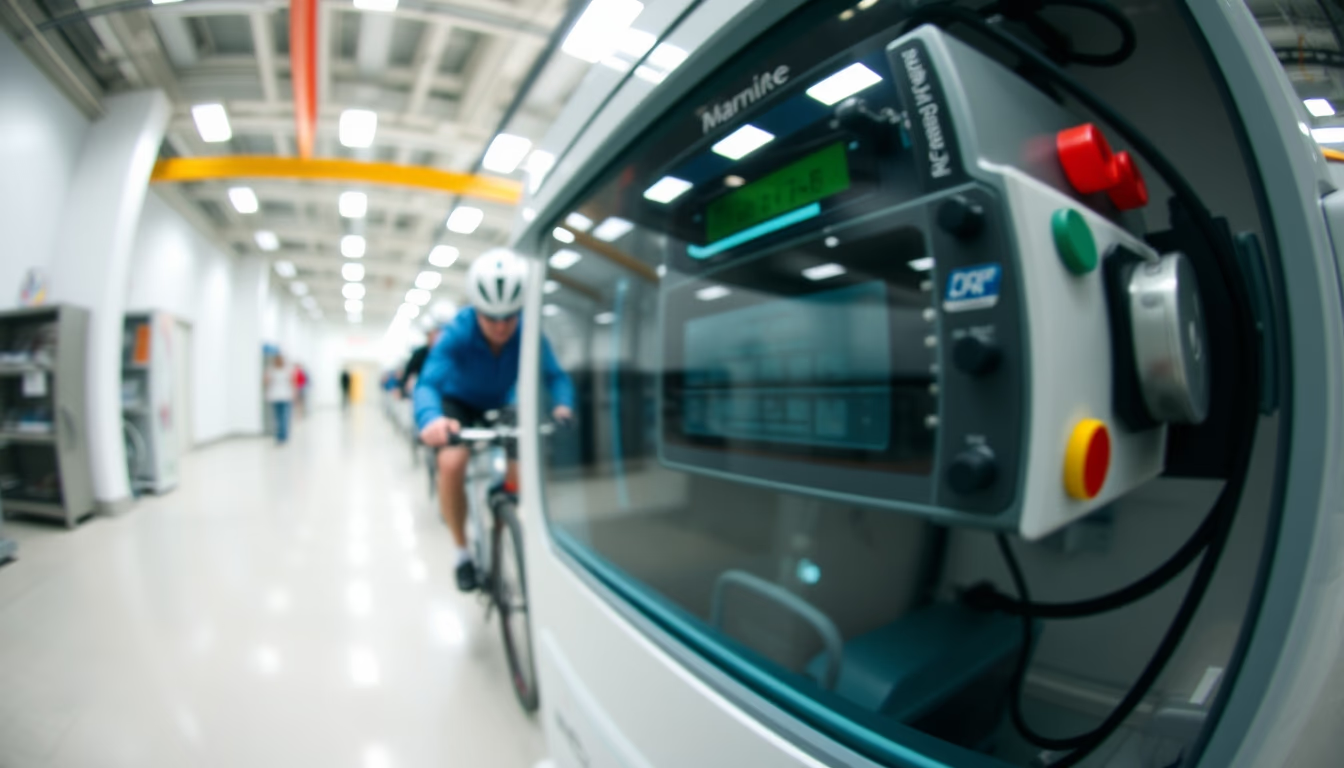
Thermal cycler in operation running PCR cycles, a fundamental technique in molecular biology for DNA amplification.
About this subject
The Polymerase Chain Reaction (PCR) is a molecular biology technique invented by Kary Mullis in 1983, for which he received the Nobel Prize in Chemistry in 1993. This method amplifies millions of copies of a specific DNA sequence from a minimal sample, revolutionizing fields such as medical diagnostics, forensic genetics, and scientific research.
The process takes place in a thermal cycler, which precisely and cyclically changes temperature. Each cycle consists of three steps: denaturation (approximately 95°C, separating DNA strands), annealing (50-65°C, primer binding), and extension (72°C, action of Taq polymerase). A typical conventional PCR cycle repeats 25 to 35 times, resulting in exponential amplification (2^n copies).
PCR has broad applications: diagnosing infectious diseases like COVID-19 (RT-PCR test), identifying genetic mutations in cancer, paternity testing, forensic DNA analysis, evolutionary studies, and genome sequencing. The technique also enabled gene cloning and personalized medicine.
Modern versions include real-time PCR (qPCR), which quantifies amplified DNA in real time using fluorescent dyes, and digital PCR (dPCR), which allows absolute molecule counting. Today's thermal cyclers can perform multiple assays simultaneously and integrate optical detection systems, making PCR faster and more accurate.
Frequently Asked Questions
What does PCR stand for?
PCR stands for Polymerase Chain Reaction, a technique that amplifies specific DNA sequences.
How many cycles are typically needed for DNA amplification?
Typically 25 to 35 cycles are performed, although the exact number depends on the initial DNA amount and reaction efficiency.
What is the difference between conventional PCR and real-time PCR?
Conventional PCR detects the final product after cycles, while real-time PCR (qPCR) monitors amplification each cycle using fluorescence, enabling precise quantification and melting curve analysis.
Direct URL
https://pub-c7d6a6ea828543ac903a74a341ccb2e1.r2.dev/imagens/pcr-machine-running-cycle-fish-eye-wide-angle-p0.avifHow to credit
Include a visible link back to UtilizAí. Copy one of the snippets below:
<a href="https://xn--utiliza-eza.com/en/midia/imagens/pcr-machine-running-cycle-fish-eye-wide-angle-p0">Pcr machine running cycle</a> by <a href="https://xn--utiliza-eza.com">UtilizAí</a>, licensed under <a href="https://creativecommons.org/licenses/by/4.0/">CC BY 4.0</a>.
[Pcr machine running cycle](https://xn--utiliza-eza.com/en/midia/imagens/pcr-machine-running-cycle-fish-eye-wide-angle-p0) by [UtilizAí](https://xn--utiliza-eza.com), CC BY 4.0
License: CC-BY-4.0