Parthenon athens columns
1344×768 · AVIF · CC BY 4.0
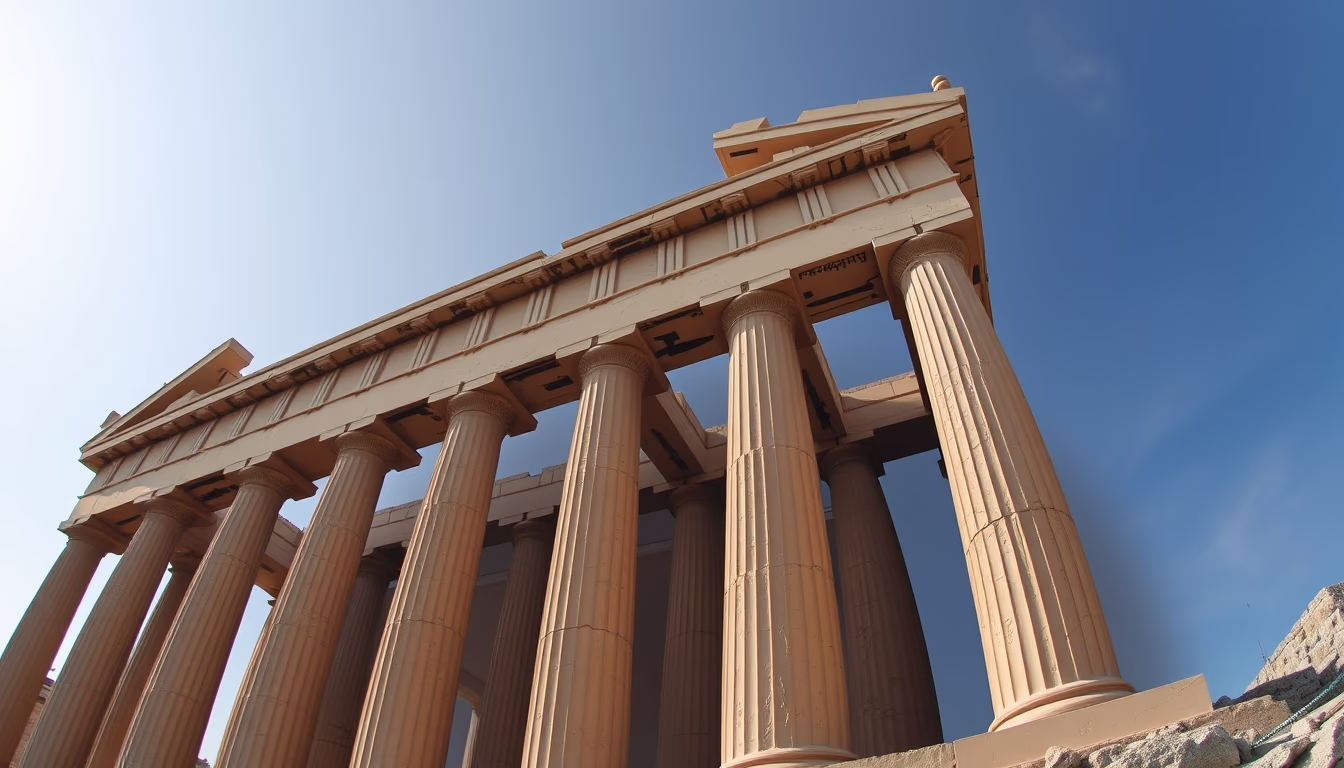
The Parthenon, a temple dedicated to the goddess Athena atop the Acropolis of Athens, is renowned for its Doric columns that feature sophisticated optical refinements.
About this subject
The Parthenon was built between 447 and 438 BCE under the leadership of Pericles, with architects Ictinus and Callicrates and sculptor Phidias. The temple is a supreme example of Classical Greek architecture, featuring 46 Doric columns around its perimeter: 8 on the front facade and 17 on each side (counting corner columns twice). Each column stands about 10.4 meters tall and is composed of drums of Pentelic marble, quarried from Mount Pentelicus about 16 km from Athens, known for its purity and subtle golden patina over time.
The Parthenon's columns are not perfectly straight but incorporate a slight swelling in the middle (entasis) to correct the visual illusion of concavity that straight lines create. Additionally, the stylobate (the platform on which the columns rest) has a subtle convex curvature, with the center about 6 cm higher than the edges. These refinements, documented by modern architectural studies, make the temple visually harmonious and are considered one of the great achievements of ancient engineering.
Originally, the Parthenon housed a colossal chryselephantine statue of Athena Parthenos, made by Phidias from gold and ivory. Over the centuries, the building served as a Greek treasury, a Christian church, an Ottoman mosque, and a gunpowder store. In 1687, during the Venetian siege, an explosion severely damaged the temple, toppling many columns. Today, the Parthenon undergoes a careful restoration program coordinated by the Acropolis Restoration Service, aimed at preserving its columns and sculptures for future generations.
Frequently Asked Questions
How many columns does the Parthenon have?
The Parthenon has 46 Doric columns in total: 8 on the front facade (including corner columns) and 17 on each side, again counting corner columns twice.
Why are the Parthenon's columns slightly curved?
The columns have a slight curvature called entasis to counteract the optical illusion of concavity. The stylobate (base) also has a subtle upward curvature in the center to prevent the appearance of sagging.
What material are the Parthenon's columns made of?
The columns are carved from Pentelic marble, quarried from Mount Pentelicus in Attica. This marble has a fine grain and a whitish hue that develops a golden patina over time due to sun exposure.
Direct URL
https://pub-c7d6a6ea828543ac903a74a341ccb2e1.r2.dev/imagens/parthenon-athens-columns-fish-eye-wide-angle-p6.avifHow to credit
Include a visible link back to UtilizAí. Copy one of the snippets below:
<a href="https://xn--utiliza-eza.com/en/midia/imagens/parthenon-athens-columns-fish-eye-wide-angle-p6">Parthenon athens columns</a> by <a href="https://xn--utiliza-eza.com">UtilizAí</a>, licensed under <a href="https://creativecommons.org/licenses/by/4.0/">CC BY 4.0</a>.
[Parthenon athens columns](https://xn--utiliza-eza.com/en/midia/imagens/parthenon-athens-columns-fish-eye-wide-angle-p6) by [UtilizAí](https://xn--utiliza-eza.com), CC BY 4.0
License: CC-BY-4.0