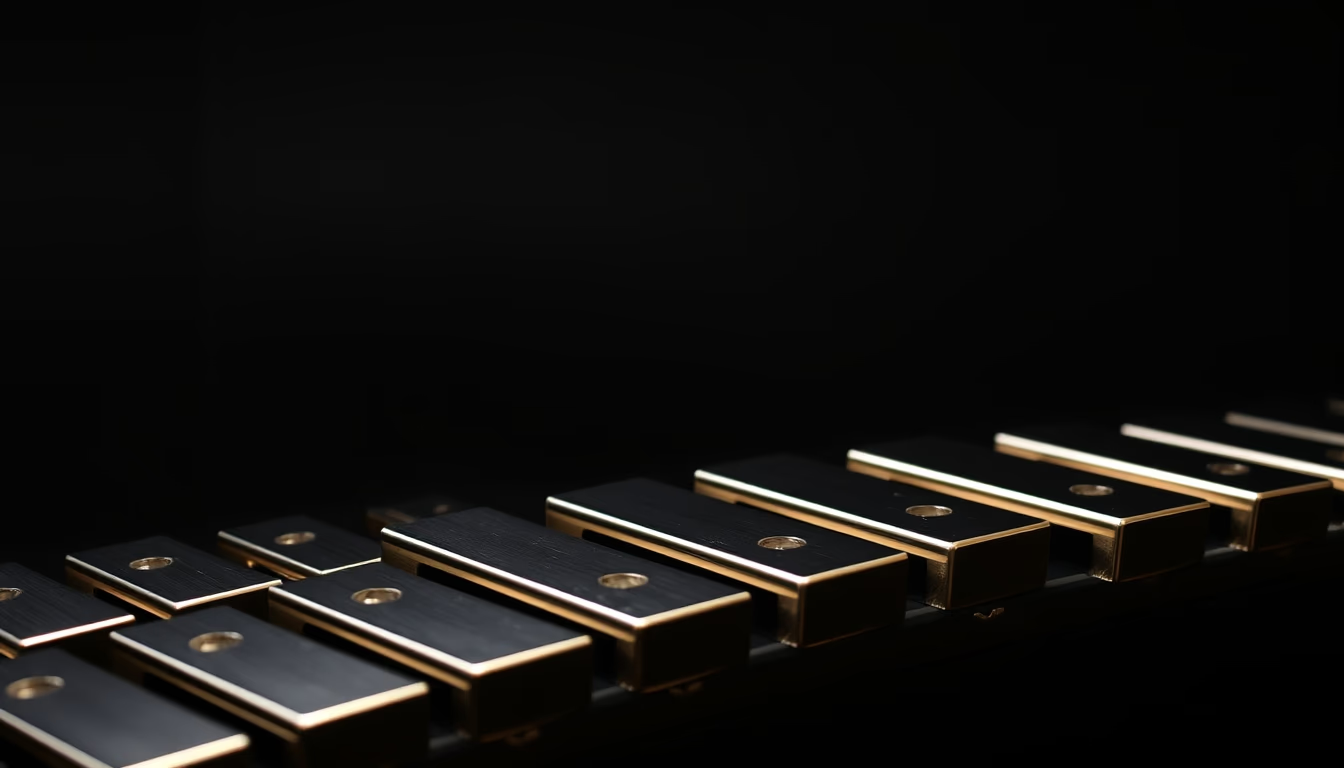
Modular synthesizer rack
1344×768 · AVIF · CC BY 4.0

A modular synthesizer is an electronic instrument made of standalone modules connected by patch cables, enabling custom signal paths.
About this subject
Modular synthesizers emerged in the 1960s with the Moog and Buchla systems, laying the groundwork for sound synthesis. Unlike fixed-architecture synthesizers, they allow users to select and interconnect modules such as voltage-controlled oscillators (VCO), filters (VCF), amplifiers (VCA), envelope generators, and LFOs. Each module has a specific function: a VCO generates waveforms, a VCF shapes timbre, and an envelope controls sound evolution over time. Connections are made via patch cables that carry audio signals or control voltages. This modular architecture offers immense flexibility, used by both experimental artists and pop musicians. In the 1970s and 1980s, systems like the Moog 55 and Buchla 200 influenced progressive rock, ambient music, and film scores. With the rise of digital synthesizers and declining prices, modulars waned, but a revival began in the 2000s thanks to the Eurorack format, which standardized sizes and voltages. Today, brands like Doepfer, Make Noise, and Intellijel produce hundreds of modules, and online communities share patches and techniques. The complexity and patch mindset make modulars an educational tool for understanding sound synthesis, as well as a creative playground for unique timbre design. Interestingly, many modern digital synthesizers include modular routing emulations, highlighting their lasting influence.
Frequently Asked Questions
How does a modular synthesizer differ from a regular synthesizer?
The key difference is modularity: in a modular synth, each function (oscillator, filter, etc.) is a separate module that you connect with patch cables, allowing you to customize the signal path. Fixed synthesizers have pre-routed internal connections.
What are the essential modules to start with in modular synthesis?
Basic modules include a VCO (oscillator), VCF (filter), VCA (amplifier), an envelope (often ADSR), and an LFO. Many beginners start with pre-assembled systems like the Moog Mother-32 or semi-modular synths like the Arturia MiniBrute.
Is it difficult to learn to play a modular synthesizer?
There is a learning curve, but the concept of connecting modules is intuitive. Many musicians begin with simple patches and experiment. Active communities and online tutorials make the process accessible.
Direct URL
https://pub-c7d6a6ea828543ac903a74a341ccb2e1.r2.dev/imagens/modular-synthesizer-rack-macro-closeup-p10.avifHow to credit
Include a visible link back to UtilizAí. Copy one of the snippets below:
<a href="https://xn--utiliza-eza.com/en/midia/imagens/modular-synthesizer-rack-macro-closeup-p10">Modular synthesizer rack</a> by <a href="https://xn--utiliza-eza.com">UtilizAí</a>, licensed under <a href="https://creativecommons.org/licenses/by/4.0/">CC BY 4.0</a>.
[Modular synthesizer rack](https://xn--utiliza-eza.com/en/midia/imagens/modular-synthesizer-rack-macro-closeup-p10) by [UtilizAí](https://xn--utiliza-eza.com), CC BY 4.0
License: CC-BY-4.0