Milky way stars
1344×768 · AVIF · CC BY 4.0
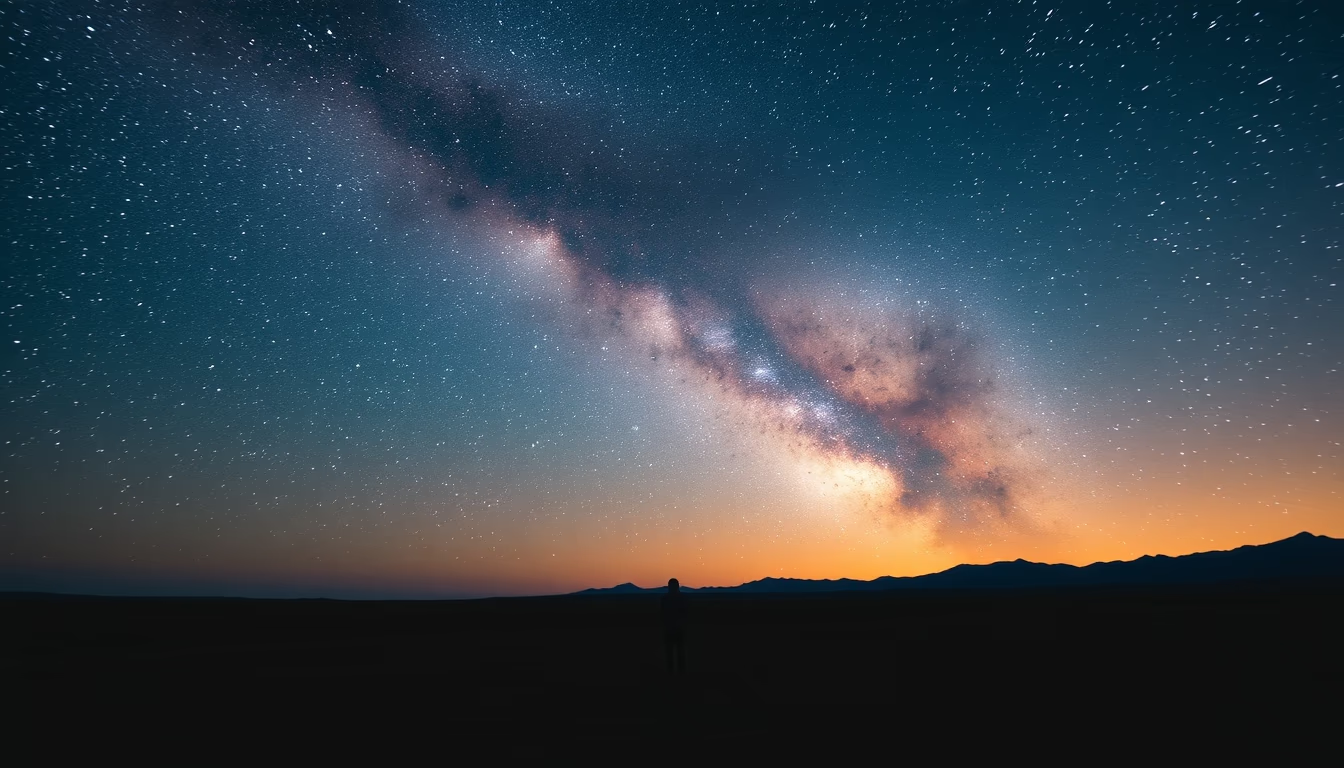
The Milky Way, our spiral galaxy, contains billions of stars visible in dark skies, a spectacle that fascinates astronomers and photographers.
About this subject
The Milky Way is a barred spiral galaxy containing between 100 and 400 billion stars, along with gas, dust, and dark matter. Our Solar System is located in one of its spiral arms, the Orion Arm, about 26,000 light-years from the galactic center. On nights without light pollution, especially in desert or mountainous regions, the milky band that gave the galaxy its name becomes visible, formed by the diffuse light of distant stars.
Night landscape photography capturing the Milky Way has become popular with the advancement of digital cameras and exposure stacking techniques. Locations such as the Atacama Desert in Chile, Yellowstone National Park in the USA, and the Brazilian hinterland offer ideal conditions for this type of recording. Astrophotography requires proper equipment, such as wide-angle lenses and tripods, as well as knowledge about moon phases and seasons.
The Milky Way plays a central role in various cultures. For ancient Greeks, the name derives from the myth of Hera, whose milk supposedly formed the celestial band. Indigenous Brazilian peoples, such as the Tupi-Guarani, associate the Milky Way with the path of souls or a celestial river. In modern astronomy, studying the Milky Way helps understand galaxy formation and the evolution of the Universe.
Trivia: the center of the Milky Way hosts a supermassive black hole called Sagittarius A*, with a mass equivalent to 4 million suns. About 50 new stars form in the galaxy each year, and it is estimated that there are millions of potentially habitable planets.
Frequently Asked Questions
What is the best time of year to photograph the Milky Way in Brazil?
In Brazil, the best time is between April and September, when the galactic center is visible in the night sky. Winter nights, with drier air and lower humidity, offer better conditions.
Can the Milky Way be seen with the naked eye in urban areas?
Generally no, due to light pollution. A dark sky away from city lights, such as in national parks or rural areas, is required.
How many stars are in the Milky Way?
Estimates range from 100 to 400 billion stars, but the exact number is difficult to determine due to interstellar dust that obscures part of the galaxy.
Direct URL
https://pub-c7d6a6ea828543ac903a74a341ccb2e1.r2.dev/imagens/milky-way-stars-landscape-photography.avifHow to credit
Include a visible link back to UtilizAí. Copy one of the snippets below:
<a href="https://xn--utiliza-eza.com/en/midia/imagens/milky-way-stars-landscape-photography">Milky way stars</a> by <a href="https://xn--utiliza-eza.com">UtilizAí</a>, licensed under <a href="https://creativecommons.org/licenses/by/4.0/">CC BY 4.0</a>.
[Milky way stars](https://xn--utiliza-eza.com/en/midia/imagens/milky-way-stars-landscape-photography) by [UtilizAí](https://xn--utiliza-eza.com), CC BY 4.0
License: CC-BY-4.0