Circuit board macro photography
1344×768 · AVIF · CC BY 4.0
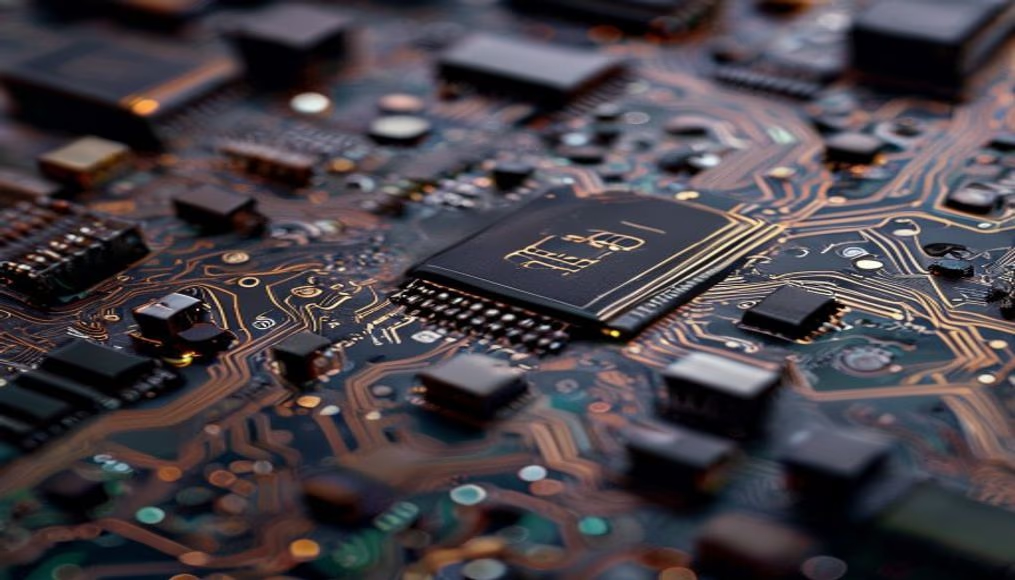
Printed circuit boards are the foundation of modern electronic devices, connecting tiny components on insulating boards.
About this subject
A printed circuit board, or PCB, is a structure that supports and electrically connects electronic components using conductive tracks etched from copper sheets laminated onto a non-conductive substrate. Typically made of fiberglass-reinforced epoxy resin (FR-4), PCBs undergo photolithography and etching to create the circuit pattern. Invented by Austrian Paul Eisler in 1936, PCB technology revolutionized electronics by enabling mass production and miniaturization of devices.
PCBs are foundational to modern electronics: without them, smartphones, computers, medical devices, and virtually all compact electronic equipment would not exist. Modern boards can have multiple layers, some exceeding 50, connected by plated through-holes, optimizing space and performance. The global PCB industry is worth billions annually, with China as the leading manufacturer.
Notably, early PCBs were made of Bakelite and used in radios. Today, materials like FR-4 (flame retardant) and polyimide support high frequencies and temperatures. Surface-mount technology (SMT) has replaced through-hole assembly, enabling denser circuits. PCB design is a specialized field combining electrical, thermal, and mechanical engineering, with CAD software like Eagle and Altium dominating the market.
Frequently Asked Questions
What is the difference between a PCB and a motherboard?
A motherboard is a specific type of PCB that serves as the main board in a computer, connecting the CPU, memory, and peripherals. All motherboards are PCBs, but not all PCBs are motherboards; there are PCBs for phones, remote controls, etc.
How is the circuit pattern etched onto the board?
The most common method is photolithography: a photosensitive layer is applied over copper, exposed to UV light through a film with the circuit design, and developed. Then, acid etches away the unprotected copper, leaving only the desired traces.
What does FR-4 stand for?
FR-4 stands for Flame Retardant 4, a composite material of woven fiberglass cloth with an epoxy resin binder. It is the most common PCB substrate due to its mechanical strength, electrical insulation, and flame-retardant properties.
Direct URL
https://pub-c7d6a6ea828543ac903a74a341ccb2e1.r2.dev/imagens/circuit-board-macro-photography-street-photography-v11.avifHow to credit
Include a visible link back to UtilizAí. Copy one of the snippets below:
<a href="https://xn--utiliza-eza.com/en/midia/imagens/circuit-board-macro-photography-street-photography-v11">Circuit board macro photography</a> by <a href="https://xn--utiliza-eza.com">UtilizAí</a>, licensed under <a href="https://creativecommons.org/licenses/by/4.0/">CC BY 4.0</a>.
[Circuit board macro photography](https://xn--utiliza-eza.com/en/midia/imagens/circuit-board-macro-photography-street-photography-v11) by [UtilizAí](https://xn--utiliza-eza.com), CC BY 4.0
License: CC-BY-4.0