Jellyfish glowing in dark
1344×768 · AVIF · CC BY 4.0
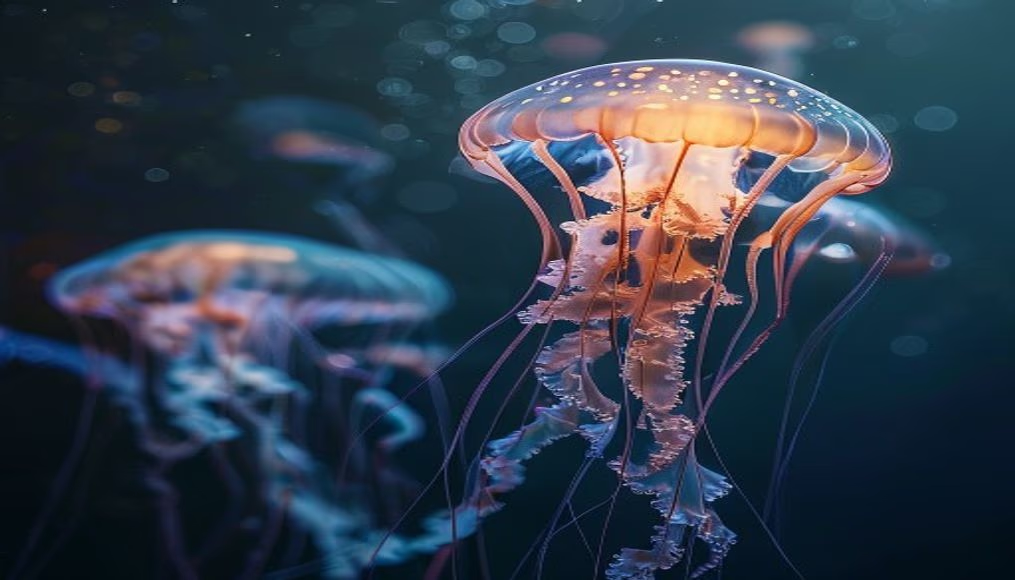
Bioluminescent jellyfish produce their own light through proteins like GFP, found in oceans worldwide, notably the species Aequorea victoria.
About this subject
Bioluminescent jellyfish are among the most captivating phenomena in the ocean. Their ability to produce light, known as bioluminescence, results from chemical reactions involving green fluorescent protein (GFP) and an enzyme called aequorin. The most studied species, Aequorea victoria, is native to the cold waters of the Pacific coast of North America, from Puget Sound to California. This jellyfish, 5 to 10 cm in diameter, has a transparent bell and fine tentacles that glow green when disturbed.
Bioluminescence serves crucial survival functions: attracting prey, confusing predators, or communication. The glow can act as an alarm, warning other organisms of nearby dangers. Moreover, the discovery of GFP revolutionized molecular biology. Isolated in the 1960s, this protein is now widely used as a genetic marker in cancer research, neuroscience, and developmental biology.
These jellyfish inhabit depths from the surface to the deep sea, with population peaks in summer and fall. Aequorea victoria is common in Puget Sound and along the California coast. Climate change and marine pollution threaten their habitats. Warming waters may shift species distribution and reduce populations, impacting ecosystems and scientific research.
Not all jellyfish glow; an estimated 50% of cnidarian species exhibit bioluminescence, with varying intensity and color. Besides Aequorea, others like Pelagia noctiluca ('night-light') emit blue flashes. Ongoing study of these organisms continues to reveal new luminescence mechanisms, with potential applications in biotechnology and medicine.
Frequently Asked Questions
Why do jellyfish glow in the dark?
They glow through bioluminescence, a chemical reaction producing light. It helps attract prey, deter predators, or communicate.
What is the significance of GFP (green fluorescent protein) for science?
GFP is used as a genetic marker to visualize cellular processes. Its discovery won the 2008 Nobel Prize in Chemistry and revolutionized biomedical research.
Where can bioluminescent jellyfish be found?
They are found in oceans worldwide, especially cold waters. Aequorea victoria is common off the west coast of the US and Canada.
Direct URL
https://pub-c7d6a6ea828543ac903a74a341ccb2e1.r2.dev/imagens/jellyfish-glowing-in-dark-commercial-product-photography-v9.avifHow to credit
Include a visible link back to UtilizAí. Copy one of the snippets below:
<a href="https://xn--utiliza-eza.com/en/midia/imagens/jellyfish-glowing-in-dark-commercial-product-photography-v9">Jellyfish glowing in dark</a> by <a href="https://xn--utiliza-eza.com">UtilizAí</a>, licensed under <a href="https://creativecommons.org/licenses/by/4.0/">CC BY 4.0</a>.
[Jellyfish glowing in dark](https://xn--utiliza-eza.com/en/midia/imagens/jellyfish-glowing-in-dark-commercial-product-photography-v9) by [UtilizAí](https://xn--utiliza-eza.com), CC BY 4.0
License: CC-BY-4.0