Enzyme catalysis 3d
1344×768 · AVIF · CC BY 4.0
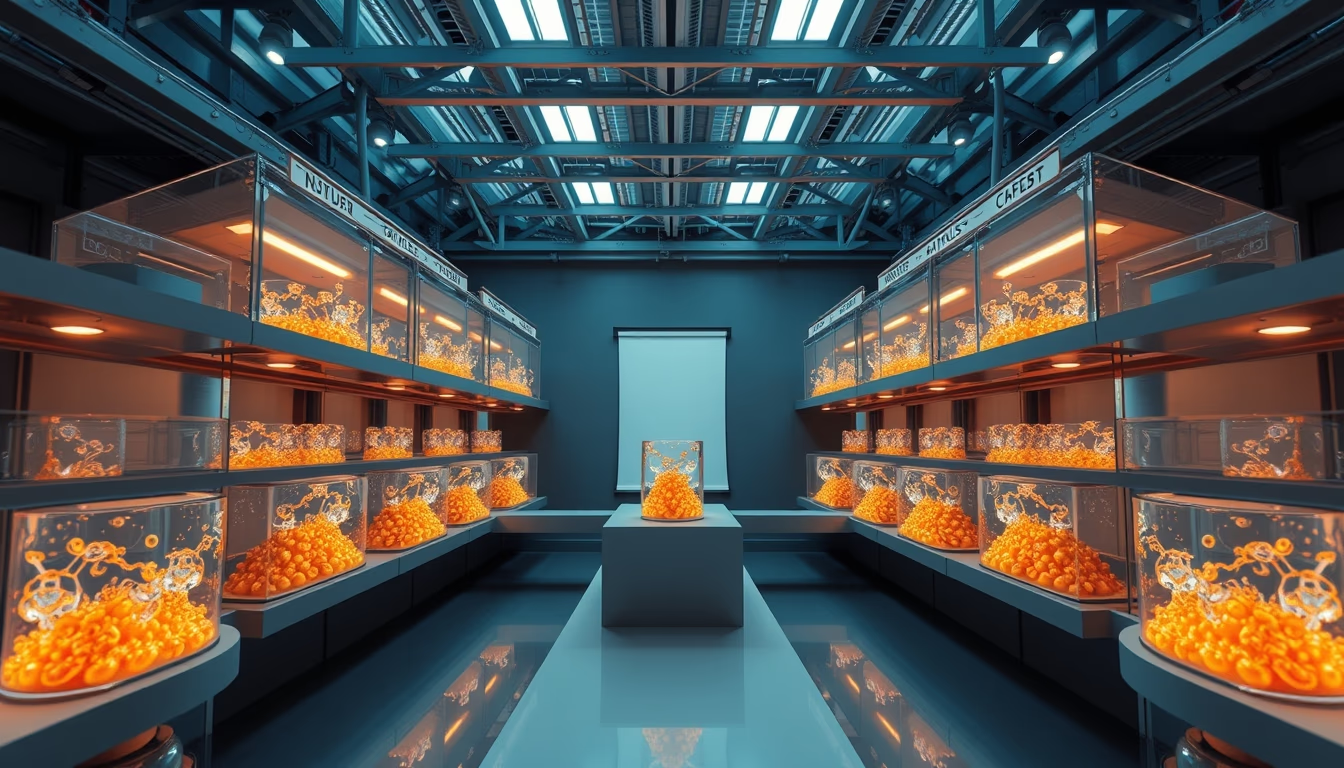
Enzyme catalysis accelerates vital chemical reactions for life, with enzymes acting as highly specific and efficient biocatalysts.
About this subject
Enzymes are proteins that act as biological catalysts, lowering the activation energy required for chemical reactions to occur under physiological conditions. Each enzyme has an active site where the substrate binds, forming an enzyme-substrate complex. This molecular recognition can follow the lock-and-key model, proposed by Emil Fischer in 1894, or the induced fit model, suggested by Daniel Koshland in 1958. In the former, the active site is complementary in shape to the substrate; in the latter, substrate binding induces a conformational change in the enzyme to optimize catalysis.
Enzyme efficiency is remarkable: some enzymes can process thousands of substrate molecules per second. Carbonic anhydrase, for example, catalyzes the conversion of carbon dioxide to carbonic acid at a rate of up to 10^6 reactions per second. Factors such as temperature, pH, substrate concentration, and the presence of inhibitors or activators modulate enzyme activity. Enzymes are essential for processes like digestion, DNA replication, and cellular metabolism.
The first enzyme discovered was diastase, isolated by Anselme Payen and Jean-François Persoz in 1833 from malt. Since then, thousands of enzymes have been identified and classified by the International Union of Biochemistry and Molecular Biology (IUBMB) into six main classes: oxidoreductases, transferases, hydrolases, lyases, isomerases, and ligases. In industry, enzymes are used in food production, detergents, biofuels, and pharmaceuticals. Enzyme engineering allows modifications to increase stability and activity under non-natural conditions.
A curious fact is that some enzymes require cofactors, such as metal ions (zinc, magnesium) or organic molecules (coenzymes derived from vitamins), for catalytic activity. Ribozymes, RNA molecules with catalytic activity, challenge the idea that only proteins act as enzymes. Understanding enzyme catalysis also underpins the development of enzyme inhibitors used as drugs, exemplified by protease inhibitors in HIV treatment.
Frequently Asked Questions
How do enzymes accelerate chemical reactions?
Enzymes lower the activation energy of the reaction by stabilizing the transition state. They bind to the substrate at the active site and provide a favorable environment for conversion to product, without being consumed.
What factors affect enzyme activity?
Temperature, pH, substrate and enzyme concentration, and the presence of inhibitors or activators. Each enzyme has an optimal pH and temperature; deviations can denature it or reduce efficiency.
What is the difference between lock-and-key and induced fit models?
In the lock-and-key model, the active site is rigid and complementary to the substrate. In induced fit, the flexible enzyme changes conformation upon substrate binding, improving fit and catalysis.
Direct URL
https://pub-c7d6a6ea828543ac903a74a341ccb2e1.r2.dev/imagens/enzyme-catalysis-3d-architectural-photography-p3.avifHow to credit
Include a visible link back to UtilizAí. Copy one of the snippets below:
<a href="https://xn--utiliza-eza.com/en/midia/imagens/enzyme-catalysis-3d-architectural-photography-p3">Enzyme catalysis 3d</a> by <a href="https://xn--utiliza-eza.com">UtilizAí</a>, licensed under <a href="https://creativecommons.org/licenses/by/4.0/">CC BY 4.0</a>.
[Enzyme catalysis 3d](https://xn--utiliza-eza.com/en/midia/imagens/enzyme-catalysis-3d-architectural-photography-p3) by [UtilizAí](https://xn--utiliza-eza.com), CC BY 4.0
License: CC-BY-4.0