Cipher disk cryptography
1344×768 · AVIF · CC BY 4.0
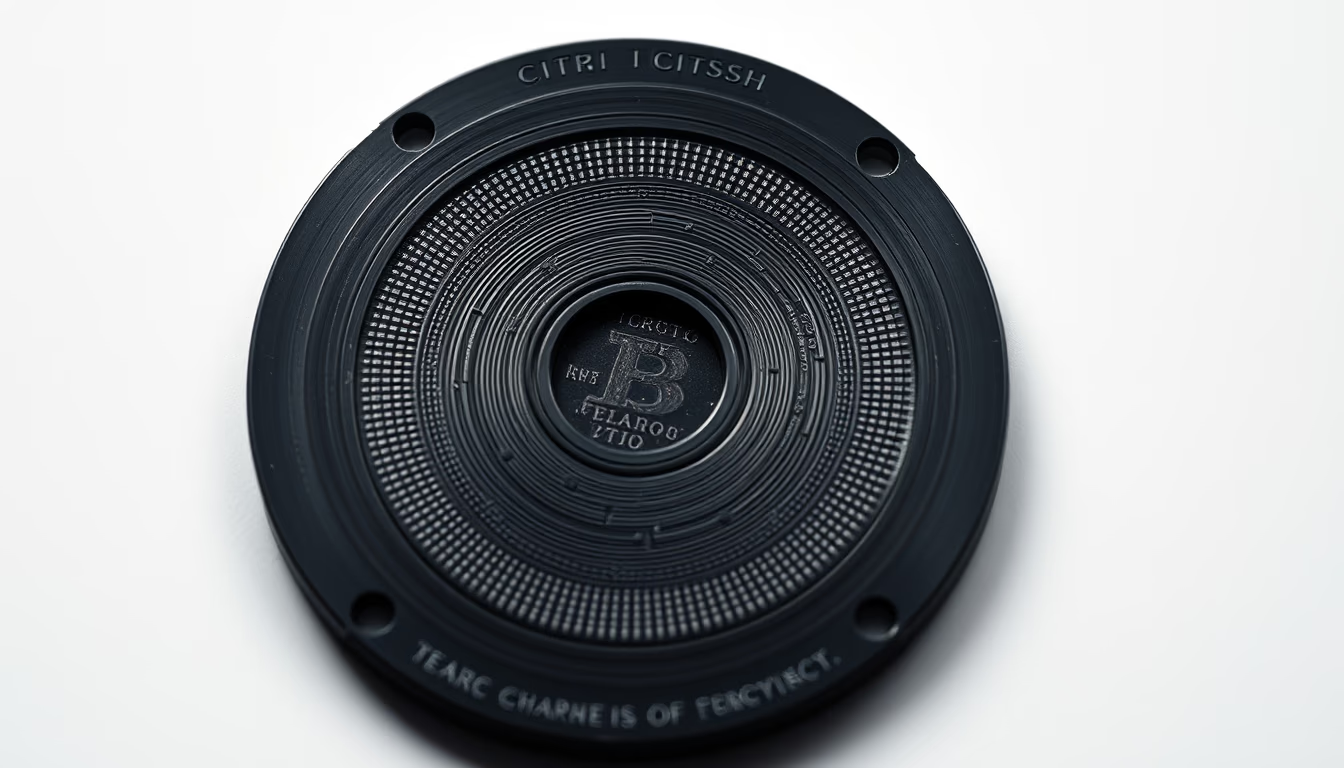
The cipher disk, a mechanical encryption device used to encode secret messages, dates back to the 15th century and was essential for military and diplomatic communications.
About this subject
The cipher disk, also known as a cipher wheel or crypto wheel, is a mechanical encryption device that enables polyalphabetic substitution of characters. Its earliest conception is attributed to Leon Battista Alberti in 1467, who created a rotating disk with scrambled alphabets, allowing for more secure encoding than simple monoalphabetic substitution ciphers. The basic principle consists of two concentric disks: a fixed outer disk (with letters in natural order) and a rotating inner disk (with shuffled letters). By aligning a letter from the inner disk with one from the outer disk, a cipher key is defined, which can be changed mid-message, making cryptanalysis more difficult.
During the Renaissance, Alberti, an Italian humanist and architect, described his disk in a treatise on cryptography, laying the groundwork for polyalphabetic cryptography. Later, in the 16th century, Johannes Trithemius and Giovan Battista Bellaso developed variations of the concept, but it was the French diplomat Blaise de Vigenère who popularized a method that, although erroneously named after him (Vigenère cipher), actually used a table, not a disk. The cipher disk nonetheless continued to be used for centuries, especially in military and diplomatic contexts, such as the American Civil War and World War I, due to its simplicity of operation and portability.
One of the most famous applications of the cipher disk principle was in the Enigma encryption device used by Nazi Germany during World War II. Although Enigma was electromechanical and more complex, the principle of rotating rotors that change the cipher with each letter has direct roots in Alberti's disk. Today, cipher disks are used in educational and recreational activities, such as escape rooms and espionage games, and are collector's items. The simplicity of the mechanism allows understanding of fundamental cryptographic concepts like key, cipher, and frequency analysis without computers.
The cipher disk is also a symbol of the struggle between coders and decoders, a recurring theme in the history of intelligence and security. With the advent of digital cryptography, the use of physical disks diminished, but they remain important historical milestones in the evolution of secret communication. Studying these devices helps understand how humanity has always sought to protect sensitive information, from military secrets to personal correspondence.
Frequently Asked Questions
Who invented the cipher disk?
The cipher disk was invented by Italian humanist and architect Leon Battista Alberti in 1467, being the first known polyalphabetic encryption device.
How does a cipher disk work?
It consists of two concentric disks: a fixed outer disk with letters and a rotating inner disk. By aligning a letter from the inner disk with one on the outer, a cipher key is set; this alignment can be changed during the message.
What is the historical importance of the cipher disk?
It was a precursor to devices like the Enigma machine and influenced modern cryptography. Used in wars and diplomacy, it demonstrates the evolution of secret communication techniques.
Direct URL
https://pub-c7d6a6ea828543ac903a74a341ccb2e1.r2.dev/imagens/cipher-disk-cryptography-fine-art-photography-fresh11.avifHow to credit
Include a visible link back to UtilizAí. Copy one of the snippets below:
<a href="https://xn--utiliza-eza.com/en/midia/imagens/cipher-disk-cryptography-fine-art-photography-fresh11">Cipher disk cryptography</a> by <a href="https://xn--utiliza-eza.com">UtilizAí</a>, licensed under <a href="https://creativecommons.org/licenses/by/4.0/">CC BY 4.0</a>.
[Cipher disk cryptography](https://xn--utiliza-eza.com/en/midia/imagens/cipher-disk-cryptography-fine-art-photography-fresh11) by [UtilizAí](https://xn--utiliza-eza.com), CC BY 4.0
License: CC-BY-4.0