Barcode scanner at checkout
1344×768 · AVIF · CC BY 4.0

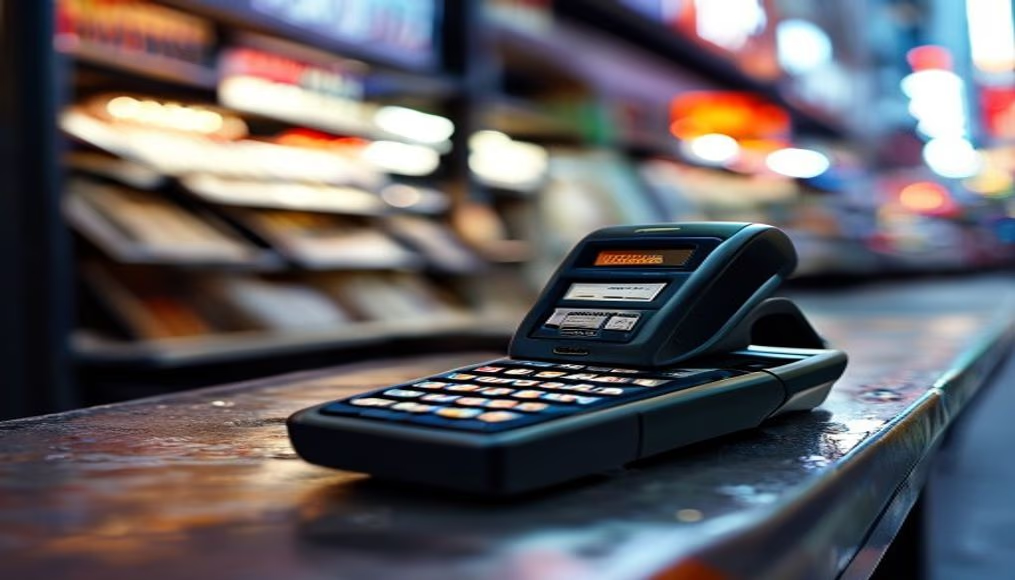
Barcode scanner at supermarket checkout, an essential tool that revolutionized retail and streamlines daily shopping.
About this subject
The barcode scanner is an optical device that captures and decodes product information through parallel lines of varying thickness. Popularized from the 1970s, the linear barcode (UPC) was created by Norman Woodland and Bernard Silver in the United States, inspired by Morse code. In Brazil, mass adoption occurred in the 1980s and 1990s, driven by retail modernization and the need for inventory control. Currently, over 5 billion barcodes are scanned daily worldwide, according to GS1, the organization responsible for global standards.
At the checkout, the laser or image scanner reads the code and sends data to the point-of-sale (POS) system, which queries the price in real time. This process drastically reduced service time: while a manual operator took about 30 seconds to register an item, with the scanner this time drops to less than 3 seconds. Additionally, reading accuracy eliminates typing errors, ensuring the customer pays the exact correct amount.
The technology has evolved beyond retail. Two-dimensional codes like the QR Code, created in Japan in 1994, allow storing more information and are used in mobile payments, parcel tracking, and even vaccination. However, the classic linear barcode still dominates Brazilian supermarkets, especially for grocery and hygiene products, due to its simplicity and low printing cost.
Curiosity: the first commercial item scanned was a pack of Wrigley's Juicy Fruit gum on June 26, 1974, at a supermarket in Ohio. Since then, the barcode scanner has become a symbol of retail efficiency, present in over 80% of commercial establishments in Brazil.
Frequently Asked Questions
How does a barcode scanner work?
The scanner emits a beam of light (laser or LED) that reflects off the light and dark lines of the barcode. A sensor captures the reflection and converts the pattern into electrical signals, which are decoded by the system to identify the product and its price.
What is the difference between a linear barcode and a QR Code?
The linear barcode stores data only horizontally, with limited capacity (about 20 characters). The QR Code is two-dimensional, stores up to 7,000 characters, and can contain links, text, and numbers, being read by smartphone cameras.
Where was the first barcode scanner used?
The first commercial use was on June 26, 1974, at the Marsh supermarket in Troy, Ohio, USA. The scanned item was a pack of Wrigley's Juicy Fruit gum, which is now on display at the Smithsonian Institution.
Direct URL
https://pub-c7d6a6ea828543ac903a74a341ccb2e1.r2.dev/imagens/barcode-scanner-at-checkout-studio-editorial-portrait.avifHow to credit
Include a visible link back to UtilizAí. Copy one of the snippets below:
<a href="https://xn--utiliza-eza.com/en/midia/imagens/barcode-scanner-at-checkout-studio-editorial-portrait">Barcode scanner at checkout</a> by <a href="https://xn--utiliza-eza.com">UtilizAí</a>, licensed under <a href="https://creativecommons.org/licenses/by/4.0/">CC BY 4.0</a>.
[Barcode scanner at checkout](https://xn--utiliza-eza.com/en/midia/imagens/barcode-scanner-at-checkout-studio-editorial-portrait) by [UtilizAí](https://xn--utiliza-eza.com), CC BY 4.0
License: CC-BY-4.0