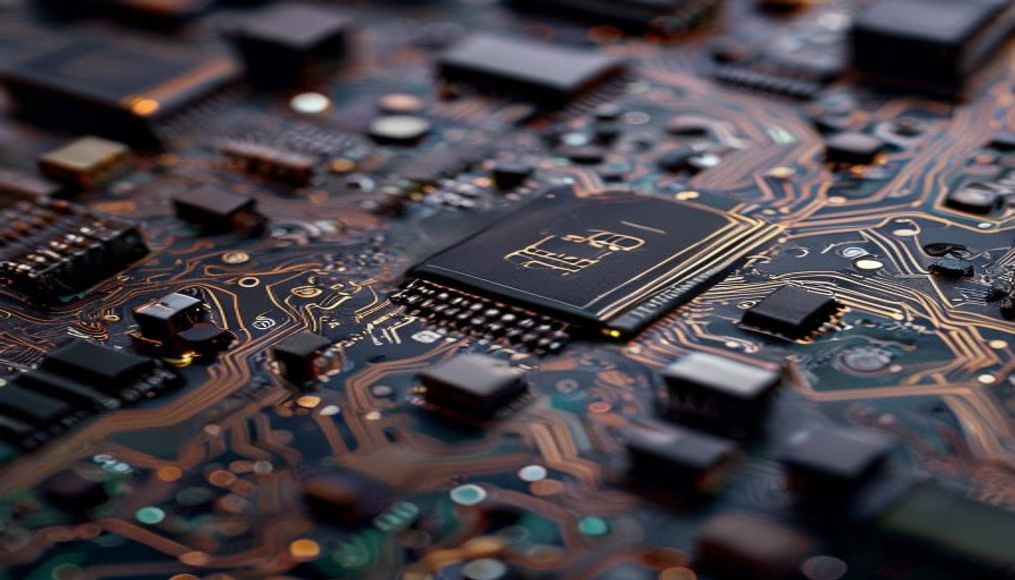
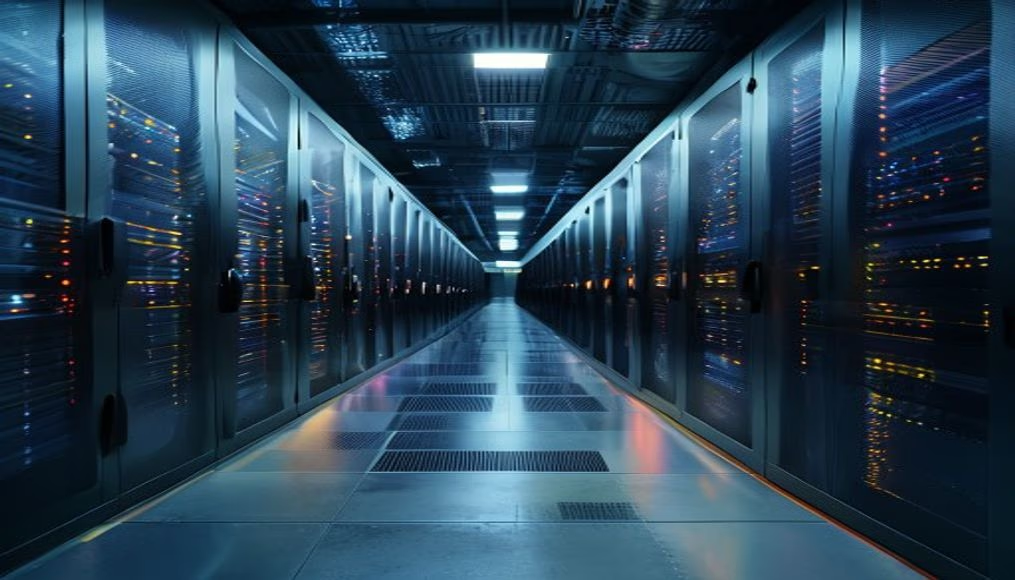
AI engineer training neural network on workstation
1344×768 · AVIF · CC BY 4.0

AI engineer trains neural network on a workstation during a morning development routine.
About this subject
Training neural networks is a central step in developing artificial intelligence systems. In this process, AI engineers use workstations equipped with high-performance GPUs to adjust model parameters from large volumes of data. A typical morning routine for an engineer includes checking training progress, analyzing loss curves, and tuning hyperparameters such as learning rate and batch size. This activity requires deep knowledge of frameworks like TensorFlow, PyTorch, and Keras, as well as hardware optimization skills.
Choosing morning hours for these tasks is not random. Many engineers prefer to run long training sessions overnight and review results in the morning, maximizing computational time. In corporate environments, workstations are configured with advanced cooling systems and robust power supplies to handle intensive loads for hours or days. Remote monitoring via SSH or web interfaces is also common, allowing engineers to track progress from anywhere.
Training neural networks involves challenges like overfitting, vanishing gradients, and data balancing. Techniques such as regularization, dropout, and batch normalization are applied to improve model generalization. Additionally, dataset curation is crucial: noisy or imbalanced data can compromise network performance. Experienced engineers dedicate significant time to preprocessing and data augmentation.
The field of AI evolves rapidly, with new architectures proposed constantly. From convolutional networks for computer vision to transformers for natural language processing, each network type requires specific training strategies. Hyperparameter optimization, often automated with tools like Optuna or Hyperopt, can drastically reduce development time. Despite advances, training neural networks remains an art combining science, intuition, and practice.
Frequently Asked Questions
What are the main frameworks used to train neural networks?
The main frameworks are TensorFlow, PyTorch, and Keras. TensorFlow is widely used in production, PyTorch is popular in research, and Keras provides a high-level API for rapid prototyping.
How long does it take to train a neural network?
Time varies from minutes to weeks, depending on network complexity, dataset size, and hardware. Simple networks on modern GPUs may take hours, while large models like GPT-3 can take months.
What is overfitting and how to avoid it during training?
Overfitting occurs when the model memorizes training data but fails to generalize to new data. To avoid it, use regularization (L1/L2), dropout, early stopping, and data augmentation.
Direct URL
https://pub-c7d6a6ea828543ac903a74a341ccb2e1.r2.dev/imagens/ai-engineer-training-neural-network-on-workstation-documentary-morning-5.avifHow to credit
Include a visible link back to UtilizAí. Copy one of the snippets below:
<a href="https://xn--utiliza-eza.com/en/midia/imagens/ai-engineer-training-neural-network-on-workstation-documentary-morning-5">AI engineer training neural network on workstation</a> by <a href="https://xn--utiliza-eza.com">UtilizAí</a>, licensed under <a href="https://creativecommons.org/licenses/by/4.0/">CC BY 4.0</a>.
[AI engineer training neural network on workstation](https://xn--utiliza-eza.com/en/midia/imagens/ai-engineer-training-neural-network-on-workstation-documentary-morning-5) by [UtilizAí](https://xn--utiliza-eza.com), CC BY 4.0
License: CC-BY-4.0