Snow capped mountain peak sunrise
1344×768 · AVIF · CC BY 4.0
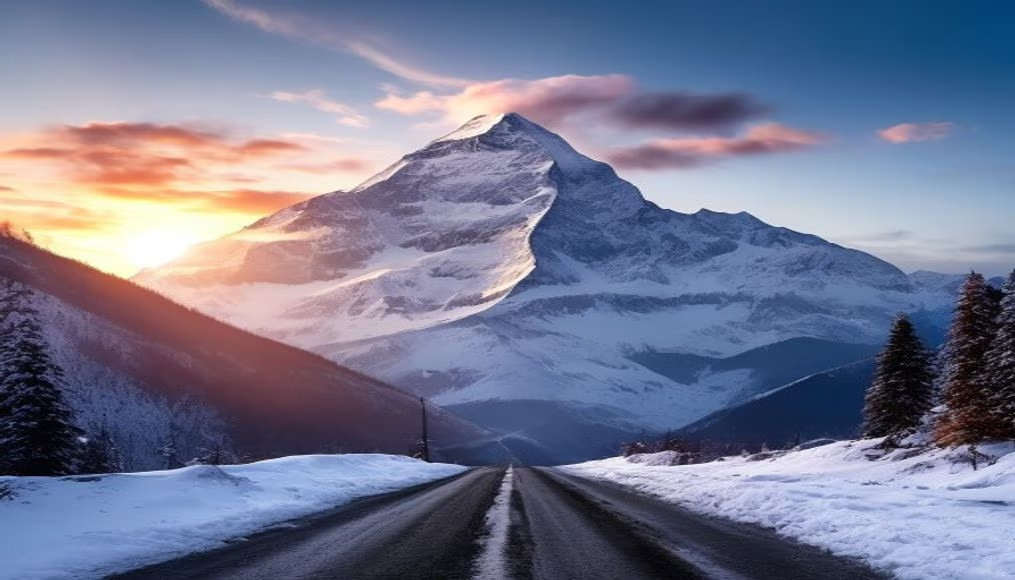
Snow-capped peaks bathed in dawn light create one of the planet's most imposing natural spectacles, blending geology, climate, and photography.
About this subject
Snow-capped mountain peaks are geological formations found in high-altitude or high-latitude regions, where temperatures remain below freezing for most of the year. Snow accumulates over seasons, forming glacial caps that intensely reflect sunlight. During sunrise, light hits at shallow angles, creating a color gradient from orange to pink on east-facing slopes while west-facing slopes remain in blue shadow.
Famous mountain ranges with snow-capped peaks include the Andes, the Alps, the Himalayas, and the North American Cordillera. In Brazil, the highest peaks such as Pico da Neblina (2,995 m) and Pico Maior de Friburgo occasionally experience snow during extreme weather events, but permanent snow only occurs at much higher altitudes typical of polar or high tropical mountains.
Culturally, snow-capped mountains symbolize purity, challenge, and transcendence in various traditions, such as Mount Kailash in Tibet or Mount Fuji in Japan. The sunrise phenomenon on snowy peaks attracts climbers, photographers, and tourists worldwide. Landscape photography in this context requires planning: knowing the sun's position, weather conditions, and correct exposure to capture snow details without burning highlights.
Interestingly, snow on peaks is not just frozen ice; each flake has a unique crystalline structure that refracts light. When the sun is low, light passes through a thicker atmospheric layer, filtering blue wavelengths and leaving reddish tones, a phenomenon known as Rayleigh scattering. This explains the characteristic coloration of dawn on mountains.
Frequently Asked Questions
Why do snow-capped peaks appear pink at sunrise?
This happens due to Rayleigh scattering: sunlight travels through a thicker atmospheric layer during dawn, filtering blue wavelengths and letting orange and red tones pass, illuminating the east-facing slopes of the mountains.
Are there mountains with permanent snow in Brazil?
No, Brazil has no permanent snow. The highest point, Pico da Neblina (2,995 m), may receive sporadic snow during extreme cold waves, but the tropical climate prevents perennial snow accumulation.
What is the minimum altitude for permanent snow in tropical regions?
In tropical regions, the permanent snow line typically starts above 4,500 to 5,000 meters, depending on latitude and local climate conditions. In the equatorial Andes, for example, eternal snow occurs above 4,800 m.
Direct URL
https://pub-c7d6a6ea828543ac903a74a341ccb2e1.r2.dev/imagens/snow-capped-mountain-peak-sunrise-street-photography-v11.avifHow to credit
Include a visible link back to UtilizAí. Copy one of the snippets below:
<a href="https://xn--utiliza-eza.com/en/midia/imagens/snow-capped-mountain-peak-sunrise-street-photography-v11">Snow capped mountain peak sunrise</a> by <a href="https://xn--utiliza-eza.com">UtilizAí</a>, licensed under <a href="https://creativecommons.org/licenses/by/4.0/">CC BY 4.0</a>.
[Snow capped mountain peak sunrise](https://xn--utiliza-eza.com/en/midia/imagens/snow-capped-mountain-peak-sunrise-street-photography-v11) by [UtilizAí](https://xn--utiliza-eza.com), CC BY 4.0
License: CC-BY-4.0