Amazon river meandering aerial
1344×768 · AVIF · CC BY 4.0
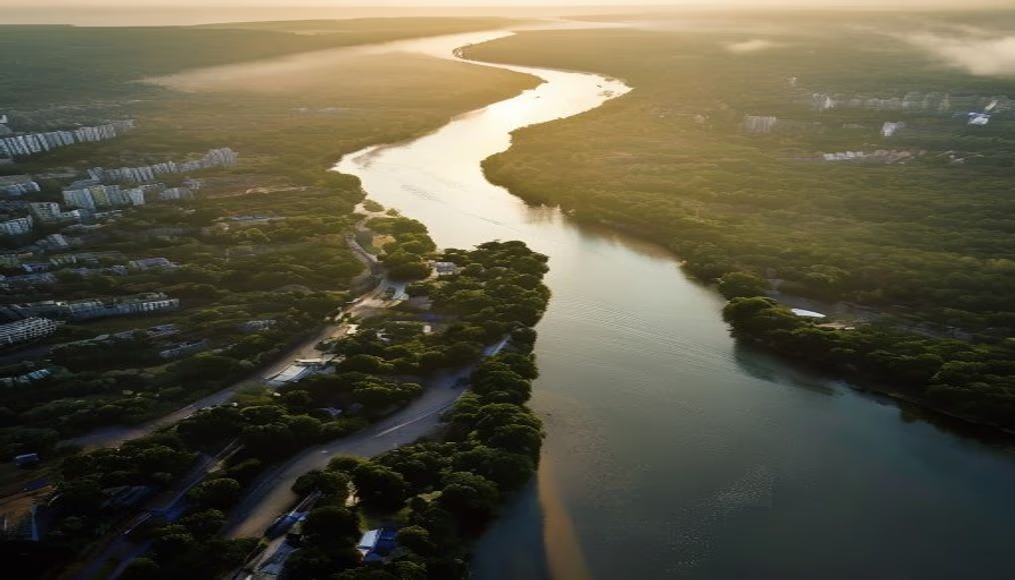
The Amazon River meanders through the world's largest tropical rainforest, forming bends that reveal the dynamics of one of the longest and most voluminous rivers on Earth.
About this subject
The Amazon River, approximately 6,400 km long, is the second longest river in the world but the largest by discharge, releasing about 209,000 cubic meters per second into the Atlantic Ocean. Its watershed spans over 7 million km², covering parts of Brazil, Peru, Colombia, Ecuador, Bolivia, Venezuela, Guyana, and Suriname. The meanders are a hallmark of the river's middle and lower course, where flat topography allows the flow to create sinuous bends. These curves form through erosion on the outer banks and sediment deposition on the inner banks, a continuous process that can isolate sections into oxbow lakes, known locally as 'lagos de meandro'.
The Amazon's ecological significance is immense. The basin hosts the highest biodiversity on Earth, with thousands of fish species, amphibians, reptiles, birds, and mammals adapted to the turbid waters and floodplain forests. The river also plays a crucial role in the global hydrological cycle. Moisture evapotranspired by the forest is carried by air currents, influencing rainfall across central-western and southeastern South America. This phenomenon is known as 'flying rivers'.
Culturally and economically, the Amazon is vital for riverside and indigenous communities, who depend on it for transportation, food, and livelihood. Remarkably, no bridge crosses the Amazon along its main stem. The average width varies from 1.6 km in the dry season to over 50 km during floods, making any fixed crossing impractical. The meanders seen from above are a visual testament to the power and resilience of this aquatic giant.
Frequently Asked Questions
Why does the Amazon River have so many meanders?
Meanders form due to the low gradient of the terrain and high water discharge, which erode outer banks and deposit sediment on inner banks, creating sinuous curves along the floodplain.
What is the ecological importance of the Amazon River?
The river and its basin host the highest biodiversity on Earth, with thousands of species. Additionally, evapotranspiration from the forest influences rainfall across much of South America, a phenomenon known as 'flying rivers'.
Is there a bridge over the Amazon River?
No. The variable width (from 1.6 km in the dry season to over 50 km in the wet season) and unstable banks prevent bridge construction. Crossing is done by ferry or boat.
Direct URL
https://pub-c7d6a6ea828543ac903a74a341ccb2e1.r2.dev/imagens/amazon-river-meandering-aerial-street-photography-v11.avifHow to credit
Include a visible link back to UtilizAí. Copy one of the snippets below:
<a href="https://xn--utiliza-eza.com/en/midia/imagens/amazon-river-meandering-aerial-street-photography-v11">Amazon river meandering aerial</a> by <a href="https://xn--utiliza-eza.com">UtilizAí</a>, licensed under <a href="https://creativecommons.org/licenses/by/4.0/">CC BY 4.0</a>.
[Amazon river meandering aerial](https://xn--utiliza-eza.com/en/midia/imagens/amazon-river-meandering-aerial-street-photography-v11) by [UtilizAí](https://xn--utiliza-eza.com), CC BY 4.0
License: CC-BY-4.0