Machu picchu ruins morning mist
1344×768 · AVIF · CC BY 4.0
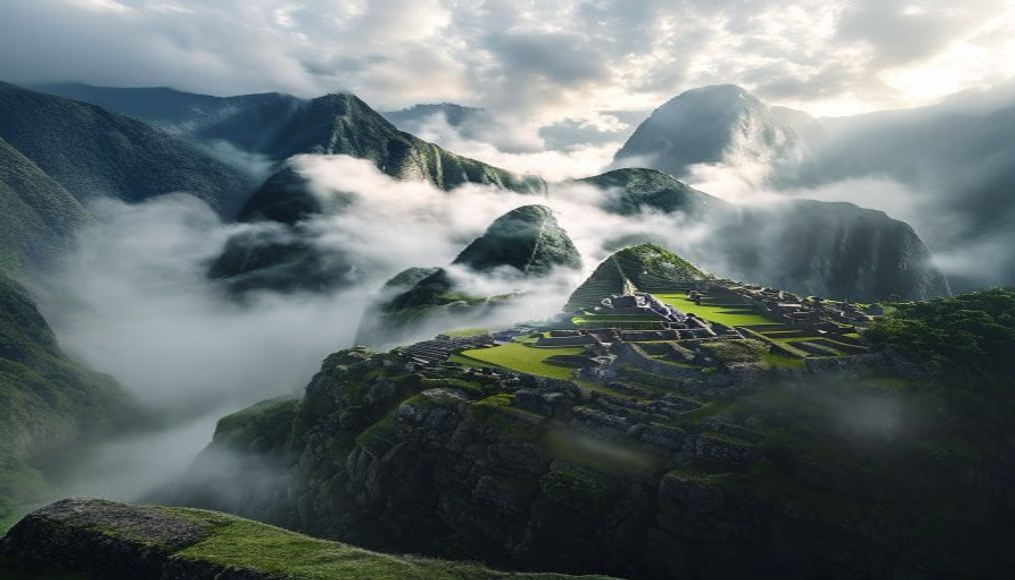
Machu Picchu, the lost city of the Incas, emerges from morning clouds in the Peruvian Andes, showcasing its ancient engineering.
About this subject
Machu Picchu is situated at 2,430 meters above sea level, atop a mountain in the Peruvian Andes, in the Cusco region. Built around 1450 at the height of the Inca Empire, it was abandoned about 100 years later, possibly due to the Spanish conquest. It remained unknown to the Western world until 1911, when explorer Hiram Bingham rediscovered it.
The city was designed as a religious sanctuary and administrative center, with granite buildings perfectly fitted without mortar. Its agricultural terraces prevented erosion and ensured supply. The Intihuatana, a stone sundial, demonstrates the Incas' advanced astronomical knowledge.
Recognized as a UNESCO World Heritage Site since 1983 and one of the New Seven Wonders of the World, Machu Picchu attracts millions of visitors annually. Preservation faces challenges with mass tourism, leading to entry restrictions. Morning mist is a common phenomenon, creating a mystical atmosphere that enhances the landscape.
Interestingly, the remote location and dense vegetation protected the site from looting. Recent studies suggest Machu Picchu was intentionally built on geological faults to improve drainage and seismic stability. The city was never found by the Spanish, explaining its excellent conservation.
Frequently Asked Questions
How was Machu Picchu built?
The granite stones were precisely cut using bronze and stone tools, fitted perfectly without mortar. The blocks have protrusions that interlock like puzzle pieces, withstanding earthquakes.
What was the function of Machu Picchu?
It is believed to have been a royal palace and religious sanctuary for Emperor Pachacuti. It also served as an administrative center, with residential areas, temples, and agricultural terraces.
Why is Machu Picchu called the Lost City?
After Inca abandonment, the jungle covered it for centuries. It remained unknown to the outside world until rediscovery by Hiram Bingham in 1911, hence the name 'Lost City'.
Direct URL
https://pub-c7d6a6ea828543ac903a74a341ccb2e1.r2.dev/imagens/machu-picchu-ruins-morning-mist-street-photography-v11.avifHow to credit
Include a visible link back to UtilizAí. Copy one of the snippets below:
<a href="https://xn--utiliza-eza.com/en/midia/imagens/machu-picchu-ruins-morning-mist-street-photography-v11">Machu picchu ruins morning mist</a> by <a href="https://xn--utiliza-eza.com">UtilizAí</a>, licensed under <a href="https://creativecommons.org/licenses/by/4.0/">CC BY 4.0</a>.
[Machu picchu ruins morning mist](https://xn--utiliza-eza.com/en/midia/imagens/machu-picchu-ruins-morning-mist-street-photography-v11) by [UtilizAí](https://xn--utiliza-eza.com), CC BY 4.0
License: CC-BY-4.0