Erhu chinese fiddle
1344×768 · AVIF · CC BY 4.0
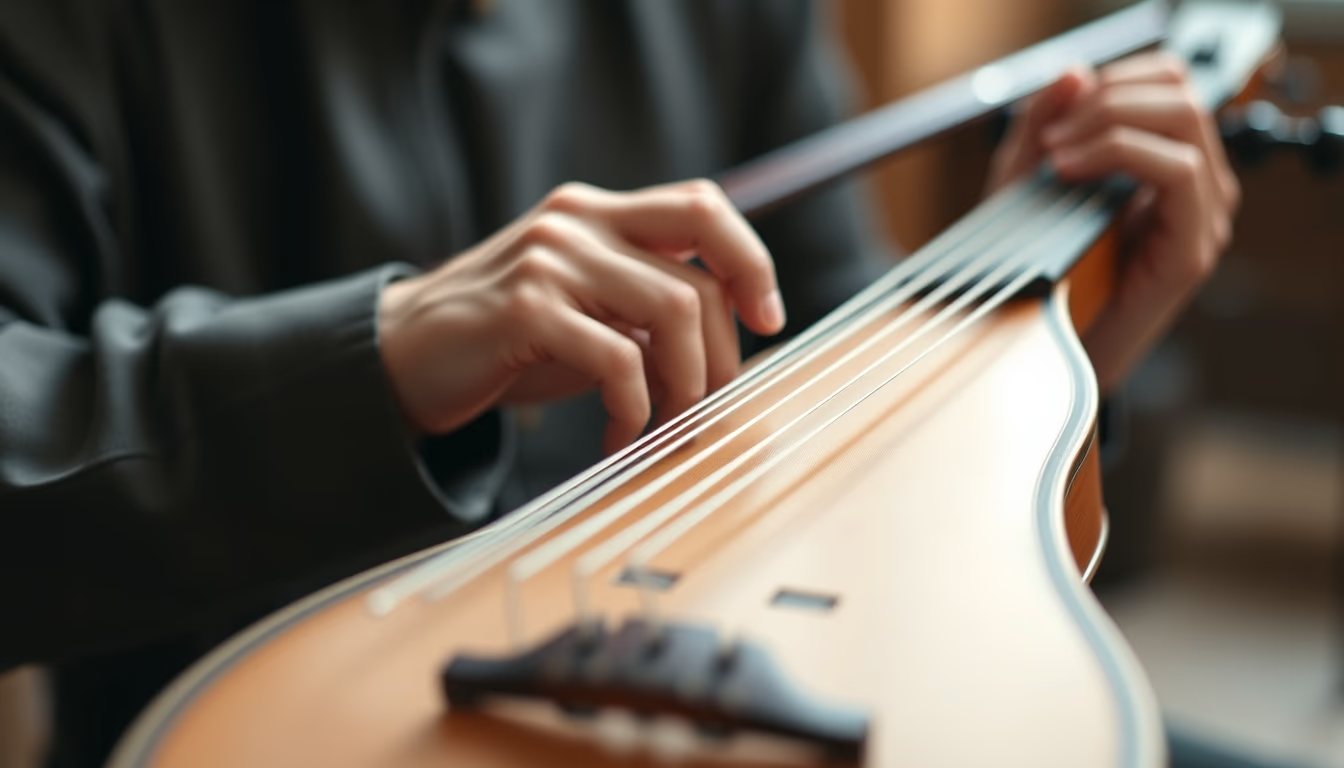
The erhu is a Chinese two-stringed bowed instrument, often called the Chinese violin, known for its melancholic and expressive sound.
About this subject
The erhu, often referred to as the Chinese violin or Chinese two-stringed fiddle, is a bowed string instrument that originated in China. With only two strings, typically tuned a fifth apart (e.g., D5 and A4), its sound is produced by a bow of horsehair that passes between the strings, never touching the wooden neck. The resonating body is made of hardwood and covered with python skin, giving it a nasal, haunting timbre that is highly expressive.
The erhu's history spans over a thousand years, emerging during the Tang dynasty when bowed instruments were introduced from Central Asia. Initially used in court music and traditional opera, such as Peking opera, it evolved into a prominent solo and orchestral instrument in modern Chinese music. Composer Liu Tianhua (1895-1932) greatly expanded its technique and repertoire in the early 20th century, establishing it as a virtuosic instrument.
Playing the erhu requires meticulous skill: the bow is fixed between the strings, and the left hand presses the strings without frets, demanding precise intonation developed through years of training. The instrument is often associated with melancholy, nostalgia, and natural landscapes, frequently used to evoke scenes from Chinese folklore or poetry. Its adaptability allows it to blend with traditional ensembles as well as Western orchestral and contemporary genres.
Today, the erhu has a global presence, with virtuosos like Wang Guohong and Jia Peng Fang performing internationally. Cultural festivals and Chinese music groups showcase it as an icon of China's musical heritage. Traditional craftsmanship uses woods like rosewood or sandalwood, and python skin, though synthetic materials are increasingly used due to conservation concerns. Despite these changes, the erhu's soulful voice remains a cornerstone of Chinese culture.
Frequently Asked Questions
What is the erhu and how is it different from a violin?
The erhu is a Chinese two-stringed bowed instrument, unlike the violin which has four strings. Its bow passes between the strings, and its body is covered with python skin, producing a more nasal and melancholic tone.
What is the historical origin of the erhu?
The erhu originated during the Tang dynasty (7th-9th centuries), evolving from Central Asian bowed instruments. It was used in opera and imperial courts, then gained solo repertoire in the 20th century thanks to Liu Tianhua.
Is the erhu difficult to learn?
Yes, the erhu is considered challenging because it has no frets or fixed fingerboard. The player must develop perfect pitch to play in tune, along with mastering bow technique and characteristic vibrato.
Direct URL
https://pub-c7d6a6ea828543ac903a74a341ccb2e1.r2.dev/imagens/erhu-chinese-fiddle-tilt-shift-miniature-p12.avifHow to credit
Include a visible link back to UtilizAí. Copy one of the snippets below:
<a href="https://xn--utiliza-eza.com/en/midia/imagens/erhu-chinese-fiddle-tilt-shift-miniature-p12">Erhu chinese fiddle</a> by <a href="https://xn--utiliza-eza.com">UtilizAí</a>, licensed under <a href="https://creativecommons.org/licenses/by/4.0/">CC BY 4.0</a>.
[Erhu chinese fiddle](https://xn--utiliza-eza.com/en/midia/imagens/erhu-chinese-fiddle-tilt-shift-miniature-p12) by [UtilizAí](https://xn--utiliza-eza.com), CC BY 4.0
License: CC-BY-4.0