Aurora borealis green sky
1344×768 · AVIF · CC BY 4.0
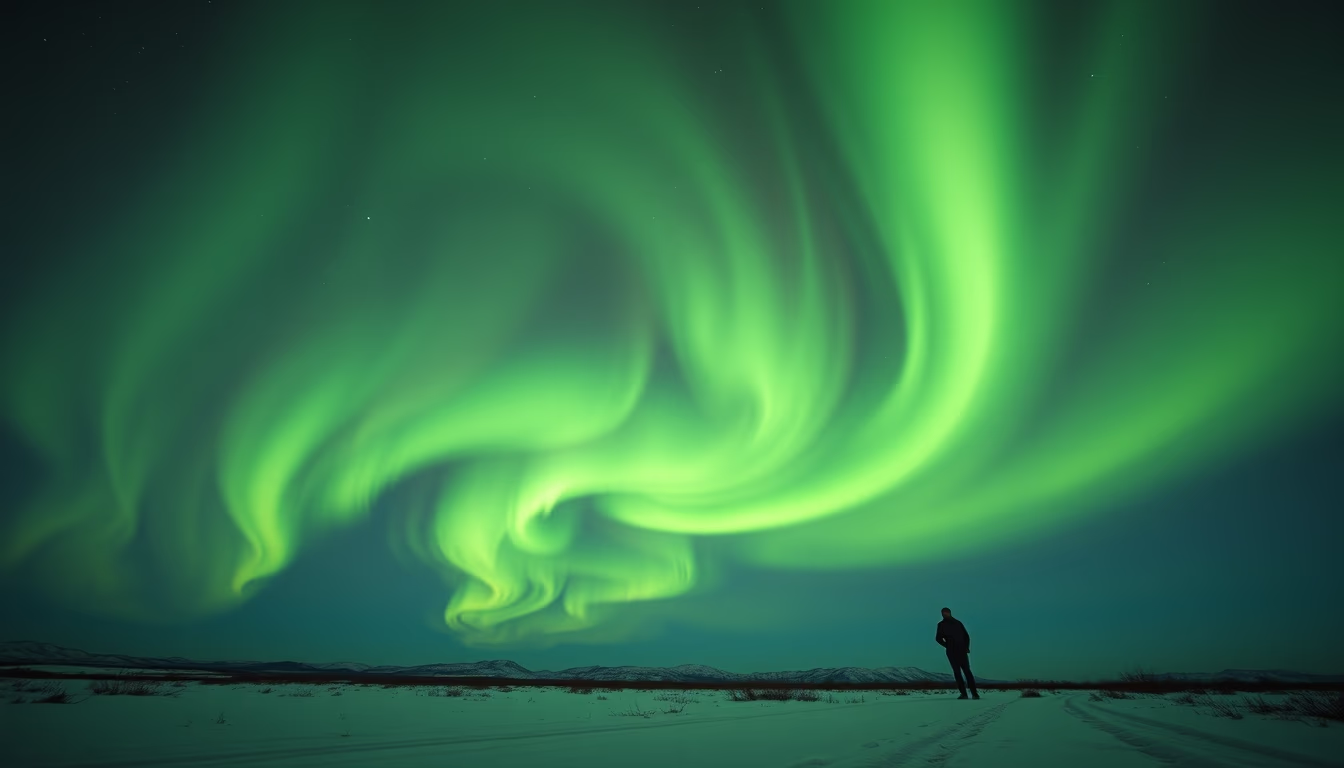
The aurora borealis is a stunning natural phenomenon that turns the night sky into a spectacle of dancing green lights.
About this subject
The aurora borealis, also known as the northern lights, is an optical phenomenon that occurs in the polar regions of the planet. It is caused by the interaction between charged particles from the solar wind and Earth's magnetic field. These particles, upon colliding with atoms and molecules in the upper atmosphere, excite them, causing them to emit light. The green color, the most common, results from the excitation of molecular oxygen at about 100-150 km altitude. Red auroras, rarer, are produced by atomic oxygen at altitudes above 200 km.
The phenomenon is most frequently observed in regions near the Arctic Circle, such as Norway, Sweden, Finland, Iceland, Canada, and Alaska. The ideal viewing season runs from September to March, when nights are longer and darker. Solar activity, which follows an approximately 11-year cycle, directly influences the intensity and frequency of auroras. During solar maximum, the lights can be seen even at lower latitudes, such as the northern United States and Europe.
Culturally, the aurora borealis holds great significance for northern peoples. The Sámi people of Scandinavia believed the lights were the souls of the dead, while the Inuit of Alaska and Canada saw them as spirits playing with a walrus skull ball. In Norse mythology, some believed it was the reflection of the Valkyries' shields. Today, the aurora attracts tourists from around the world, generating a significant travel industry in places like Tromsø, Norway, and Yellowknife, Canada.
To photograph the aurora, specific equipment is needed, such as cameras with good ISO sensitivity and wide-angle lenses. Long exposure, typically between 5 and 30 seconds, captures the movement of the lights. The phenomenon can also be predicted with some advance notice using geomagnetic activity indices, such as the Kp index, which ranges from 0 to 9. The higher the Kp, the greater the chance of seeing auroras at lower latitudes.
Frequently Asked Questions
What is the best time of year to see the aurora borealis?
The best time is from September to March, when nights are longer and darker, especially near the equinox when geomagnetic activity tends to be stronger.
What causes the green color of the aurora borealis?
The green color is caused by the excitation of molecular oxygen at about 100-150 km altitude. When solar particles collide with oxygen, it emits green light.
Can you see the aurora borealis in Brazil?
No, the aurora borealis is only visible in polar regions. Brazil, being near the equator, does not experience the phenomenon. However, in very rare cases of strong solar activity, auroras can be seen at lower latitudes, but still far from Brazil.
Direct URL
https://pub-c7d6a6ea828543ac903a74a341ccb2e1.r2.dev/imagens/aurora-borealis-green-sky-cinematic-wide-shot-v2.avifHow to credit
Include a visible link back to UtilizAí. Copy one of the snippets below:
<a href="https://xn--utiliza-eza.com/en/midia/imagens/aurora-borealis-green-sky-cinematic-wide-shot-v2">Aurora borealis green sky</a> by <a href="https://xn--utiliza-eza.com">UtilizAí</a>, licensed under <a href="https://creativecommons.org/licenses/by/4.0/">CC BY 4.0</a>.
[Aurora borealis green sky](https://xn--utiliza-eza.com/en/midia/imagens/aurora-borealis-green-sky-cinematic-wide-shot-v2) by [UtilizAí](https://xn--utiliza-eza.com), CC BY 4.0
License: CC-BY-4.0