Wolf in snowy forest
1344×768 · AVIF · CC BY 4.0
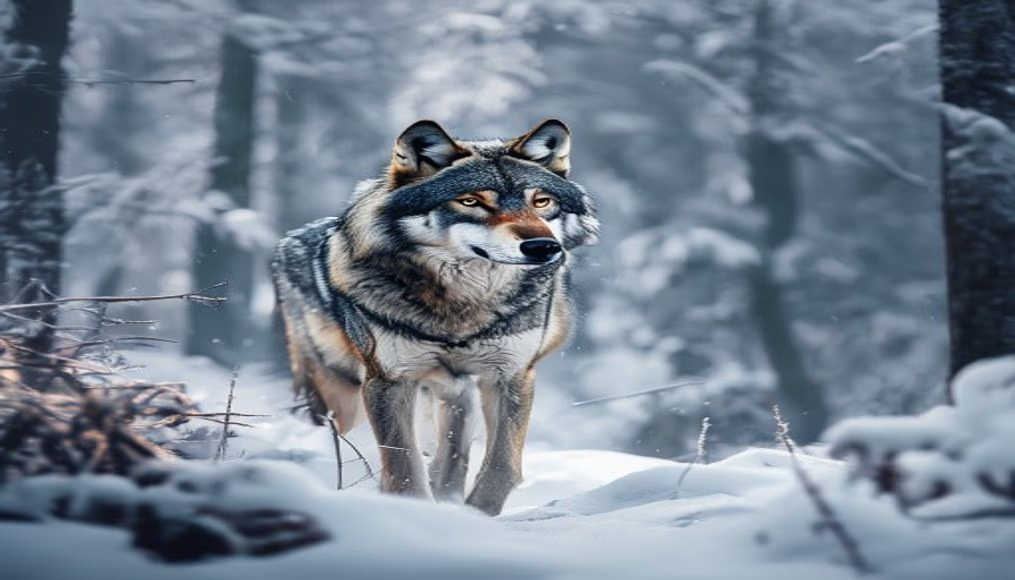
Wolf in snowy forest: understand how these canids survive and hunt in frozen environments during harsh winters.
About this subject
The gray wolf (Canis lupus) is one of the predators best adapted to extreme cold, inhabiting boreal forests and tundras across the Northern Hemisphere. During winter, when snow covers the ground for months, these animals rely on a suite of physiological and behavioral adaptations. Their double coat, composed of waterproof guard hairs and a dense undercoat, retains body heat even in temperatures as low as -50°C. Broad, padded paws act as natural snowshoes, distributing weight over soft snow and enabling silent movement.
Wolves are social animals living in packs structured by a rigid hierarchy. In winter, cooperation intensifies: while some members pursue prey such as moose, caribou, and bison, others cut off escape routes to exhaust the animal. A pack can travel up to 200 km in a single day while hunting. Studies show that hunting success in snow ambushes is higher, as snow hampers the flight of large prey. Contrary to common belief, howls are not only for communication; they also help locate pack members during snowstorms.
The gray wolf's geographic range spans North America, Europe, Asia, and even the Middle East. However, deforestation and illegal hunting have reduced populations in several regions. In Scandinavia, for instance, the species was nearly extinct and now lives under strict protection. Interestingly, in areas like Yellowstone National Park (USA), wolf reintroduction in 1995 rebalanced ecosystems: by controlling deer populations, it allowed willows and aspens to regenerate, benefiting beavers and birds.
Another little-known fact is wolves' ability to see in the dark. Their eyes have a layer called the tapetum lucidum, which reflects light and enhances night vision up to sixfold. Additionally, their sense of smell is acute: they can detect odors from more than 2 km away. These senses are crucial in snowy forests, where visibility can be reduced and wind carries prey scents.
Frequently Asked Questions
How do wolves keep warm in extreme cold?
Wolves have a dense double coat and adapted paws. They also tuck their paws close to the body and curl up to reduce heat loss. While sleeping, the tail covers the snout, protecting the airways from freezing air.
Do wolves hunt alone or in packs during winter?
Although they can hunt small prey alone, cooperative pack hunting is essential in winter to take down large animals like moose or bison. The pack works together to isolate and exhaust the prey in the snow.
What is the difference between a wolf and a dog?
Wolves are wild and have never been domesticated. They have larger skulls, stronger jaws, and bigger paws. Behaviorally, they are more cautious, and their howls serve for long-distance communication, unlike dogs' barks.
Direct URL
https://pub-c7d6a6ea828543ac903a74a341ccb2e1.r2.dev/imagens/wolf-in-snowy-forest-commercial-product-photography-v9.avifHow to credit
Include a visible link back to UtilizAí. Copy one of the snippets below:
<a href="https://xn--utiliza-eza.com/en/midia/imagens/wolf-in-snowy-forest-commercial-product-photography-v9">Wolf in snowy forest</a> by <a href="https://xn--utiliza-eza.com">UtilizAí</a>, licensed under <a href="https://creativecommons.org/licenses/by/4.0/">CC BY 4.0</a>.
[Wolf in snowy forest](https://xn--utiliza-eza.com/en/midia/imagens/wolf-in-snowy-forest-commercial-product-photography-v9) by [UtilizAí](https://xn--utiliza-eza.com), CC BY 4.0
License: CC-BY-4.0