View camera bellows
1344×768 · AVIF · CC BY 4.0
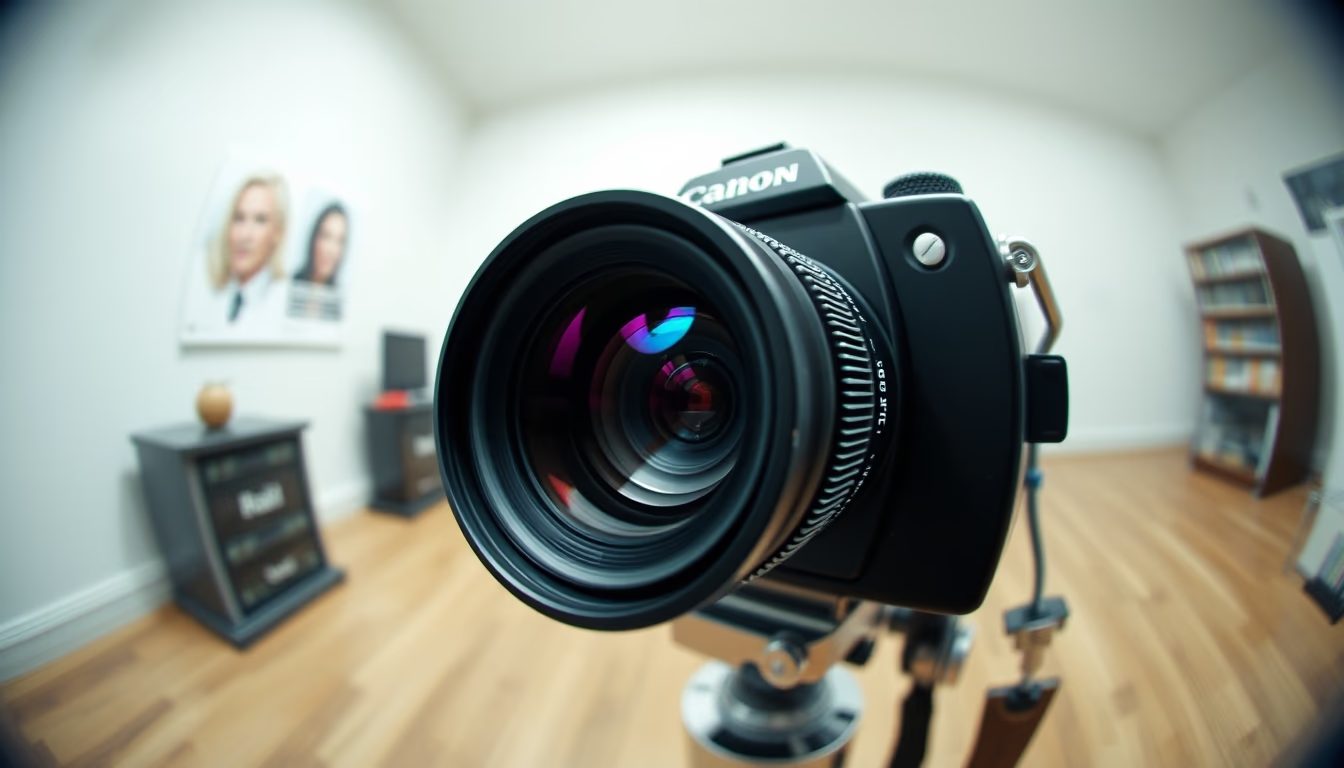
The bellows of a view camera are flexible components connecting the lens to the film, enabling precise perspective and focus movements.
About this subject
The bellows of a view camera, also known as camera bellows, are foldable structures that connect the front standard (where the lens is mounted) to the rear standard (where the film or digital sensor is). This construction allows the photographer to execute movements such as shift, tilt, and swing on both planes, correcting perspective distortions and adjusting the focus plane according to the Scheimpflug rule. These movements are essential in architectural, still life, and landscape photography, where converging lines and controlled depth of field are desired.
Historically, the first bellows appeared in the 19th century, with folding cameras like the Kodak in 1888, but the refined design of modern view cameras was developed by manufacturers like Sinar in Switzerland and Linhof in Germany. Bellows are typically made of leather, rubber, or synthetic materials to seal out light and allow expansion and contraction. Camera bellows models vary in length, from short ones for wide-angle lenses to long ones for telephoto lenses, with wide-angle bellows specifically designed to avoid obstruction with very wide angle lenses.
A notable technical curiosity is that the ability to extend and compress the bellows enables the camera to focus on very close subjects (macro) or distant ones without losing optical quality, something fixed-lens cameras cannot achieve. Additionally, tilt and shift movements allow for effects like the 'miniature effect' (tilt to selectively blur) or perspective correction in buildings, keeping vertical lines parallel. Large format photographers still use these features in formats like 4x5, 5x7, and 8x10 inches, valuing the precision and richness of detail that bellows provide.
Frequently Asked Questions
What is the main function of bellows in a large format camera?
Bellows enable perspective and focus adjustments, such as shift, tilt, and swing, essential for correcting distortions and controlling depth of field.
How do bellows help avoid converging lines in architectural photography?
By using the shift movement of the front or rear standard, it is possible to keep vertical lines parallel, correcting the distortion that occurs when photographing buildings from a low angle.
Are there different types of bellows for different lenses?
Yes. Wide-angle bellows are shorter to avoid obstruction with extremely wide lenses, while long bellows are used for telephoto lenses or macro photography, allowing greater extension.
Direct URL
https://pub-c7d6a6ea828543ac903a74a341ccb2e1.r2.dev/imagens/view-camera-bellows-fish-eye-wide-angle-fresh3.avifHow to credit
Include a visible link back to UtilizAí. Copy one of the snippets below:
<a href="https://xn--utiliza-eza.com/en/midia/imagens/view-camera-bellows-fish-eye-wide-angle-fresh3">View camera bellows</a> by <a href="https://xn--utiliza-eza.com">UtilizAí</a>, licensed under <a href="https://creativecommons.org/licenses/by/4.0/">CC BY 4.0</a>.
[View camera bellows](https://xn--utiliza-eza.com/en/midia/imagens/view-camera-bellows-fish-eye-wide-angle-fresh3) by [UtilizAí](https://xn--utiliza-eza.com), CC BY 4.0
License: CC-BY-4.0