Taj mahal symmetric reflection
1344×768 · AVIF · CC BY 4.0
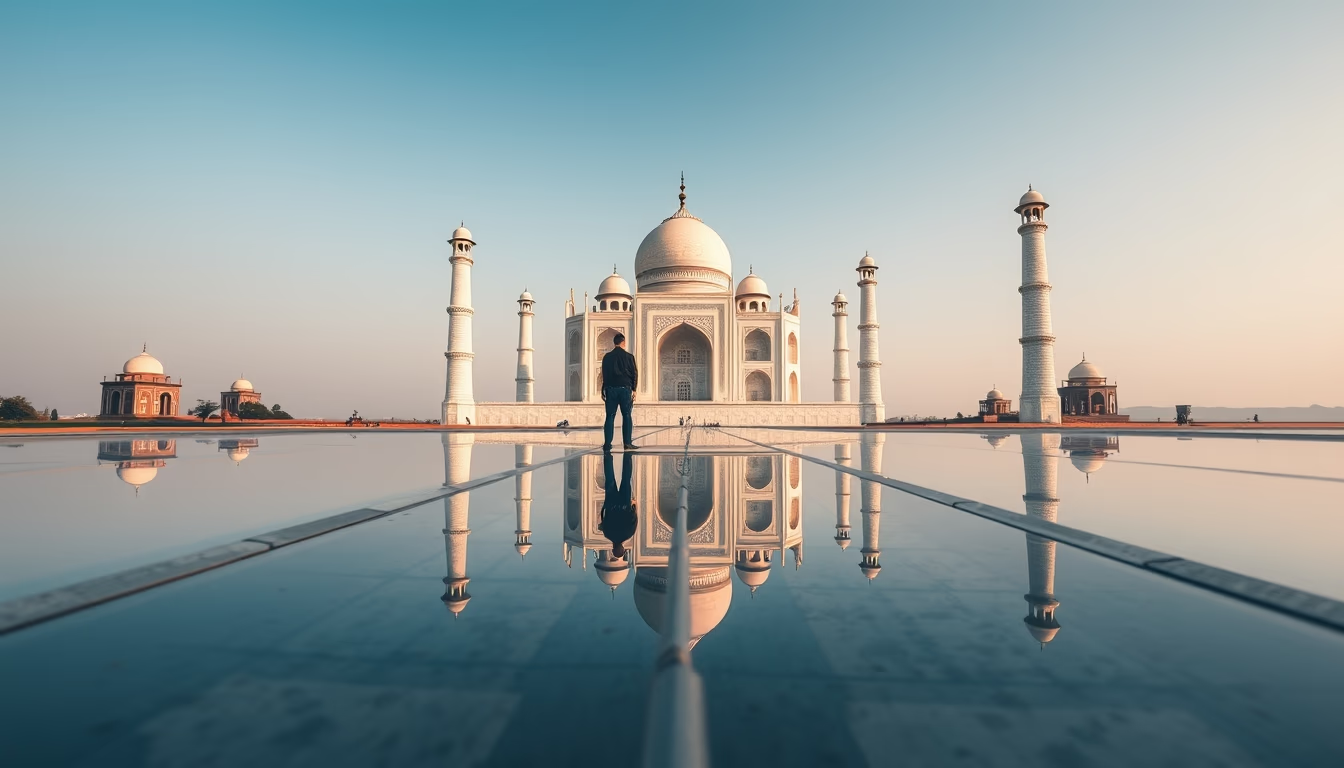
The Taj Mahal in Agra, India, is a white marble mausoleum built by Emperor Shah Jahan in memory of his wife Mumtaz Mahal.
About this subject
The Taj Mahal is one of the most iconic monuments in the world, located on the banks of the Yamuna River in Agra, India. It was commissioned in 1632 by the Mughal emperor Shah Jahan to house the tomb of his favorite wife, Mumtaz Mahal, who died giving birth to their 14th child. The construction took about 22 years and involved over 20,000 artisans and workers from across the empire and Central Asia. The main building is made of white marble quarried from Makrana in Rajasthan and is decorated with inlays of semi-precious stones such as jade, crystal, lapis lazuli, and turquoise, forming floral patterns and Islamic calligraphy.
The symmetry of the Taj Mahal is one of its most striking features. The complex was designed as a Muslim garden of paradise, with water channels that reflect the structure and create a perfect mirrored image. The central dome, 35 meters high, is flanked by four 40-meter minarets slightly tilted outward to protect the mausoleum in case of an earthquake. The use of axial symmetry and mathematical proportions reflects the influence of Persian and Mughal architecture, combining Islamic, Indian, and Persian elements.
The Taj Mahal has been a UNESCO World Heritage Site since 1983 and was named one of the New Seven Wonders of the World in 2007. Despite its beauty, the monument faces environmental threats such as air pollution and yellowing of the marble due to particle deposition. Conservation measures, including periodic restoration and limiting vehicle traffic nearby, have been implemented to preserve its integrity. About 7 to 8 million tourists visit the Taj Mahal annually, making it one of the most visited destinations on the planet.
Frequently Asked Questions
Why was the Taj Mahal built?
The Taj Mahal was built by Emperor Shah Jahan as a mausoleum for his wife Mumtaz Mahal, who died in 1631 during childbirth. It is a symbol of eternal love.
How long did it take to build the Taj Mahal?
The main construction took about 22 years, from 1632 to 1653. The entire complex, including gardens and auxiliary structures, was completed in 1653.
Is the Taj Mahal actually changing color?
Yes, the white marble of the Taj Mahal has developed a yellowish tint due to air pollution and particle deposition. Conservation efforts, such as applying a clay mask, help restore its original color.
Direct URL
https://pub-c7d6a6ea828543ac903a74a341ccb2e1.r2.dev/imagens/taj-mahal-symmetric-reflection-documentary-photography.avifHow to credit
Include a visible link back to UtilizAí. Copy one of the snippets below:
<a href="https://xn--utiliza-eza.com/en/midia/imagens/taj-mahal-symmetric-reflection-documentary-photography">Taj mahal symmetric reflection</a> by <a href="https://xn--utiliza-eza.com">UtilizAí</a>, licensed under <a href="https://creativecommons.org/licenses/by/4.0/">CC BY 4.0</a>.
[Taj mahal symmetric reflection](https://xn--utiliza-eza.com/en/midia/imagens/taj-mahal-symmetric-reflection-documentary-photography) by [UtilizAí](https://xn--utiliza-eza.com), CC BY 4.0
License: CC-BY-4.0