Soccer ball on grass field
1344×768 · AVIF · CC BY 4.0
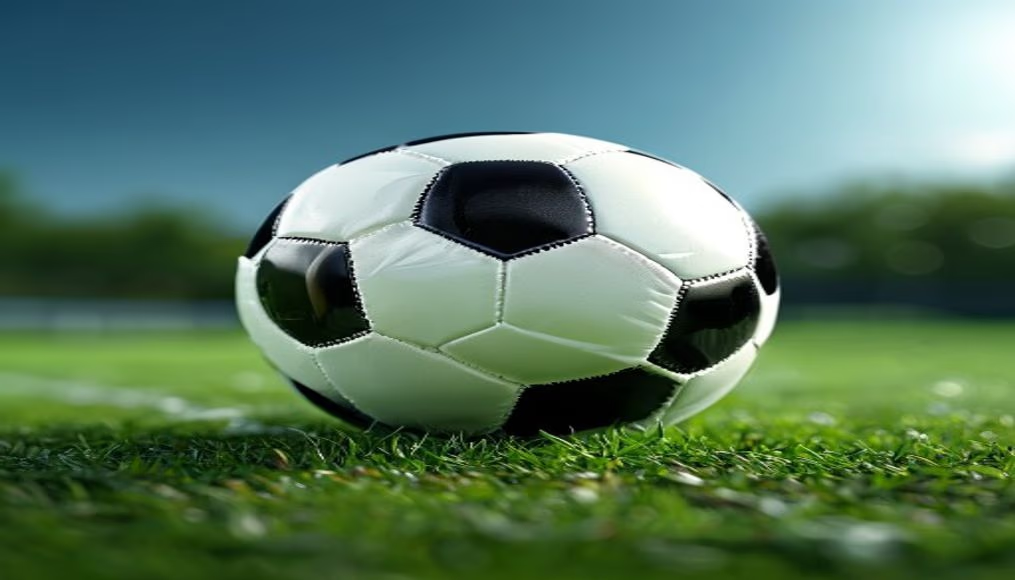
The soccer ball, essential gear for the world's most popular sport, features a hexagonal and pentagonal panel design, made of synthetic leather and inflated with air for matches on grass fields.
About this subject
The soccer ball is the central icon of the most beloved sport in Brazil, where football is nearly a religion. Since the first World Cup in 1930, ball design has evolved significantly. Modern balls follow FIFA specifications: circumference between 68 and 70 cm, weight between 410 and 450 grams, and pressure between 0.6 and 1.1 atm. The traditional pentagonal and hexagonal panels, patented by Richard Buckminster Fuller, ensure aerodynamics and stability. In Brazil, balls are manufactured by brands like Penalty, Topper, and Nike, using synthetic materials that withstand the heat and humidity typical of the country. The natural or artificial grass of the field influences friction and bounce, with taller grass reducing speed. Interestingly, the first official Brazilian soccer ball, used in the 1950 World Cup, was made of tanned leather and was heavier than current ones, making kicks more powerful. The ball's center contains a latex or butyl bladder that retains air longer, essential for 90-minute matches. The traditional white color facilitates visibility on the grass, though colored versions are used for night games or snow. Its cultural importance is so great that the Brazilian soccer ball has been featured on postage stamps and songs, such as Jorge Ben Jor's 'A Bola'.
Frequently Asked Questions
What is the official size of a soccer ball for professional matches?
FIFA specifies that the circumference must be between 68 and 70 cm, weight between 410 and 450 grams, and pressure between 0.6 and 1.1 atmospheres.
Why does a soccer ball have pentagonal and hexagonal panels?
The design of pentagonal and hexagonal panels was developed by Richard Buckminster Fuller to create a shape as close to a perfect sphere as possible, ensuring aerodynamics and predictable behavior during play.
What is the difference between soccer balls for natural and artificial grass?
Balls for artificial grass usually have a more abrasion-resistant coating and lower water absorption, and they bounce slightly differently due to the harder surface of the field.
Direct URL
https://pub-c7d6a6ea828543ac903a74a341ccb2e1.r2.dev/imagens/soccer-ball-on-grass-field-commercial-product-photography-v9.avifHow to credit
Include a visible link back to UtilizAí. Copy one of the snippets below:
<a href="https://xn--utiliza-eza.com/en/midia/imagens/soccer-ball-on-grass-field-commercial-product-photography-v9">Soccer ball on grass field</a> by <a href="https://xn--utiliza-eza.com">UtilizAí</a>, licensed under <a href="https://creativecommons.org/licenses/by/4.0/">CC BY 4.0</a>.
[Soccer ball on grass field](https://xn--utiliza-eza.com/en/midia/imagens/soccer-ball-on-grass-field-commercial-product-photography-v9) by [UtilizAí](https://xn--utiliza-eza.com), CC BY 4.0
License: CC-BY-4.0