Salt crystal macro
1344×768 · AVIF · CC BY 4.0
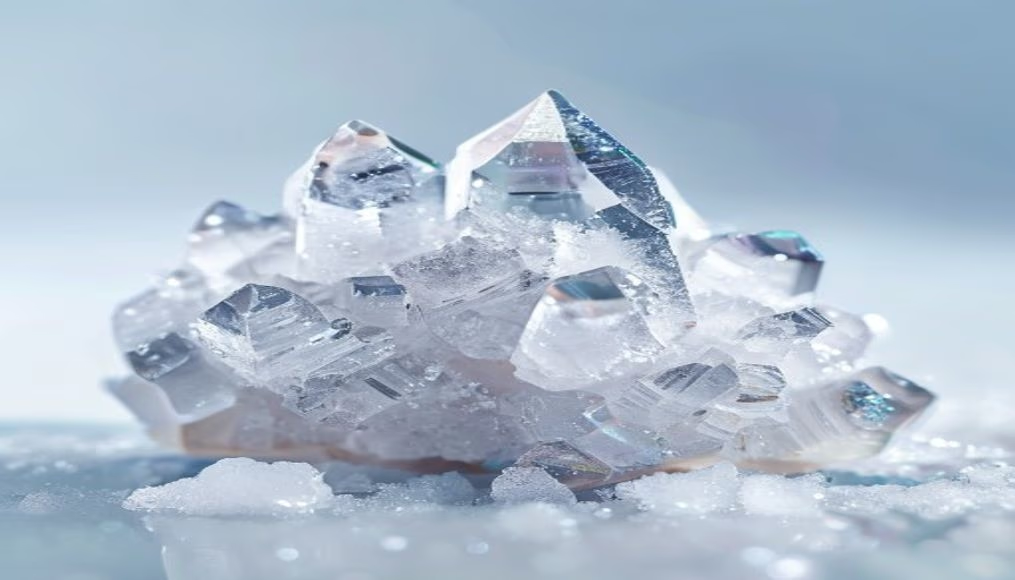
Microscopic details of salt reveal perfect cubic structures, formed over millennia in marine and terrestrial environments.
About this subject
Table salt, or sodium chloride (NaCl), crystallizes in the cubic system, forming near-perfect cubes under ideal conditions. Each crystal is a regular arrangement of sodium and chlorine ions held together by ionic bonds. In macro photography, one can observe the smooth faces and characteristic right angles, as well as liquid or gas inclusions that tell the geological history of the deposit.
Salt can be of marine origin (sea salt) or terrestrial origin (rock salt). Sea salt is obtained by evaporation of seawater in salt pans, a process that can take months to years. Rock salt is mined from underground deposits formed by the evaporation of ancient seas millions of years ago. Each type presents distinct impurities and microstructures: sea salt often contains traces of magnesium, calcium, and potassium, influencing flavor and texture.
Beyond culinary use, salt is essential for food preservation, production of chlorine and caustic soda, and even industrial processes like glass manufacturing. Interestingly, the size and purity of crystals determine their application: large, pure crystals are preferred for table salt, while smaller ones are used in chemical industries. In some regions, such as the Himalayas, pink salt mined from deposits contains up to 84 minerals, giving it color and commercial value.
The formation of a salt crystal depends on factors such as temperature, solution concentration, and the presence of impurities. Under controlled conditions, giant crystals can be grown in the laboratory, but nature also produces impressive specimens, such as the salt crystals from the Wieliczka mine in Poland, which reach meters in length. These crystals are true geological records, preserving information about the climate and chemical composition of past eras.
Frequently Asked Questions
Why does salt form cubic crystals?
Sodium chloride has a face-centered cubic crystal structure, where each sodium ion is surrounded by six chlorine ions and vice versa. This symmetrical arrangement naturally produces cube-shaped crystals.
What is the difference between sea salt and rock salt?
Sea salt is obtained by evaporating seawater and contains trace minerals that can affect flavor and color. Rock salt is mined from underground deposits formed by ancient seas and is usually purer, but may contain impurities like clay.
How are inclusions formed inside salt crystals?
During crystal growth, small bubbles of liquid or gas can become trapped. These inclusions reflect the chemical and temperature conditions of the environment where the crystal formed, serving as geological archives.
Direct URL
https://pub-c7d6a6ea828543ac903a74a341ccb2e1.r2.dev/imagens/salt-crystal-macro-commercial-product-photography-v9.avifHow to credit
Include a visible link back to UtilizAí. Copy one of the snippets below:
<a href="https://xn--utiliza-eza.com/en/midia/imagens/salt-crystal-macro-commercial-product-photography-v9">Salt crystal macro</a> by <a href="https://xn--utiliza-eza.com">UtilizAí</a>, licensed under <a href="https://creativecommons.org/licenses/by/4.0/">CC BY 4.0</a>.
[Salt crystal macro](https://xn--utiliza-eza.com/en/midia/imagens/salt-crystal-macro-commercial-product-photography-v9) by [UtilizAí](https://xn--utiliza-eza.com), CC BY 4.0
License: CC-BY-4.0