Sahara desert dunes pattern
1344×768 · AVIF · CC BY 4.0

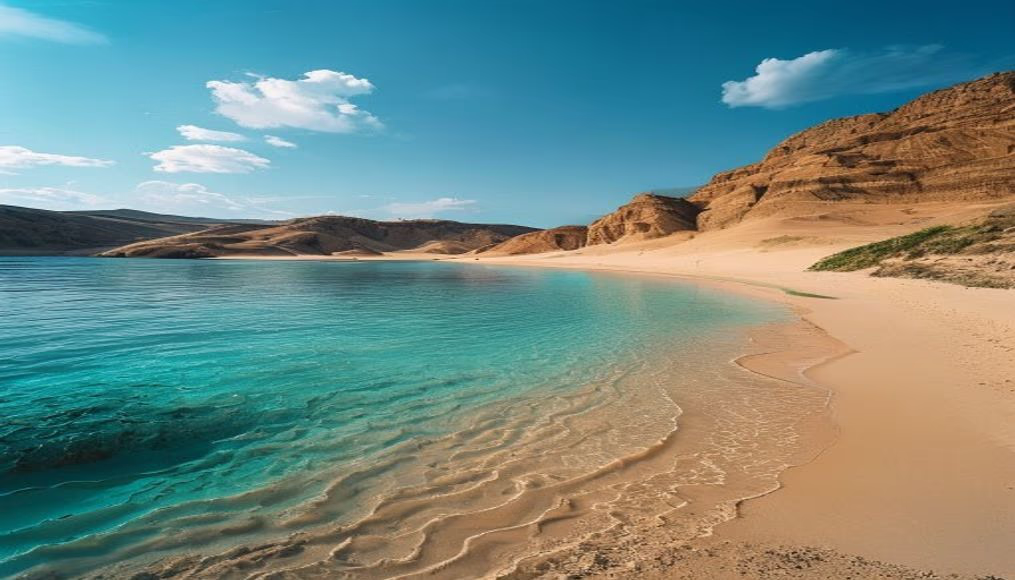
The dunes of the Sahara form mesmerizing geometric patterns, sculpted by wind over millennia in the world's largest hot desert.
About this subject
The Sahara Desert, covering about 9.2 million square kilometers in North Africa, is the largest hot desert on Earth. Its dunes, known as ergs, cover approximately 20% of the desert's surface and can reach heights of up to 300 meters. The patterns observed in the dunes result from constant trade winds and convection currents that transport and deposit sand into shapes such as barchan (crescent-shaped), transverse, and star dunes. Geological studies indicate that some Sahara dunes are over 10,000 years old, with sands originating from the erosion of ancient rocks in the Hoggar and Tibesti massifs. Sand composition varies but is rich in quartz and iron oxides, giving characteristic orange and reddish hues.
The Sahara is not a continuous sea of sand; only 15% of its area is covered by dunes, with the remainder consisting of gravel plains (regs), rocky plateaus (hamadas), and oases. The most famous dune patterns are found in the Erg Chebbi sand sea in Morocco and the Eastern Erg in Algeria. Dune crest orientation follows the prevailing wind direction, creating parallel lines that can extend for hundreds of kilometers. These patterns are dynamic: mobile dunes can advance up to 15 meters per year, burying roads and settlements. Aerial and satellite photography reveal the abstract beauty of these formations, which have inspired artists such as Swiss painter Paul Klee.
Culturally, Sahara dunes symbolize isolation and resilience. Nomadic peoples like the Tuareg and Bedouins developed techniques for navigating by stars and sand marks to cross the desert. The Sahara also hosts archaeological sites with 8,000-year-old rock paintings, indicating that the region was once a humid savanna. Climate change and desert expansion are current research topics. Dune patterns, viewed from above, offer a unique perspective on natural processes shaping the landscape, often used in graphic design and architecture for their organic repetition of forms.
Frequently Asked Questions
What is the average height of Sahara dunes?
Sahara dunes can reach up to 300 meters in height, but the average ranges from 30 to 100 meters, depending on the region and dune type.
How do dune patterns form?
Patterns form by wind action, which transports and deposits sand into specific shapes. Wind direction and intensity, along with sand availability, determine dune types like barchan or transverse.
Are Sahara dunes stable or do they move?
Many dunes are mobile and can shift up to 15 meters per year due to constant wind. Fixed dunes are usually stabilized by vegetation or moisture.
Direct URL
https://pub-c7d6a6ea828543ac903a74a341ccb2e1.r2.dev/imagens/sahara-desert-dunes-pattern-studio-editorial-portrait-v3.avifHow to credit
Include a visible link back to UtilizAí. Copy one of the snippets below:
<a href="https://xn--utiliza-eza.com/en/midia/imagens/sahara-desert-dunes-pattern-studio-editorial-portrait-v3">Sahara desert dunes pattern</a> by <a href="https://xn--utiliza-eza.com">UtilizAí</a>, licensed under <a href="https://creativecommons.org/licenses/by/4.0/">CC BY 4.0</a>.
[Sahara desert dunes pattern](https://xn--utiliza-eza.com/en/midia/imagens/sahara-desert-dunes-pattern-studio-editorial-portrait-v3) by [UtilizAí](https://xn--utiliza-eza.com), CC BY 4.0
License: CC-BY-4.0