Romanesque cathedral arches
1344×768 · AVIF · CC BY 4.0
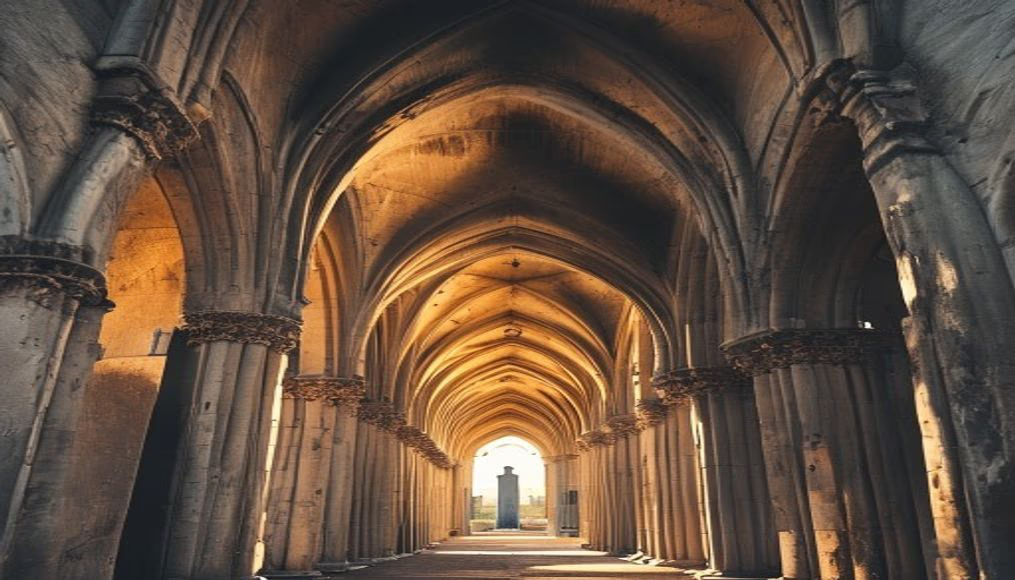
Semicircular arches define Romanesque architecture, prominently featured in European cathedrals from the 6th to the 11th centuries.
About this subject
Romanesque arches, defined by their semicircular shape, are one of the most distinctive features of Romanesque architecture, which flourished in Europe between the 6th and 11th centuries. Unlike the pointed Gothic arches that succeeded them, Romanesque arches are wider and lower, requiring thick walls and sturdy piers to bear the weight of stone structures. This construction method limited openings, resulting in dimly lit interiors but conveying a sense of solidity and permanence.
Cathedrals such as Speyer in Germany and Saint-Sernin in Toulouse display rows of semicircular arches forming side aisles and arcades. In Portugal, the Old Cathedral of Coimbra and Braga Cathedral are notable examples. Romanesque arches also appear in cloisters and portals, often adorned with biblical or geometric carvings, as seen at the Abbey of Cluny in France.
The semicircular arch's origins trace back to ancient Rome, but Romanesque builders perfected its use in barrel and groin vaults, creating stone ceilings for large spaces. This style spread along pilgrimage routes, such as the Way of St. James, where churches and cathedrals served as landmarks of faith and local power. Today, these arches symbolize an era when architecture merged functionality with religious symbolism.
Interestingly, the transition to Gothic occurred when builders began raising the arch to form a pointed shape, allowing larger windows and thinner walls. Nonetheless, Romanesque arches influenced later revival movements, such as 19th-century Neoromanesque, found in Brazilian churches like the São Paulo Cathedral, designed by Ramos de Azevedo.
Frequently Asked Questions
What is the difference between Romanesque and Gothic arches?
Romanesque arches are semicircular, while Gothic arches are pointed (ogival). The Romanesque arch distributes weight more vertically, requiring thick walls, whereas the Gothic arch allows lighter structures and larger windows.
Where can I see Romanesque arches in Brazil?
In Brazil, Neoromanesque influence appears in 19th-century churches such as the São Paulo Cathedral and the Metropolitan Cathedral of Porto Alegre, which use semicircular arches on their facades and interiors.
Why are Romanesque arches important in architectural history?
They mark the transition from Roman to Gothic architecture, being crucial for the development of stone vaulting techniques and for shaping public spaces in medieval cathedrals.
Direct URL
https://pub-c7d6a6ea828543ac903a74a341ccb2e1.r2.dev/imagens/romanesque-cathedral-arches-cinematic-wide-shot-p0.avifHow to credit
Include a visible link back to UtilizAí. Copy one of the snippets below:
<a href="https://xn--utiliza-eza.com/en/midia/imagens/romanesque-cathedral-arches-cinematic-wide-shot-p0">Romanesque cathedral arches</a> by <a href="https://xn--utiliza-eza.com">UtilizAí</a>, licensed under <a href="https://creativecommons.org/licenses/by/4.0/">CC BY 4.0</a>.
[Romanesque cathedral arches](https://xn--utiliza-eza.com/en/midia/imagens/romanesque-cathedral-arches-cinematic-wide-shot-p0) by [UtilizAí](https://xn--utiliza-eza.com), CC BY 4.0
License: CC-BY-4.0