Rocket launch night
1344×768 · AVIF · CC BY 4.0
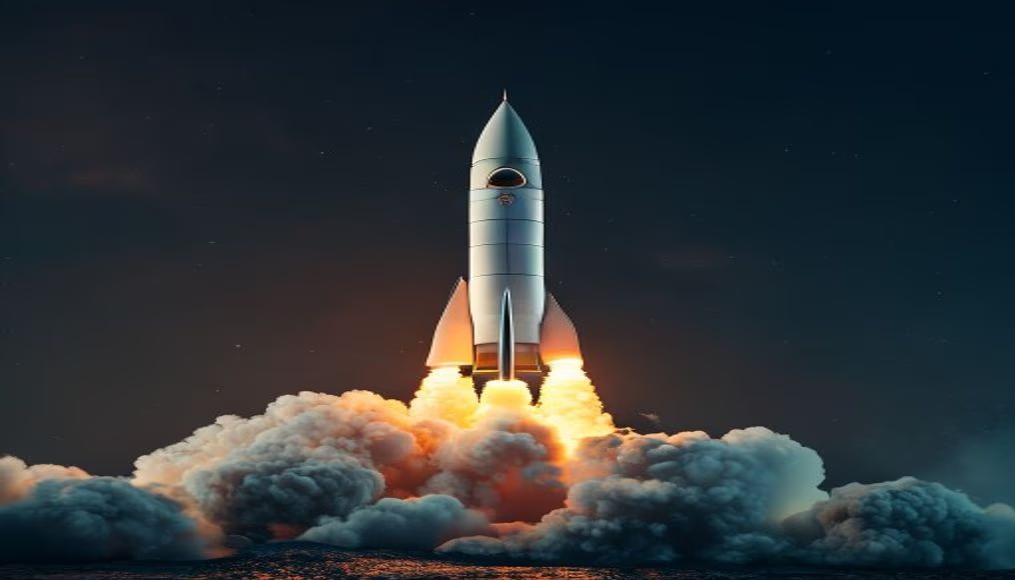
Night rocket launches combine technical precision and visual spectacle, scheduled at specific times to optimize trajectories and deliver payloads to precise orbits.
About this subject
Night rocket launches are events that combine advanced engineering and visual beauty. They occur when the ideal launch window coincides with nightfall, whether to place satellites into specific orbits, such as Sun-synchronous, or for scientific missions requiring darkness for astronomical observations. The choice of nighttime also helps avoid air traffic congestion and facilitates optical tracking, as the rocket stands out against the dark sky.
Technically, a night launch requires powerful lighting systems on the ground and on the vehicle. Launch pads, like those at Cape Canaveral or the Baikonur Cosmodrome, are equipped with xenon floodlights that illuminate the rocket during countdown. Infrared cameras and thermal sensors monitor each stage, while strobe lights on the rocket itself aid visual location. SpaceX, for example, routinely conducts night launches of its Falcon 9 rockets, broadcasting live high-definition footage showing the engine's glow illuminating the smoke.
Historically, one of the most iconic night launches was Apollo 17 on December 7, 1972, the only crewed lunar mission launched at night. The Saturn V lit up the Florida sky, and the liftoff was photographed by millions. More recently, the launch of the James Webb Space Telescope on December 25, 2021, occurred at 7:20 UTC (local time in French Guiana), in the middle of the night, to ensure the best alignment with its orbit at the L2 point. These events are covered by global media and attract enthusiasts who travel to observation sites, generating tourism and cultural impact.
Beyond the scientific aspect, night launches have strong visual and emotional appeal. The trail of light left by the rocket is visible for hundreds of kilometers, creating a phenomenon known as a "noctilucent cloud" when exhaust gases reflect sunlight at twilight. Professional and amateur photographers seek unique angles to capture the contrast between the engine's brilliance and the starry background, making these images icons of the space age.
Frequently Asked Questions
Why are rockets launched at night?
Night launches are scheduled to meet specific launch windows, which depend on the desired orbit, target satellite positions, and lighting conditions for solar panels. Additionally, nighttime facilitates optical tracking and reduces collision risks with aircraft.
How is a rocket illuminated during a night launch?
Illumination is provided by powerful xenon floodlights on the launch pad that bathe the rocket in light. The vehicle itself has strobe lights and infrared video systems for monitoring. High-sensitivity cameras capture the engine's flare and trajectory.
What are the most famous night launches in history?
The Apollo 17 launch in 1972, the only crewed lunar mission at night, is one of the most iconic. Another example is the launch of the James Webb Space Telescope on December 25, 2021. SpaceX launches, such as the Falcon Heavy Test Flight in 2018, also occurred at night and generated widespread attention.
Direct URL
https://pub-c7d6a6ea828543ac903a74a341ccb2e1.r2.dev/imagens/rocket-launch-night-commercial-product-photography-v9.avifHow to credit
Include a visible link back to UtilizAí. Copy one of the snippets below:
<a href="https://xn--utiliza-eza.com/en/midia/imagens/rocket-launch-night-commercial-product-photography-v9">Rocket launch night</a> by <a href="https://xn--utiliza-eza.com">UtilizAí</a>, licensed under <a href="https://creativecommons.org/licenses/by/4.0/">CC BY 4.0</a>.
[Rocket launch night](https://xn--utiliza-eza.com/en/midia/imagens/rocket-launch-night-commercial-product-photography-v9) by [UtilizAí](https://xn--utiliza-eza.com), CC BY 4.0
License: CC-BY-4.0