Reichsmark germany 1920
1344×768 · AVIF · CC BY 4.0

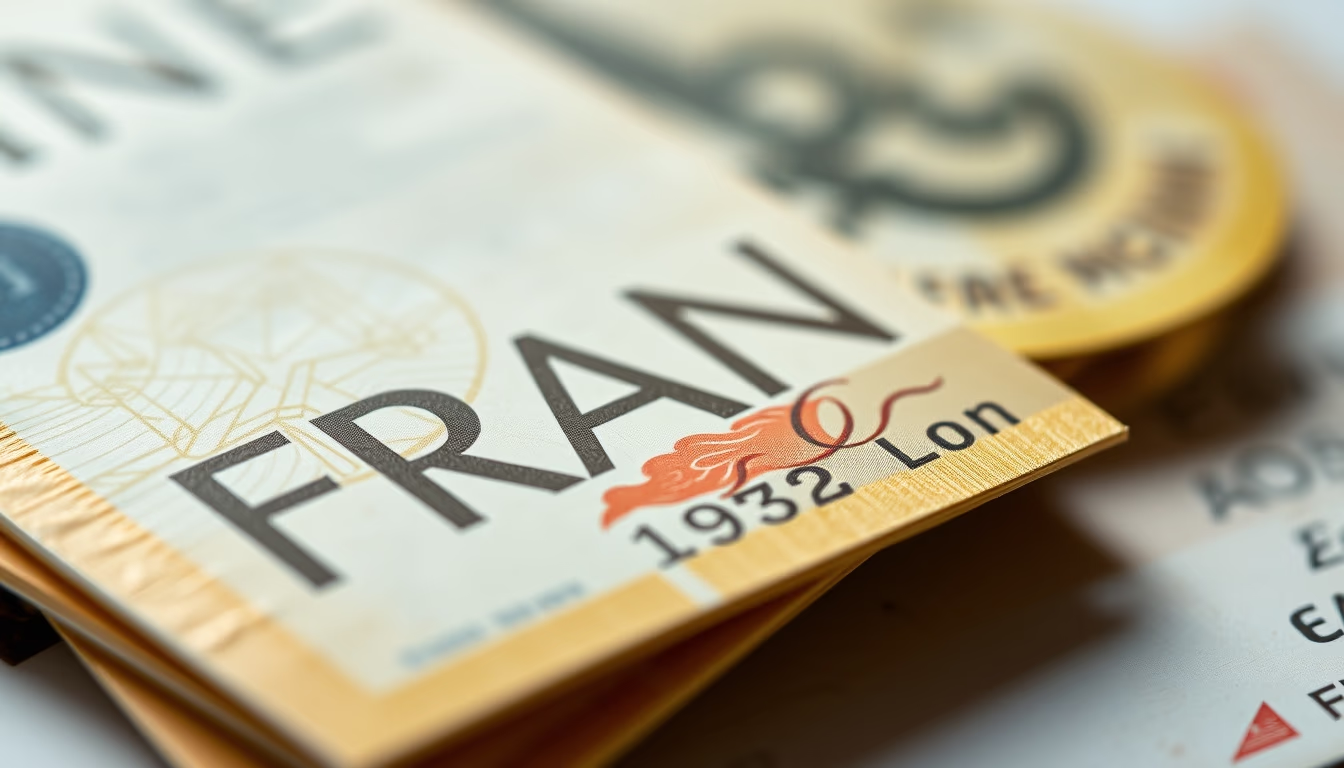
The 1920 German Reichsmark is a historical banknote from the hyperinflation era of the Weimar Republic, signifying the monetary transition that led to the 1924 reform.
About this subject
The Reichsmark, officially introduced only in 1924 as part of the Dawes Plan, appears on banknotes dated 1920 due to the continued use of the denomination by the Reichsbank. In practice, the circulating currency in 1920 was the Papiermark, which underwent rapid devaluation after World War I. Banknotes from this period, such as the 1920 issue, feature complex designs with Art Deco elements and portraits of mythological or allegorical figures, reflecting an attempt to convey stability amidst economic chaos.
The German hyperinflation peaked in 1923, when the US dollar reached 4.2 trillion marks. To curb the crisis, the government introduced the Rentenmark in November 1923, backed by land and agricultural products, followed by the Reichsmark in 1924, which replaced the old currency at a rate of 1 trillion Papiermarks to 1 Reichsmark. Thus, the 1920 banknotes represent remnants from the pre-hyperinflation era, now collector's items illustrating the Weimar Republic's economic fragility.
In numismatic contexts, the 1920 Reichsmark is valued for its rarity and condition. Uncirculated notes can fetch hundreds of euros at auctions. The low-quality paper typical of the time, along with watermarks and serial numbers, aid authentication. Collectors also appreciate design variations among different Reichsbank districts, each issuing its own series.
Interestingly, the 1920 date on notes does not always correspond to the actual year of issuance; many were printed later but retained the original date to avoid confusion. This complicates cataloging. Moreover, the existence of contemporary counterfeits, especially during hyperinflation, adds layers of historical and forensic interest for scholars.
Frequently Asked Questions
What distinguishes the 1920 Reichsmark from the Rentenmark launched in 1923?
The 1920 Reichsmark is a pre-hyperinflation banknote backed only by state credit, while the 1923 Rentenmark was a temporary currency backed by land and goods, later replaced by the new Reichsmark in 1924.
Why are German 1920 banknotes so rare and valuable?
Many were destroyed during hyperinflation, as their face value became negligible. Those surviving in good condition are rare because the paper was low-quality and easily damaged.
How to identify an authentic 1920 Reichsmark banknote?
Check for a watermark (portrait or geometric pattern), the paper type (rough and thin), typical serial numbers, and sharp printing details. Contemporary counterfeits often have alignment flaws or blurred colors.
Direct URL
https://pub-c7d6a6ea828543ac903a74a341ccb2e1.r2.dev/imagens/reichsmark-germany-1920-film-grain-authentic-fresh8.avifHow to credit
Include a visible link back to UtilizAí. Copy one of the snippets below:
<a href="https://xn--utiliza-eza.com/en/midia/imagens/reichsmark-germany-1920-film-grain-authentic-fresh8">Reichsmark germany 1920</a> by <a href="https://xn--utiliza-eza.com">UtilizAí</a>, licensed under <a href="https://creativecommons.org/licenses/by/4.0/">CC BY 4.0</a>.
[Reichsmark germany 1920](https://xn--utiliza-eza.com/en/midia/imagens/reichsmark-germany-1920-film-grain-authentic-fresh8) by [UtilizAí](https://xn--utiliza-eza.com), CC BY 4.0
License: CC-BY-4.0