Pedal steel guitar
1344×768 · AVIF · CC BY 4.0
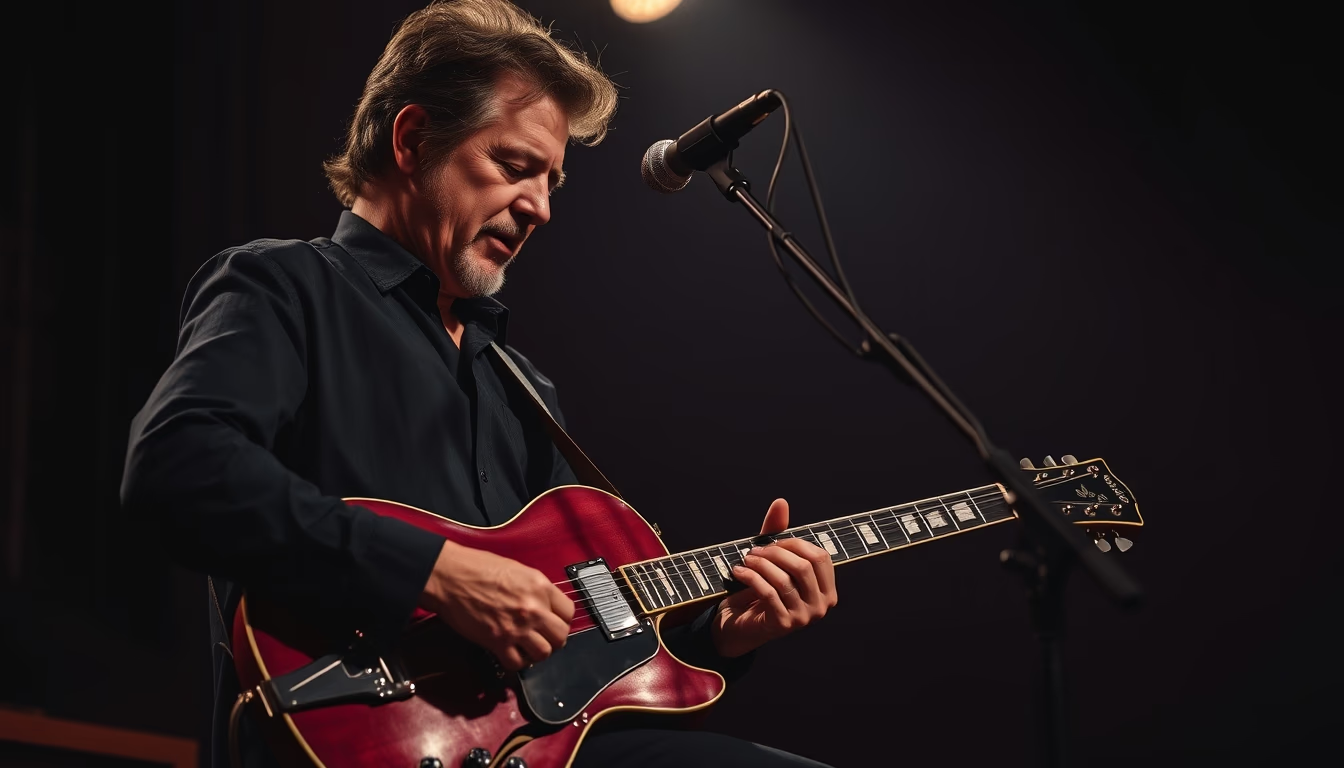
The pedal steel guitar is an iconic instrument in country and sertanejo music, known for its melancholic glissandos and complex pedal mechanisms.
About this subject
The pedal steel guitar is a string instrument derived from the Hawaiian lap steel, developed in the United States in the 1940s. Unlike a standard guitar, it is played horizontally on legs, using a metal bar (steel) to press the strings and pedals that change string tension, producing characteristic bends and glissandos. Its construction often involves multiple necks, typically two, with different tunings such as E9 (common for leads) and C6 (for chords and jazz).
The instrument was popularized by musicians like Bud Isaacs, who in 1954 recorded the hit "Slowly" with Webb Pierce, and later by legends such as Buddy Emmons, Ralph Mooney, and the Brazilian Ronaldo do Bandolim, who introduced it to Brazilian sertanejo music. In Brazil, the pedal steel became essential in caipira and sertanejo styles, especially in the 1970s and 1980s, with artists like Chitãozinho & Xororó and Milionário & José Rico. Its expressive sound, which avoids pick percussion and prioritizes sustain, is associated with nostalgia and rural melancholy.
Technically, the pedal steel has a complex mechanism: each pedal and knee lever acts on a set of strings, altering their pitch in chromatic intervals. The standard E9 tuning includes D, B, G#, E, D, B, G#, E, D, B (from thickest to thinnest string), allowing open chords and melodic passages. The instrument requires intense motor coordination, as the player must use both hands, feet, and knees simultaneously to control the bar, vibrato, and tuning changes.
Despite its US origins, the pedal steel has regional variants. In Brazil, luthiers adapt it for the viola caipira, such as the 12-string pedal steel. At festivals like Barretos Rodeo, the instrument is a highlight in major shows. Recently, contemporary artists like the duo Anavitória and the band 5 a Seco have explored its sound in fusions with pop and MPB, expanding its reach to new generations.
Frequently Asked Questions
What is the difference between pedal steel and Hawaiian guitar?
The Hawaiian guitar (lap steel) is played on the lap without pedals, while the pedal steel has pedals and knee levers that change string tuning during playing, allowing greater harmonic and melodic expressiveness.
Why is the pedal steel associated with Brazilian sertanejo music?
It was introduced by Ronaldo do Bandolim in the 1960s and quickly adopted by duos like Chitãozinho & Xororó, becoming a symbol of the genre due to its melancholic timbre that evokes the Brazilian countryside.
How many strings does a typical pedal steel have?
The most common is 10 strings, but there are 8, 12, or even 14-string versions, usually distributed across two necks with different tunings, such as E9 and C6.
Direct URL
https://pub-c7d6a6ea828543ac903a74a341ccb2e1.r2.dev/imagens/pedal-steel-guitar-fine-art-photography-p7.avifHow to credit
Include a visible link back to UtilizAí. Copy one of the snippets below:
<a href="https://xn--utiliza-eza.com/en/midia/imagens/pedal-steel-guitar-fine-art-photography-p7">Pedal steel guitar</a> by <a href="https://xn--utiliza-eza.com">UtilizAí</a>, licensed under <a href="https://creativecommons.org/licenses/by/4.0/">CC BY 4.0</a>.
[Pedal steel guitar](https://xn--utiliza-eza.com/en/midia/imagens/pedal-steel-guitar-fine-art-photography-p7) by [UtilizAí](https://xn--utiliza-eza.com), CC BY 4.0
License: CC-BY-4.0