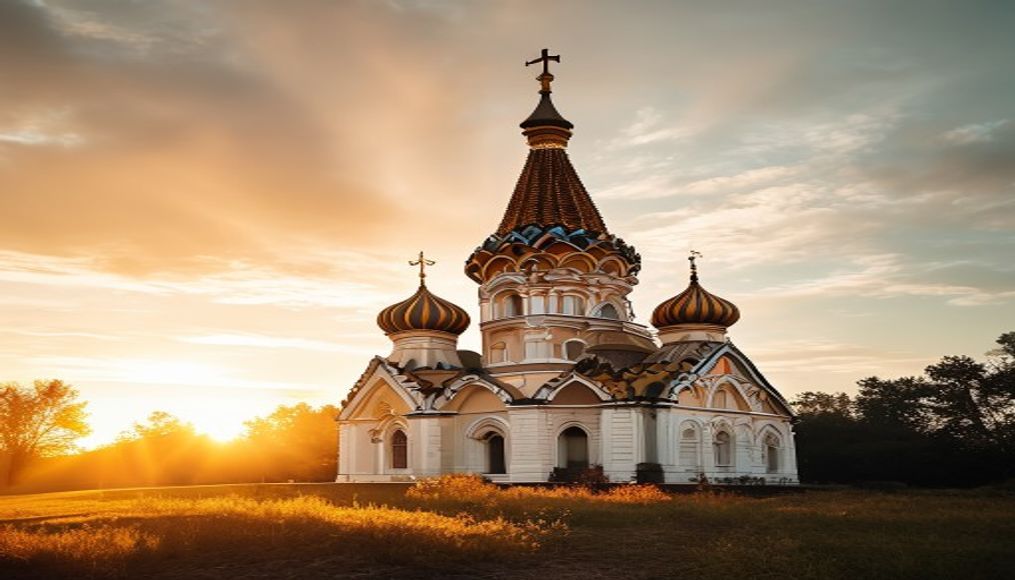
Orthodox church onion
1344×768 · AVIF · CC BY 4.0

The bulb-shaped domes, known as onions, are a striking feature of Orthodox churches, especially in Russia and Eastern Europe, symbolizing heaven and a candle flame.
About this subject
The onion-shaped domes, or bulbous domes, are among the most recognizable architectural elements of Orthodox churches. Their origin dates back to the Byzantine period, but it was in Russia that this shape became established from the 12th century onward. Influenced by Slavic wooden architecture, the domes gained a more elongated and rounded profile, resembling a candle flame pointing toward the sky. This shape carries deep religious symbolism: it represents the flame of faith rising to God, while also evoking the image of heaven and the divine dwelling.
The colors of the domes also hold specific meanings. Gold symbolizes celestial glory and was often used in important churches, such as the Cathedral of Christ the Savior in Moscow. Blue domes with gold stars represent the Virgin Mary and are common in churches dedicated to her. Green domes refer to the Holy Spirit, while silver or white ones are associated with purity and holiness. The combination of these colors in churches like Saint Basil's Cathedral on Red Square creates a unique visual effect that attracts worshippers and tourists from around the world.
An interesting aspect is the variation in the number of domes. Russian Orthodox churches often have five domes, representing Jesus Christ and the four evangelists. Smaller churches may have one or three domes, while larger cathedrals may feature thirteen, symbolizing Christ and the twelve apostles. The isometric flat lay design, popular in modern illustrations, perfectly highlights this symmetrical arrangement and the rich detail of the domes, making them a globally recognized cultural and religious icon.
Beyond Russia, onion-shaped domes are found in countries such as Ukraine, Romania, Bulgaria, and Serbia. Each region has developed local variations, such as the pear-shaped domes in Ukraine or the more elongated ones in Romanian monasteries. These structures not only beautify urban and rural landscapes but also serve as a testament to the faith and cultural identity of Orthodox peoples. To this day, the construction of new churches continues to use this design, demonstrating its enduring relevance.
Frequently Asked Questions
Why do Orthodox churches have onion-shaped domes?
Onion-shaped domes symbolize a candle flame rising to heaven, representing faith ascending to God. Their shape also evokes the idea of heaven as a divine dwelling, an architectural adaptation developed in Russia from the 12th century onward.
What is the meaning of the colors of Orthodox domes?
Each color has a specific symbolism: gold represents celestial glory, blue with gold stars refers to the Virgin Mary, green is associated with the Holy Spirit, and silver or white symbolizes purity and holiness. These colors are chosen according to the church's dedication.
How many domes does a typical Russian Orthodox church have?
The number varies, but the most common is five domes, representing Jesus Christ and the four evangelists. Small churches may have one or three, while major cathedrals can have thirteen, symbolizing Christ and the twelve apostles.
Direct URL
https://pub-c7d6a6ea828543ac903a74a341ccb2e1.r2.dev/imagens/orthodox-church-onion-isometric-flat-lay-p0.avifHow to credit
Include a visible link back to UtilizAí. Copy one of the snippets below:
<a href="https://xn--utiliza-eza.com/en/midia/imagens/orthodox-church-onion-isometric-flat-lay-p0">Orthodox church onion</a> by <a href="https://xn--utiliza-eza.com">UtilizAí</a>, licensed under <a href="https://creativecommons.org/licenses/by/4.0/">CC BY 4.0</a>.
[Orthodox church onion](https://xn--utiliza-eza.com/en/midia/imagens/orthodox-church-onion-isometric-flat-lay-p0) by [UtilizAí](https://xn--utiliza-eza.com), CC BY 4.0
License: CC-BY-4.0