Oboe wooden detail
1344×768 · AVIF · CC BY 4.0
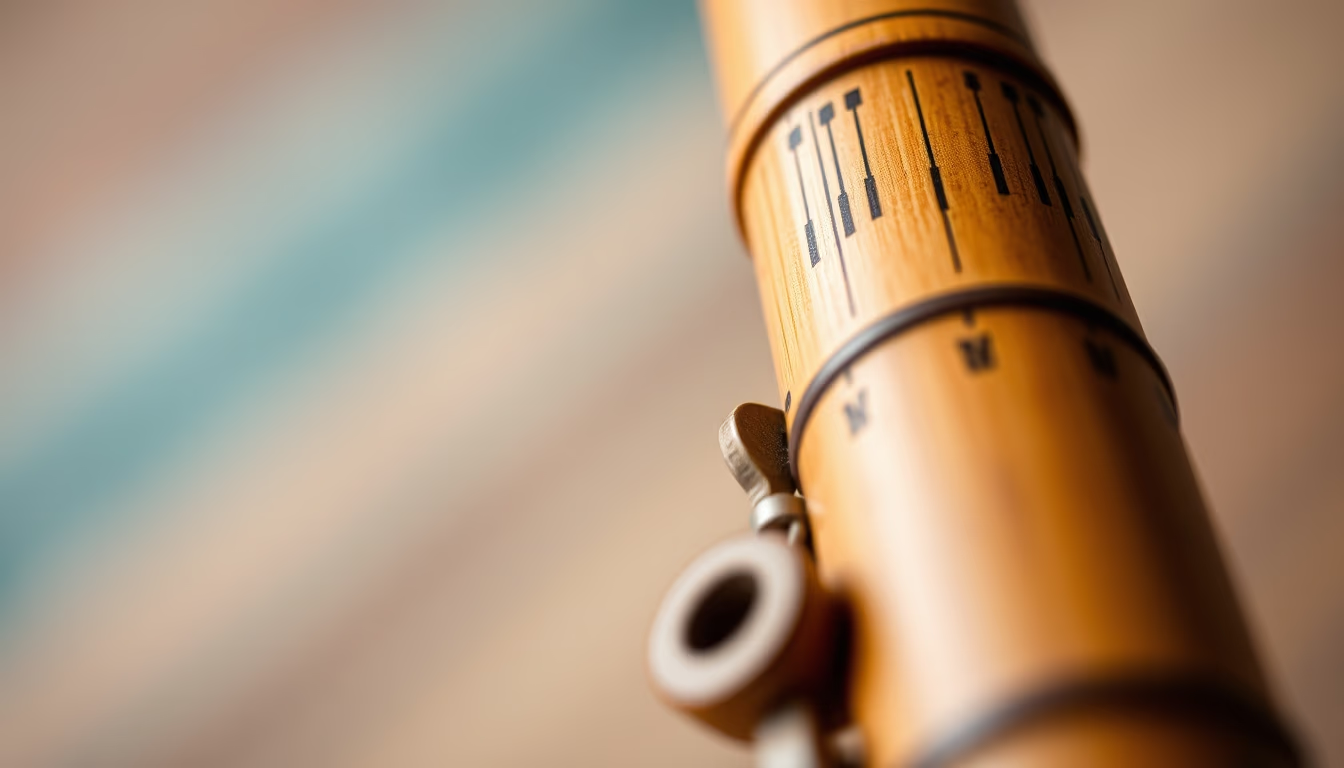
The oboe is a double-reed woodwind instrument known for its penetrating and expressive tone, widely used in orchestras and chamber music.
About this subject
The oboe is a double-reed woodwind instrument known for its penetrating and expressive tone, widely used in orchestras and chamber music. Its body is traditionally made from grenadilla wood (Dalbergia melanoxylon), a dense and dark wood native to Africa, which gives the instrument its characteristic resonance. The modern oboe has a complex key system, evolved from Baroque instruments, allowing great chromatic agility.
The origin of the oboe dates back to 17th-century France, where it was developed from the Renaissance instrument called the shawm. Over time, it underwent several modifications, with the Boehm key system being one of the most significant innovations, although the oboe retains its distinctive semi-automatic fingering. The oboe is often used as the tuning instrument in orchestras, as its A (440 Hz) has been the standard reference since the 19th century.
In the symphony orchestra, the oboe plays a prominent role, either as a soloist in lyrical passages or as part of the woodwind section. Composers such as Mozart, Tchaikovsky, and Richard Strauss wrote important solos for the instrument. Additionally, the oboe is used in chamber music, wind bands, and some folk traditions, such as Bedouin music or Portuguese bagpipe playing.
Maintaining an oboe requires special care: the reed is made from cane (Arundo donax) and must be moistened before playing; the wood must be protected from humidity changes to prevent cracking. The oboe's timbre is often described as 'pastoral' or 'plaintive' due to its ability to express melancholy and softness. Interestingly, the oboe is one of the most difficult instruments to play, requiring precise breath control and embouchure.
Frequently Asked Questions
What is the difference between oboe and clarinet?
Although both are woodwind instruments, the oboe uses a double reed (two cane blades) while the clarinet uses a single reed. Additionally, the oboe has a conical bore and a more penetrating sound, whereas the clarinet has a cylindrical bore and a mellower timbre.
Why is the oboe used to tune the orchestra?
The oboe is traditionally the instrument that gives the tuning A (440 Hz) to the orchestra because its timbre is easily audible and its pitch is stable. This practice was established in the 19th century and continues today.
What material is the oboe reed made of?
The oboe reed is made from cane of the species Arundo donax, primarily cultivated in southern France and California. The cane is cut into strips, shaped, and scraped to the ideal thickness, allowing vibration that produces sound.
Direct URL
https://pub-c7d6a6ea828543ac903a74a341ccb2e1.r2.dev/imagens/oboe-wooden-detail-tilt-shift-miniature-p6.avifHow to credit
Include a visible link back to UtilizAí. Copy one of the snippets below:
<a href="https://xn--utiliza-eza.com/en/midia/imagens/oboe-wooden-detail-tilt-shift-miniature-p6">Oboe wooden detail</a> by <a href="https://xn--utiliza-eza.com">UtilizAí</a>, licensed under <a href="https://creativecommons.org/licenses/by/4.0/">CC BY 4.0</a>.
[Oboe wooden detail](https://xn--utiliza-eza.com/en/midia/imagens/oboe-wooden-detail-tilt-shift-miniature-p6) by [UtilizAí](https://xn--utiliza-eza.com), CC BY 4.0
License: CC-BY-4.0