Niagara falls horseshoe
1344×768 · AVIF · CC BY 4.0
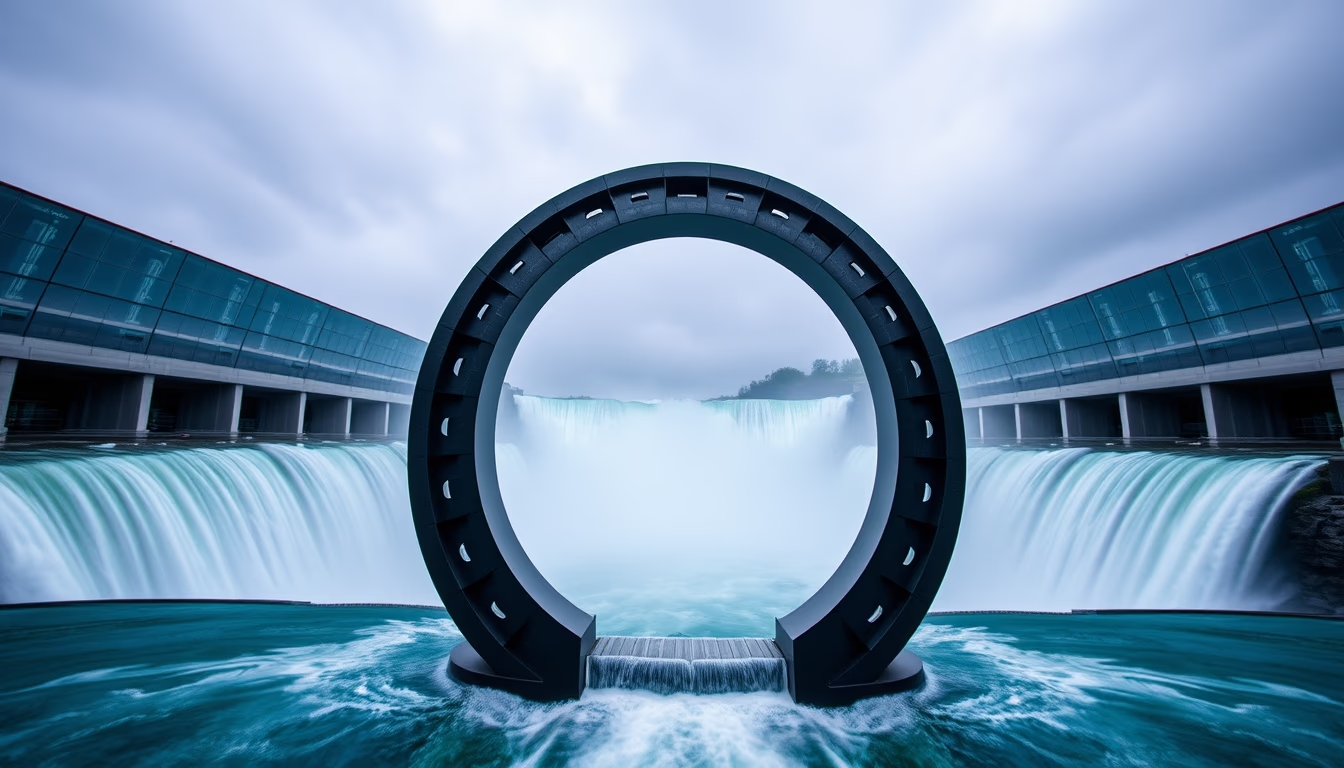
The Horseshoe Falls, on the border between Canada and the United States, are the largest and most powerful of the three waterfalls that form the Niagara Falls complex.
About this subject
Niagara Falls Horseshoe Falls, also known as the Canadian Falls, is the largest and most powerful of the three waterfalls that make up the Niagara Falls complex. Straddling the border between Ontario (Canada) and New York (USA), it measures approximately 2,600 feet (792 meters) wide and 187 feet (57 meters) high, with an average flow rate of 100,000 cubic feet (2,832 cubic meters) per second. The name “Horseshoe” comes from the distinct horseshoe shape carved by the water into the bedrock over millennia.
Formed about 12,000 years ago at the end of the last ice age, these falls are a result of glacial retreat that created the Great Lakes. The continuous water flow from Lake Erie to Lake Ontario passes over a resistant layer of dolomite underlain by softer shale and sandstone, an erosive process that causes the waterfall to retreat at roughly 1 foot (30 centimeters) per year. Horseshoe Falls accounts for about 90% of the total water volume flowing through the Niagara system, making it the primary tourist attraction in the region.
Culturally, the falls are a globally significant natural landmark: the site was crucial for the development of hydroelectric power with the construction of power plants in the late 19th century, and it has been the scene of numerous stunts and historical events, such as the first barrel ride over the falls in 1901 by teacher Annie Edson Taylor. The complex is protected by state and provincial parks, offering viewpoints and tours like “Journey Behind the Falls” that take visitors through tunnels behind the cascade. The multicolored nighttime illumination, first introduced in 1925, attracts millions of tourists annually, solidifying Niagara Falls as one of the most photographed natural destinations in the world.
Frequently Asked Questions
What is the difference between Niagara Falls Horseshoe and the American Falls?
Horseshoe Falls (Canadian Falls) is the largest, carrying about 90% of the total water flow. The American Falls, on the US side, are smaller and separated by an island. Horseshoe has a distinct curved shape, while American Falls is more linear.
Can you visit behind the curtain of Niagara Falls?
Yes, the "Journey Behind the Falls" attraction on the Canadian side takes visitors through tunnels that open behind the Horseshoe Falls, offering a close-up view and sound of the falling water. It is an immersive and safe experience.
Are the Horseshoe Falls shrinking?
Yes, due to natural erosion, the Horseshoe Falls retreats about 1 foot (30 cm) per year. However, engineering projects and water diversion for power generation have reduced the erosion rate over time.
Direct URL
https://pub-c7d6a6ea828543ac903a74a341ccb2e1.r2.dev/imagens/niagara-falls-horseshoe-architectural-photography-p6.avifHow to credit
Include a visible link back to UtilizAí. Copy one of the snippets below:
<a href="https://xn--utiliza-eza.com/en/midia/imagens/niagara-falls-horseshoe-architectural-photography-p6">Niagara falls horseshoe</a> by <a href="https://xn--utiliza-eza.com">UtilizAí</a>, licensed under <a href="https://creativecommons.org/licenses/by/4.0/">CC BY 4.0</a>.
[Niagara falls horseshoe](https://xn--utiliza-eza.com/en/midia/imagens/niagara-falls-horseshoe-architectural-photography-p6) by [UtilizAí](https://xn--utiliza-eza.com), CC BY 4.0
License: CC-BY-4.0