Music sheet handwritten antique
1344×768 · AVIF · CC BY 4.0
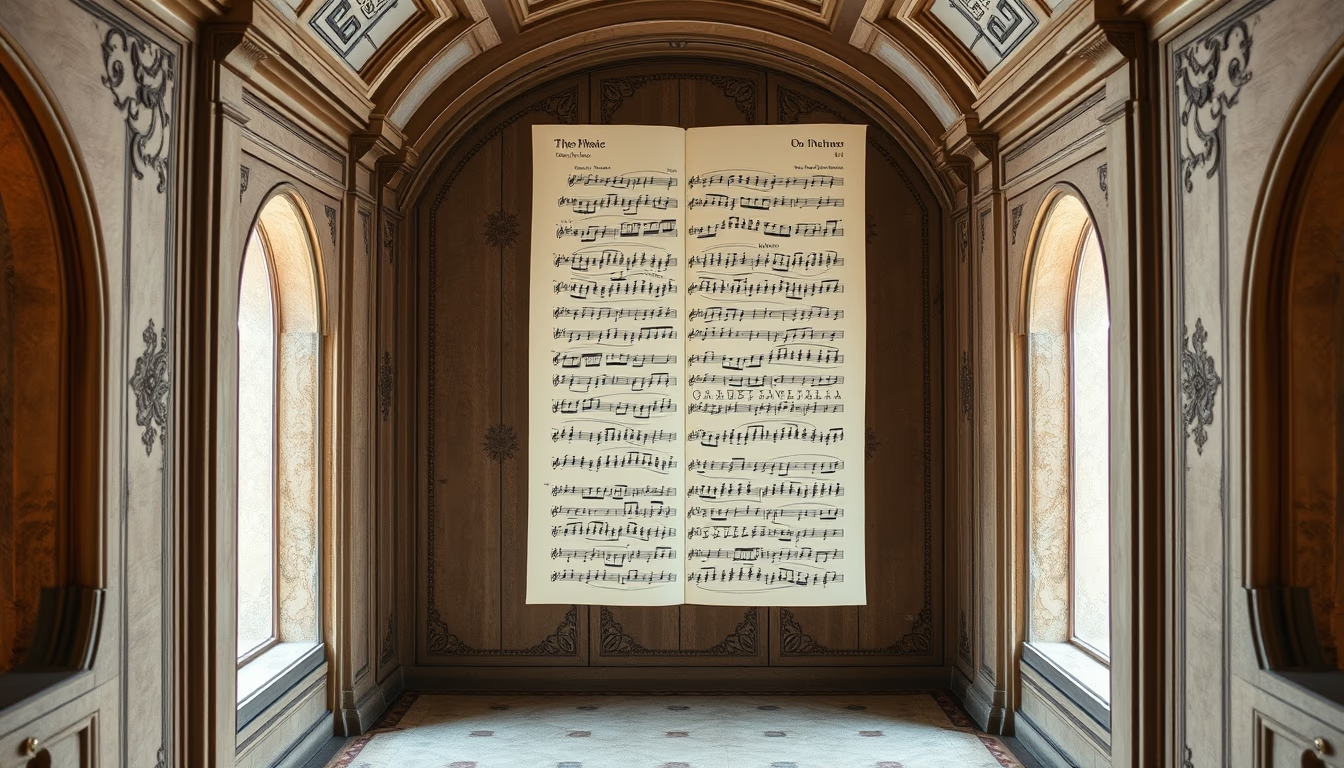
Antique handwritten music sheet reveals historical notation practices and the art of musical calligraphy.
About this subject
Antique handwritten music sheets are direct witnesses to musical practices of past eras, before mass music printing. From medieval parchment manuscripts with neumes on tetragrams to Renaissance and Baroque scores on ruled paper, each stroke reflects not only the music but also the calligraphy and available materials. Composers like Johann Sebastian Bach and Wolfgang Amadeus Mozart left autographs that are today treasured by musicologists, studied to understand original intentions and performance practices.
The creation process involved bird feather quills, carbon or iron-gall inks, and staves drawn by hand or with rulers. Notation evolved: in the 15th century, the large choirbook format (meant to be read by several singers) contrasts with personal partbooks from the 18th century. Many manuscripts contain annotations by later owners, dedications or corrections, revealing a living history of use.
In Brazil, the collections of the National Library in Rio de Janeiro and the Museum of Music in Mariana hold rare examples, including pieces from the colonial period blending European and African influences. Preservation involves techniques to avoid deterioration of acidic paper and ink. Digitalization projects now allow global access, such as the International Music Score Library Project (IMSLP), which provides facsimiles.
The cultural and financial value of an antique handwritten music sheet is immense: a Beethoven autograph can fetch millions at auction. More than antique objects, they are primary sources for reconstructing historical sounds. The practice of writing music by hand, though rare today, persists in contemporary notation circles, keeping alive the tactile connection between composer and work.
Frequently Asked Questions
How were handwritten music sheets preserved before the digital age?
Before digitization, handwritten scores were kept in archives, libraries, and private collections under controlled temperature and humidity. Many were bound or placed in acid-free folders. Access was restricted to scholars, requiring gloves and low light to prevent damage.
What is the difference between ancient and modern musical notation?
Ancient notation varies by period: medieval neumes indicated melodic contour without precise rhythm; modern notation (from the 17th century onward) uses a five-line staff, clefs, bar lines, and standardized dynamic markings. Ancient manuscripts often omit tempo or articulation, leaving room for historical interpretation.
Why are old handwritten music sheets valuable?
They are primary sources revealing details about the composer's intent, performance practices, and notation evolution. Market value is high due to rarity, condition, and historical importance. Autographs of masters like Bach or Mozart can be worth millions.
Direct URL
https://pub-c7d6a6ea828543ac903a74a341ccb2e1.r2.dev/imagens/music-sheet-handwritten-antique-architectural-photography-p3.avifHow to credit
Include a visible link back to UtilizAí. Copy one of the snippets below:
<a href="https://xn--utiliza-eza.com/en/midia/imagens/music-sheet-handwritten-antique-architectural-photography-p3">Music sheet handwritten antique</a> by <a href="https://xn--utiliza-eza.com">UtilizAí</a>, licensed under <a href="https://creativecommons.org/licenses/by/4.0/">CC BY 4.0</a>.
[Music sheet handwritten antique](https://xn--utiliza-eza.com/en/midia/imagens/music-sheet-handwritten-antique-architectural-photography-p3) by [UtilizAí](https://xn--utiliza-eza.com), CC BY 4.0
License: CC-BY-4.0