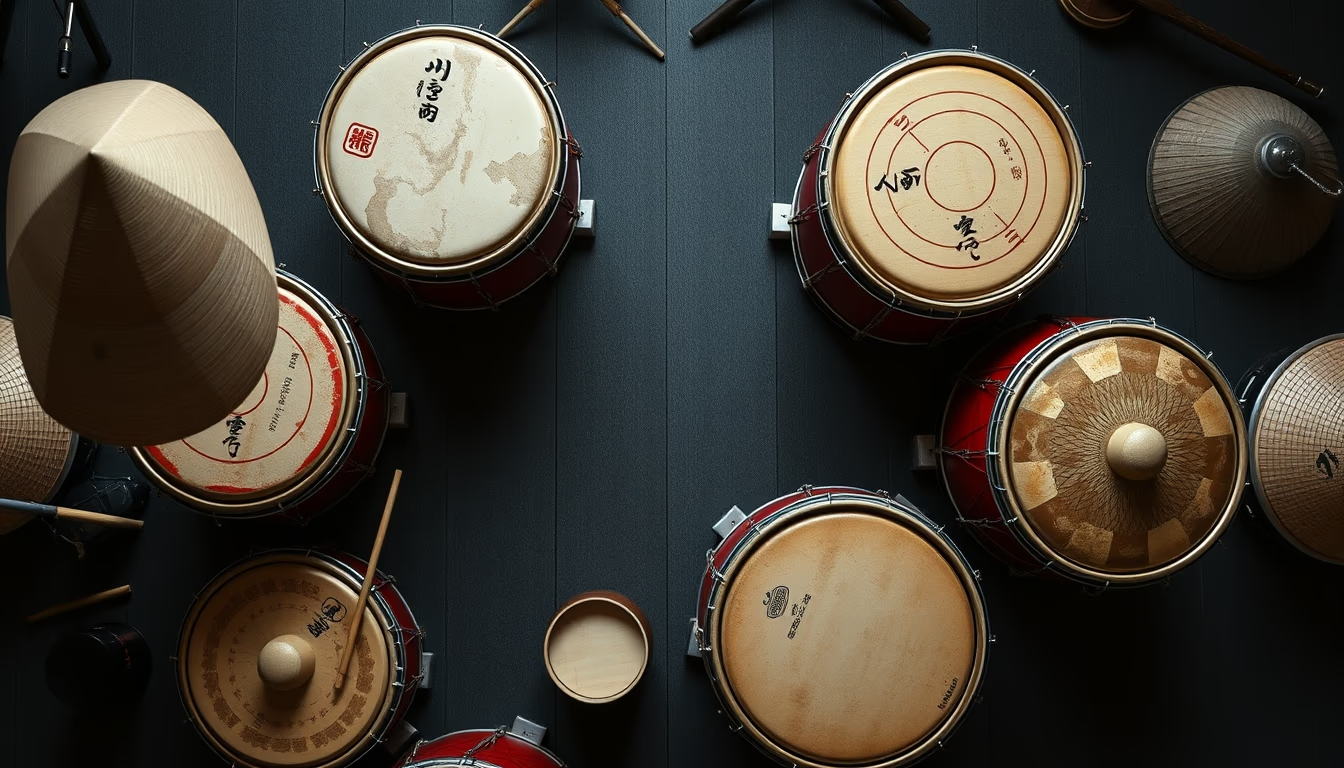
Music notes flowing visualization
1344×768 · AVIF · CC BY 4.0

Flowing visualization of musical notes. Understand music notation, the staff, and how notes represent pitch and duration in music.
About this subject
Music notation is the graphic system used to write down and communicate musical ideas. Each note represents a combination of pitch (frequency) and duration (time). On the staff, notes are placed on lines and spaces that indicate their position in the musical scale. The note shape (whole note, half note, quarter note, eighth note, etc.) defines its rhythmic value.
The idea of flow in music note visualization relates to how musicians read scores: not as isolated symbols but as a continuous stream of melodic and rhythmic information. This perception is crucial for real‑time performance, where anticipatory reading enables natural expression.
Historically, Western notation evolved from medieval neumes, through Guido d'Arezzo's four‑line staff (11th century) to the modern five‑line staff. The word "note" comes from Latin "nota", meaning mark or sign. Each graphic element carries precise instructions for the performer.
In contemporary visualizations, musical notes are often depicted in motion to illustrate tempo and dynamics. Such representations help music students grasp temporal hierarchy and the connection between sounds, making learning more intuitive.
Frequently Asked Questions
What is a musical note?
A musical note is a symbol representing a sound with defined pitch and duration. In Western music, notes are named C, D, E, F, G, A, B.
How did the staff originate?
The modern staff evolved from Guido d'Arezzo's four‑line staff in the 11th century. It was later expanded to five lines, becoming the standard for music notation.
What does the visualization of flowing notes mean?
It represents the perception of music as a temporal continuum. In scores, fluent note reading allows musicians to anticipate phrases and dynamics, essential for expressive performance.
Direct URL
https://pub-c7d6a6ea828543ac903a74a341ccb2e1.r2.dev/imagens/music-notes-flowing-visualization-studio-editorial-portrait-p2.avifHow to credit
Include a visible link back to UtilizAí. Copy one of the snippets below:
<a href="https://xn--utiliza-eza.com/en/midia/imagens/music-notes-flowing-visualization-studio-editorial-portrait-p2">Music notes flowing visualization</a> by <a href="https://xn--utiliza-eza.com">UtilizAí</a>, licensed under <a href="https://creativecommons.org/licenses/by/4.0/">CC BY 4.0</a>.
[Music notes flowing visualization](https://xn--utiliza-eza.com/en/midia/imagens/music-notes-flowing-visualization-studio-editorial-portrait-p2) by [UtilizAí](https://xn--utiliza-eza.com), CC BY 4.0
License: CC-BY-4.0