Milky way stars
1344×768 · AVIF · CC BY 4.0
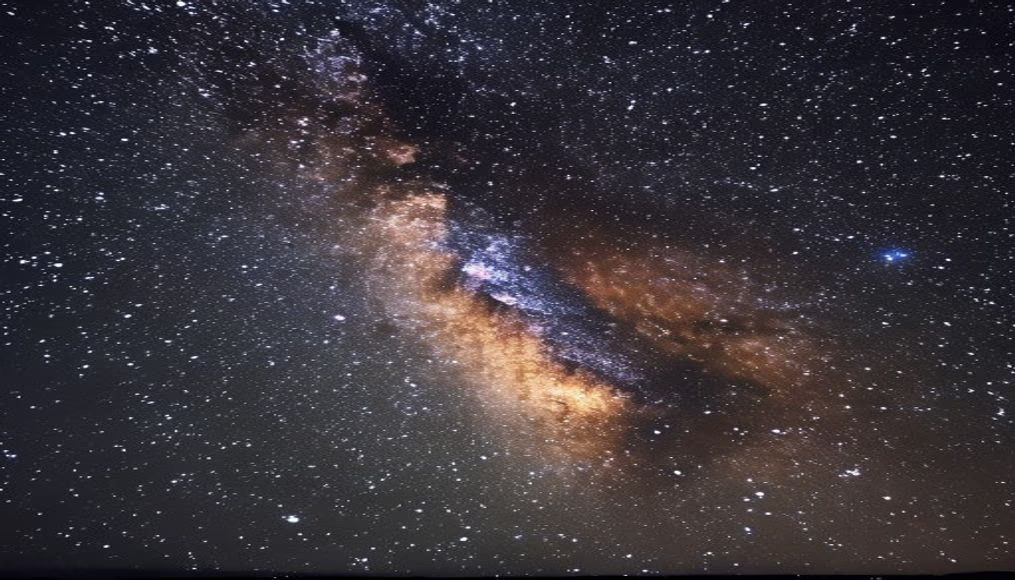
The Milky Way, our spiral galaxy, appears as a milky band of billions of stars in the night sky, visible in places with low light pollution.
About this subject
The Milky Way is a barred spiral galaxy that hosts the Solar System. It contains an estimated 100 to 400 billion stars, along with planets, gas, dust, and dark matter. Its diameter is about 100,000 light-years. The name 'Milky Way' derives from the Latin 'via lactea', referring to its milky appearance in the sky, a concept inherited from Greek mythology, which considered it spilled milk from Hera.
In the southern hemisphere, the galactic core is more prominent, making it a prime target for travel astrophotography. Destinations like the Atacama Desert in Chile or Aoraki Mackenzie National Park in New Zealand are famous for their dark skies, allowing naked-eye observation of the galaxy. The best viewing period varies by hemisphere but generally falls between March and October, away from a full moon.
Culturally, the Milky Way holds great significance. For the Tupi-Guarani people, it was called 'Tape' (path) and associated with a celestial serpent. In modern astronomy, studying the Milky Way has helped understand the spiral structure of galaxies and the position of our Solar System in the Orion Arm, about 27,000 light-years from the galactic center, which harbors a supermassive black hole known as Sagittarius A*.
Frequently Asked Questions
What is the Milky Way?
The Milky Way is the barred spiral galaxy that contains the Solar System. It is composed of billions of stars, planets, gas, and dust, and appears as a milky band in the night sky.
How many stars are in the Milky Way?
The Milky Way is estimated to have between 100 and 400 billion stars, though the exact number is difficult to determine due to interstellar dust obscuring the view.
Where is the best place to see the Milky Way?
The best places are remote areas with low light pollution, such as deserts (Atacama), mountains (Hawaii, Andes), and dark-sky parks (New Zealand, Namibia). The southern hemisphere offers a brighter view of the galactic core.
Direct URL
https://pub-c7d6a6ea828543ac903a74a341ccb2e1.r2.dev/imagens/milky-way-stars-travel-photography-v10.avifHow to credit
Include a visible link back to UtilizAí. Copy one of the snippets below:
<a href="https://xn--utiliza-eza.com/en/midia/imagens/milky-way-stars-travel-photography-v10">Milky way stars</a> by <a href="https://xn--utiliza-eza.com">UtilizAí</a>, licensed under <a href="https://creativecommons.org/licenses/by/4.0/">CC BY 4.0</a>.
[Milky way stars](https://xn--utiliza-eza.com/en/midia/imagens/milky-way-stars-travel-photography-v10) by [UtilizAí](https://xn--utiliza-eza.com), CC BY 4.0
License: CC-BY-4.0