Medical evacuation helicopter
1344×768 · AVIF · CC BY 4.0
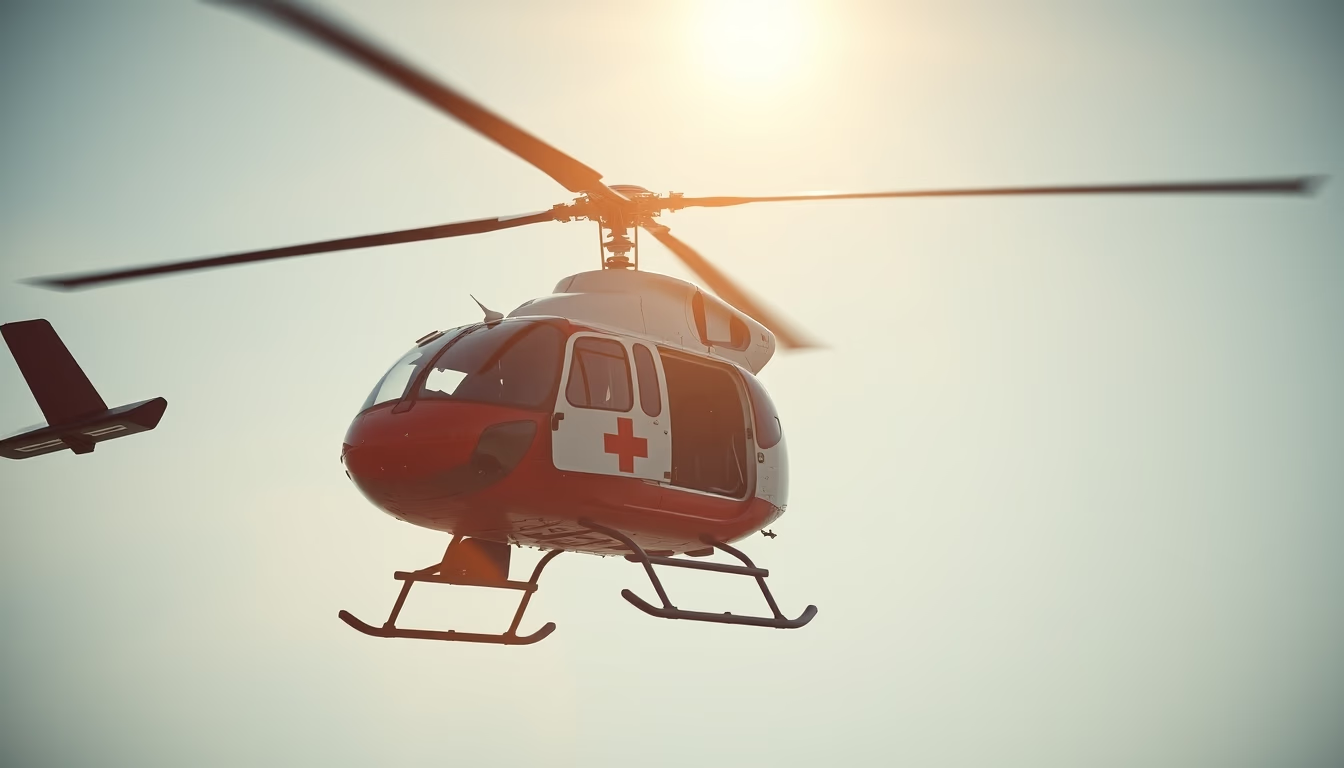
Medical evacuation helicopters are specialized aircraft for rapid transport of injured or critically ill patients, vital in global emergencies.
About this subject
Medical evacuation helicopters, or medevac, are aircraft adapted to function as flying intensive care units. Equipped with advanced life support systems such as ventilators, defibrillators, and cardiac monitors, they allow medical teams to initiate treatment during flight. These helicopters are widely used in rescue operations in difficult-to-access areas like mountains, remote regions, and disaster zones. Common models include the Eurocopter EC135, Bell 429, and Sikorsky S-76, each configured to meet different capacity and range demands.
The use of helicopters for medical evacuation dates back to the Korean War (1950-1953), when the US Army employed the Bell H-13 to transport wounded soldiers. Since then, technology has evolved significantly. In the 1960s, helicopters like the UH-1 Huey were adapted for the role, and the Vietnam War solidified the aeromedical concept as a military standard. Today, civilian services such as SAMU (in Brazil) and HEMS (in Europe) operate dedicated fleets, with public-private partnerships covering metropolitan and rural areas. In Brazil, the EC135 helicopter is one of the most used, operated by fire departments and state services.
Technical characteristics of these aircraft include an expanded cabin to accommodate a stretcher and crew, GPS and infrared navigation systems for night flights, and the ability to land in confined spaces. Average speed ranges from 240 to 280 km/h, with a range of up to 600 km. Response time is crucial: studies indicate that helicopter use reduces transport time by up to 50% compared to ground ambulances in congested areas. However, weather factors such as wind and visibility limit operations, requiring highly trained pilots.
Fun facts: the fastest medical evacuation helicopter is the AgustaWestland AW139, reaching 310 km/h. In countries like Australia and Canada, these helicopters are essential for covering vast distances over uninhabited areas. Certifying an aircraft for medevac requires specific structural and electrical modifications, as well as recurrent training for the crew. The cost per flight hour can range from USD 1,500 to USD 3,000, depending on the model.
Frequently Asked Questions
What is the difference between a medical evacuation helicopter and an air ambulance?
Medical evacuation helicopters are typically used for short-range emergencies and can land at unprepared sites. Air ambulances are fixed-wing aircraft or helicopters configured for long-range inter-hospital transport with full medical support.
Which helicopters are most used for medical evacuation in Brazil?
In Brazil, the most common models are the Eurocopter EC135, Bell 429, and Airbus H145. They are operated by SAMU, fire departments, and private rescue services.
How does safety work in medical evacuation flights?
Safety involves specially trained pilots for night and adverse conditions, rigorous maintenance, redundant navigation equipment, and communication protocols with air traffic control. Helicopters undergo regular inspections.
Direct URL
https://pub-c7d6a6ea828543ac903a74a341ccb2e1.r2.dev/imagens/medical-evacuation-helicopter-minimalist-composition-fresh18.avifHow to credit
Include a visible link back to UtilizAí. Copy one of the snippets below:
<a href="https://xn--utiliza-eza.com/en/midia/imagens/medical-evacuation-helicopter-minimalist-composition-fresh18">Medical evacuation helicopter</a> by <a href="https://xn--utiliza-eza.com">UtilizAí</a>, licensed under <a href="https://creativecommons.org/licenses/by/4.0/">CC BY 4.0</a>.
[Medical evacuation helicopter](https://xn--utiliza-eza.com/en/midia/imagens/medical-evacuation-helicopter-minimalist-composition-fresh18) by [UtilizAí](https://xn--utiliza-eza.com), CC BY 4.0
License: CC-BY-4.0