Machu picchu ruins morning mist
1344×768 · AVIF · CC BY 4.0
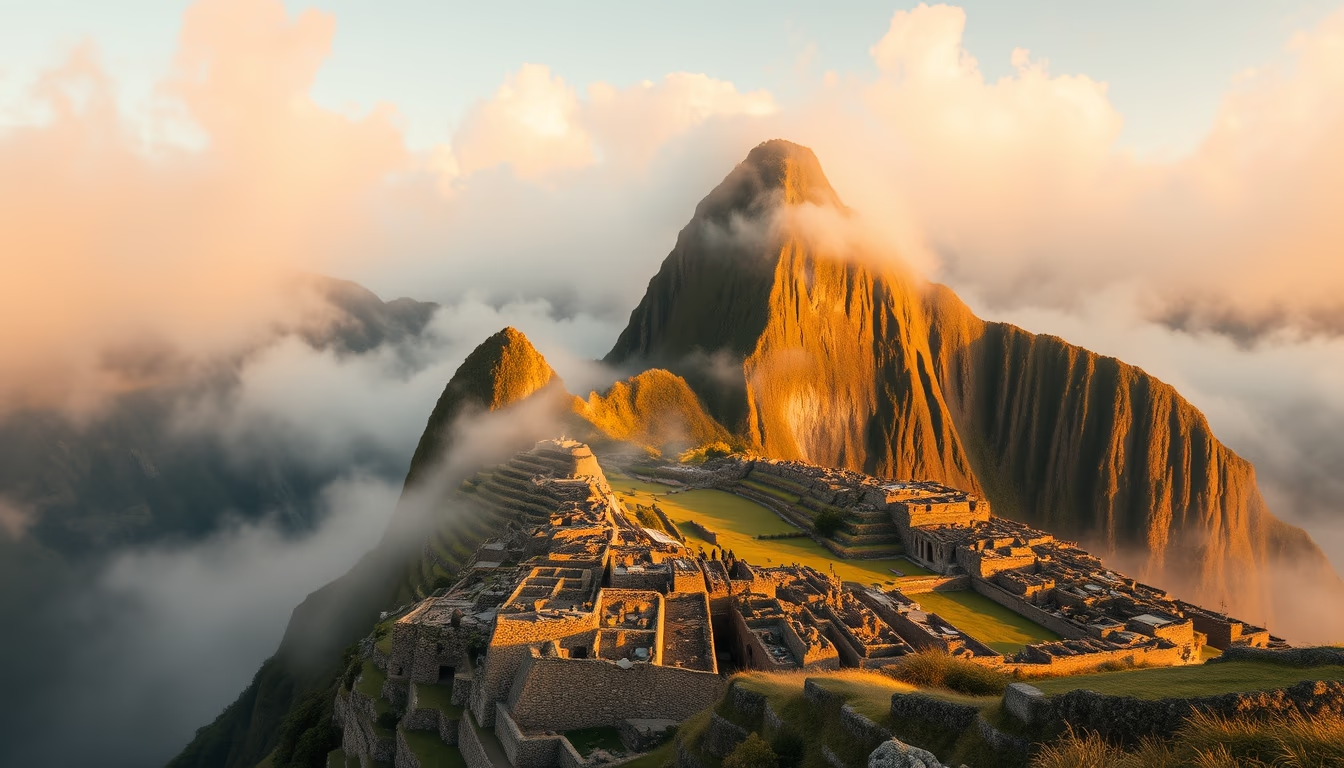
Machu Picchu ruins shrouded in morning mist, a UNESCO World Heritage site and ultimate symbol of the Inca civilization.
About this subject
Machu Picchu, the lost city of the Incas, sits at 2,430 meters above sea level atop a mountain in the Peruvian Andes, above the Sacred Valley near Cusco. Built around 1450 at the height of the Inca Empire, it was abandoned less than a century later, likely due to the Spanish conquest. It remained unknown to the outside world until explorer Hiram Bingham brought it to global attention in 1911. The name means "old mountain" in Quechua, the Inca language.
The morning mist that often envelops the site results from humidity rising from the Amazon rainforest and condensing upon meeting the cold high-altitude air. This phenomenon creates a mystical atmosphere that enhances the sense of isolation and preservation. Machu Picchu's architecture is remarkable for its stone construction technique, with perfectly fitted blocks without mortar, which has withstood earthquakes for centuries. The site is divided into agricultural (farming terraces), urban (plazas, temples, and residences), and religious sectors (Intihuatana, Temple of the Sun).
Machu Picchu was declared a UNESCO World Heritage site in 1983 and was chosen as one of the New Seven Wonders of the World in 2007. It receives about 1.5 million visitors annually, leading to access restrictions for preservation. The Inca Trail, a four-day hike arriving at the site through the Sun Gate, is one of the world's most famous trekking routes. Despite its fame, only about 30% of the original city has been reconstructed; the rest remains covered by vegetation, awaiting excavation.
The image of Machu Picchu at dawn, with mist slowly lifting, has become a global icon of adventure and mystery. The site stands as a testament to Inca engineering and worldview, which integrated mountains, rivers, and celestial bodies into urban planning. For Inca descendants, Machu Picchu remains a sacred place, connected to the worship of apus (mountain spirits) and Pachamama (Mother Earth).
Frequently Asked Questions
What is the exact altitude of Machu Picchu?
Machu Picchu sits at 2,430 meters above sea level, on a mountain ridge in the Peruvian Andes, above the Sacred Valley and below the neighboring peak Huayna Picchu.
Why was Machu Picchu built?
It is believed to have been a royal estate and religious sanctuary for Inca emperor Pachacuti. Its remote location and refined architecture suggest ceremonial and administrative functions, as well as astronomical observation.
Is it true that Machu Picchu is at risk of collapse?
Yes, the site faces natural erosion and tourism impact. Conservation measures include a daily visitor limit (2,500 people) and restricted access to fragile areas. In 2020, a nearby landslide did not affect the ruins but highlighted geological risks.
Direct URL
https://pub-c7d6a6ea828543ac903a74a341ccb2e1.r2.dev/imagens/machu-picchu-ruins-morning-mist-cinematic-wide-shot-v2.avifHow to credit
Include a visible link back to UtilizAí. Copy one of the snippets below:
<a href="https://xn--utiliza-eza.com/en/midia/imagens/machu-picchu-ruins-morning-mist-cinematic-wide-shot-v2">Machu picchu ruins morning mist</a> by <a href="https://xn--utiliza-eza.com">UtilizAí</a>, licensed under <a href="https://creativecommons.org/licenses/by/4.0/">CC BY 4.0</a>.
[Machu picchu ruins morning mist](https://xn--utiliza-eza.com/en/midia/imagens/machu-picchu-ruins-morning-mist-cinematic-wide-shot-v2) by [UtilizAí](https://xn--utiliza-eza.com), CC BY 4.0
License: CC-BY-4.0