Lidar sensor on car roof
1344×768 · AVIF · CC BY 4.0

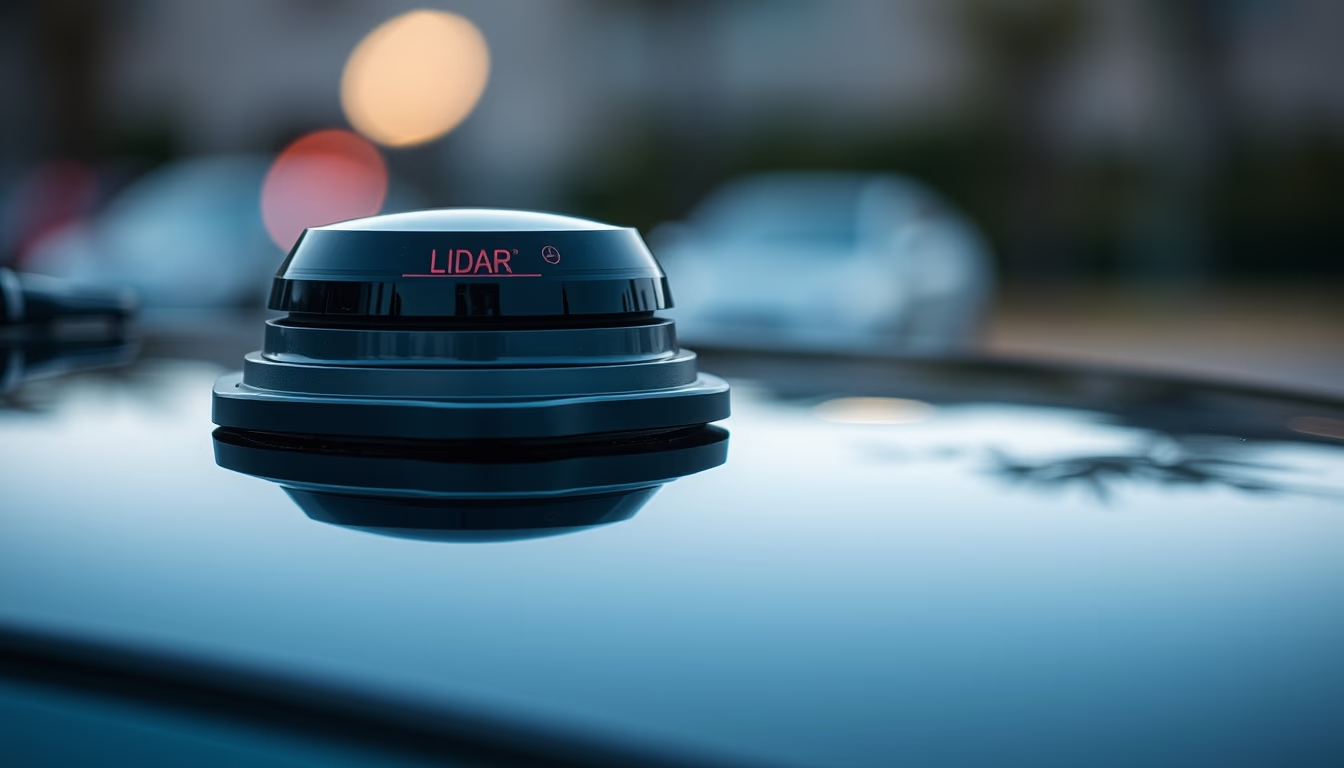
The lidar sensor mounted on the roof of autonomous vehicles is an essential component for three-dimensional perception of the environment around the car.
About this subject
Lidar, an acronym for Light Detection and Ranging, is a remote sensing technology that uses laser pulses to measure distances and create detailed three-dimensional maps of the environment. In autonomous vehicles, the sensor is often mounted on the roof to obtain an unobstructed 360-degree view, enabling real-time detection of objects, pedestrians, other vehicles, and obstacles. This technology is considered one of the pillars of autonomous driving systems, complementing cameras and radars.
Roof mounting offers advantages such as greater range and field of view, but also poses aerodynamic and aesthetic challenges. Companies like Waymo, Uber, and various automakers have employed different Lidar configurations, from traditional spinning sensors to more compact solid-state models. The Velodyne HDL-64E, for example, was one of the first widely adopted units, capable of emitting 64 laser beams simultaneously.
Lidar's precision is crucial for safe navigation in adverse conditions, such as low light or fog, where cameras fail. Although the cost of these sensors has decreased significantly in recent years, they remain one of the most expensive components of an autonomous vehicle. Recent advances aim to integrate Lidar directly into the bodywork, reducing visual impact and improving efficiency.
In the context of Brazilian traffic, the adoption of autonomous driving technologies faces specific challenges, such as the complexity of urban traffic and irregular road infrastructure. However, research projects and tests in cities like São Paulo and Campinas are already evaluating the feasibility of using Lidar in local conditions, paving the way for eventual commercial implementation.
Frequently Asked Questions
What is the main function of a lidar sensor in an autonomous vehicle?
Lidar creates a three-dimensional map of the vehicle's surroundings, detecting objects and their distances with high precision, which is essential for navigation and collision avoidance.
Why is lidar mounted on the roof of cars?
Roof mounting provides an unobstructed 360-degree panoramic view, maximizing the sensor's range and detection capability.
What are the limitations of lidar in autonomous vehicles?
Key limitations include high cost, sensitivity to adverse weather like rain and fog, and aerodynamic/aesthetic impacts when externally mounted.
Direct URL
https://pub-c7d6a6ea828543ac903a74a341ccb2e1.r2.dev/imagens/lidar-sensor-on-car-roof-aerial-drone-shot-p5.avifHow to credit
Include a visible link back to UtilizAí. Copy one of the snippets below:
<a href="https://xn--utiliza-eza.com/en/midia/imagens/lidar-sensor-on-car-roof-aerial-drone-shot-p5">Lidar sensor on car roof</a> by <a href="https://xn--utiliza-eza.com">UtilizAí</a>, licensed under <a href="https://creativecommons.org/licenses/by/4.0/">CC BY 4.0</a>.
[Lidar sensor on car roof](https://xn--utiliza-eza.com/en/midia/imagens/lidar-sensor-on-car-roof-aerial-drone-shot-p5) by [UtilizAí](https://xn--utiliza-eza.com), CC BY 4.0
License: CC-BY-4.0