Humanoid robot in clean white lab
1344×768 · AVIF · CC BY 4.0
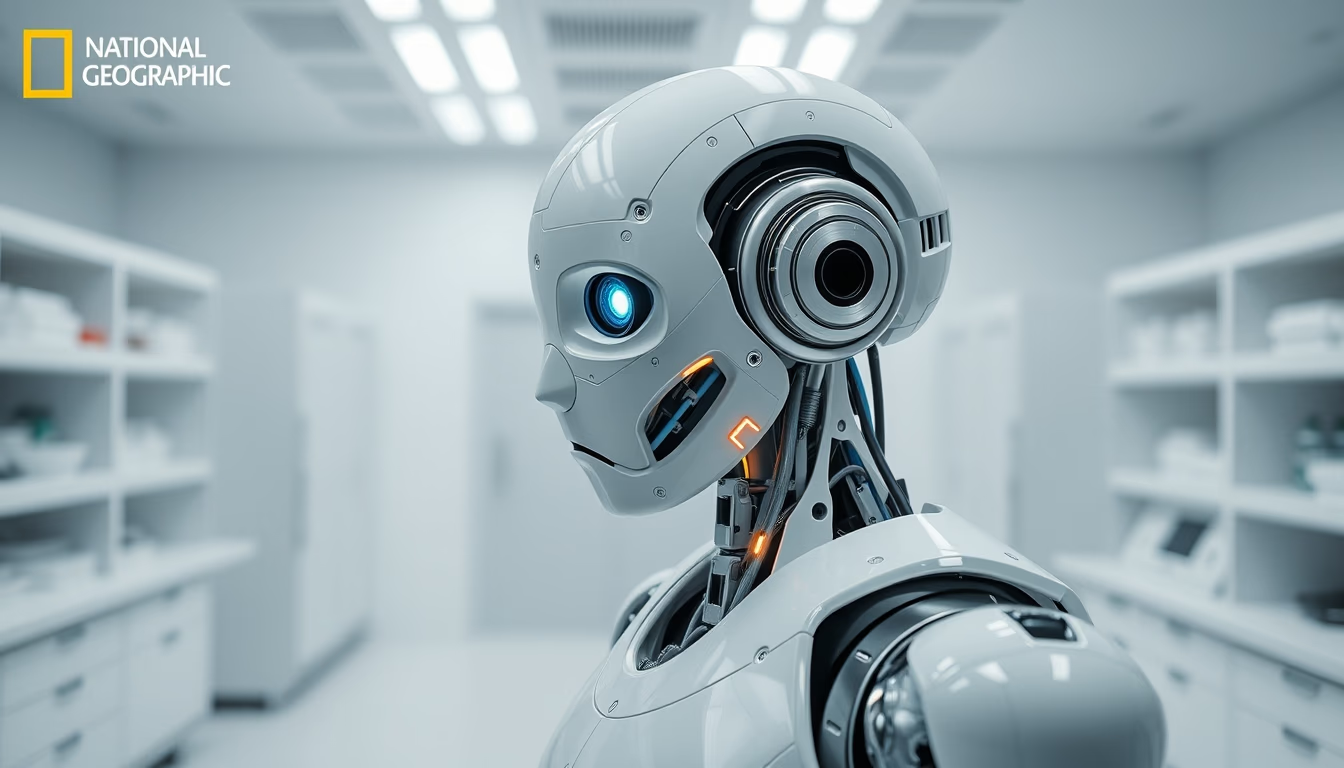
Humanoid robots in clean white labs symbolize the advancement of robotics, combining artificial intelligence with biomimetic design.
About this subject
Humanoid robots, such as Boston Dynamics' Atlas or Honda's ASIMO, are designed to mimic human form and movement, enabling interaction in human-built environments. They use actuators, sensors, and control algorithms to navigate, manipulate objects, and perform complex tasks like opening doors or climbing stairs. Artificial skin and lightweight materials like carbon fiber reduce weight and improve energy efficiency. These robots are often tested in clean white labs, which provide controlled lighting and reflective surfaces for calibrating optical sensors.
Research in humanoid robotics began in the 1970s in Japan with Waseda University's WABOT-1, which could walk and speak. Since then, advances in processors and lithium batteries have enabled greater autonomy. Atlas, for instance, performs parkour and backflips, demonstrating dynamic balance. Simulation in controlled environments is crucial to prevent damage and collect precise data on locomotion and manipulation.
Culturally, humanoid robots evoke fascination and fear, reflected in films like "The Terminator" and "I, Robot." However, practical applications include hospital assistance, disaster rescue, and space exploration. NASA develops the Valkyrie robot for Mars missions. In Brazil, the RoboFEI project at FEI creates humanoids for competitions, fostering engineering and AI.
A key technical aspect is bipedal locomotion, requiring real-time torque control. Inertial sensors and depth cameras (like Kinect) aid environmental perception. Calibration in white labs reduces visual noise, improving computer vision algorithm accuracy. The trend is for humanoid robots to become more common in industries and homes, with decreasing prices and enhanced reinforcement learning capabilities.
Frequently Asked Questions
What are humanoid robots used for?
They are designed to interact in human environments, performing tasks such as hospital assistance, disaster rescue, space exploration, and AI research.
Which humanoid robot is the most advanced today?
Boston Dynamics' Atlas is considered one of the most advanced, capable of parkour, backflips, and handling heavy objects, thanks to dynamic control algorithms.
Why are labs white for testing robots?
White labs provide uniform lighting and neutral backgrounds, facilitating calibration of optical sensors and computer vision, while reducing visual interference during tests.
Direct URL
https://pub-c7d6a6ea828543ac903a74a341ccb2e1.r2.dev/imagens/humanoid-robot-in-clean-white-lab-national-geographic-style.avifHow to credit
Include a visible link back to UtilizAí. Copy one of the snippets below:
<a href="https://xn--utiliza-eza.com/en/midia/imagens/humanoid-robot-in-clean-white-lab-national-geographic-style">Humanoid robot in clean white lab</a> by <a href="https://xn--utiliza-eza.com">UtilizAí</a>, licensed under <a href="https://creativecommons.org/licenses/by/4.0/">CC BY 4.0</a>.
[Humanoid robot in clean white lab](https://xn--utiliza-eza.com/en/midia/imagens/humanoid-robot-in-clean-white-lab-national-geographic-style) by [UtilizAí](https://xn--utiliza-eza.com), CC BY 4.0
License: CC-BY-4.0